Charn
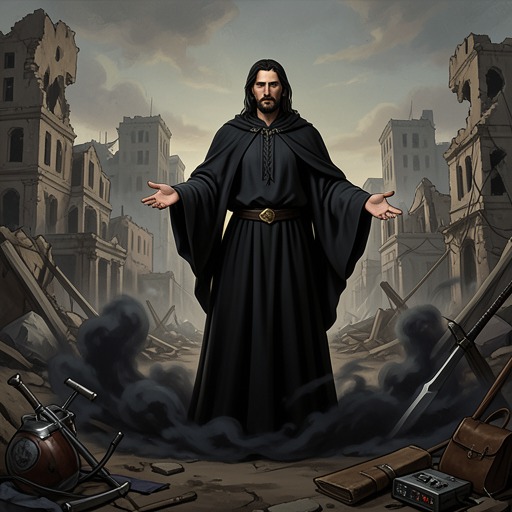
The Magician's NephewCharn is a ruined world whose once-great city lies beneath a weary red sun, with no living thing in sight. Its dry riverbed and silent monuments form the book’s bleak counter-image to Narnia’s emergence: Charn’s destruction is not merely a fallen city’s history but a warning about what can happen when power is used without regard for life.
The city beneath the dying sun
From a high terrace, Digory and Polly look out over a vast city stretching in every direction. A red sun, far larger than the sun in their own world, hangs low near the horizon; Digory senses that it is old, as though near the end of its life. A single bright star accompanies it in the dark sky. Together, the two lights make a desolate scene.
The city’s temples, towers, palaces, pyramids, and bridges still dominate the landscape, but their long shadows fall over a place without inhabitants. The river that once ran through Charn has vanished, leaving only a broad ditch of grey dust. The surviving architecture testifies to past grandeur; the empty streets and dried watercourse show that grandeur has not protected the world from ruin.
A vanished kingdom and its queen
Jadis presents the landscape as the remains of Charn, the city of the King of Kings and, in her account, a wonder of the world. She urges Digory to look on it as something no eyes will ever see again, and compares its former greatness with the power of his Uncle Andrew. Her boasting turns the ruins into a display of her own supremacy, while the lifeless city supplies a grim measure of what she has done.
Charn is therefore encountered not as a living society but through its aftermath. The empty city and dead river make its history legible as loss: the structures remain, but the lives and conditions that gave them meaning have disappeared.
Charn as a warning
After the children return to the newly formed Narnia, Aslan shows them the hollow where the pool to Charn had been. He explains that the pool is gone and that the world beneath the dying sun has ended as if it had never existed. He presents Charn’s fate as a warning to the human race, linking its destruction to the possibility that someone might discover and use a secret as evil as the Deplorable Word.
That warning gains force through the contrast between the worlds. Charn is dry, barren, and silent; Narnia begins as bare earth, rock, and water, then becomes green and crowded with newly awakened life. Aslan’s command to guard the Tree of Protection further connects the lesson to care for the living world: Charn stands as the fate against which Narnia is to be protected.