Destruction of Charn
The Magician's NephewThe Destruction of Charn is the annihilation of a world by its last queen, Jadis, who used the Deplorable Word during the final battle against her sister. The disaster left the great city silent and lifeless, with its river reduced to dust. Jadis describes the act as a response to her sister’s defiance; the account’s stark contrast between that justification and the destruction of an entire population makes the event a defining revelation of her rule.
Background and the City Before Its Destruction
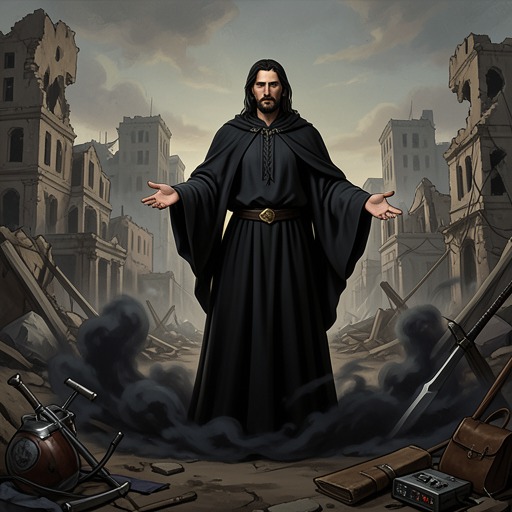
Jadis tells Digory and Polly about the catastrophe while showing them Charn from a high terrace. The city below is vast, filled with temples, towers, palaces, pyramids, and bridges, but no living thing remains. A huge red sun hangs low over it, with a single bright star above; the sun seems old and exhausted. The river that once flowed through the city has vanished, leaving only a broad ditch of grey dust. This is not simply a defeated capital: the landscape presents the whole world as a ruin.
Jadis recalls an earlier Charn full of noise and activity: feet, wheels, chariots, and drums in the temples. She says that, near the end, the battle filled every street and the river ran red. Her memory sets the city’s former life against its present silence, while her claim that one woman erased it all identifies the destruction as the consequence of a personal struggle for power.
The Civil War and the Deplorable Word
Jadis blames her sister for the conflict, alleging that she would have made peace and spared her sister’s life if the latter had yielded the throne. She also says that both sides had solemnly promised not to use Magic once war began, and accuses her sister of breaking that promise first. In Jadis’s telling, the breach releases her from restraint; she portrays her own choice as compelled rather than freely made.
The Deplorable Word was a secret known to the great kings of Jadis’s race: spoken with the proper ceremonies, it destroyed every living thing except the speaker. Earlier kings had bound themselves and their successors by oaths not even to seek its knowledge. Jadis says she learned it in a secret place at a terrible price, and claims she exhausted other means before resorting to it. The existence of this power makes the old oath significant: the catastrophe came not from an unknown accident but from the deliberate use of a forbidden, world-ending weapon.
The last battle raged for three days at Charn. Jadis says she watched from the terrace until her soldiers had fallen and her sister’s forces, led by the sister herself, were halfway up the stairs from the city. She waited until the two queens could see one another’s faces. Her sister declared victory; Jadis answered that it would not be hers, then spoke the Word. In Jadis’s account, a moment later she alone remained alive beneath the sun. The confrontation’s immediate reversal—from an apparent battlefield victory to the extinction of the world—makes the act both the end of the war and the destruction of any society left to govern.
Victims and Jadis’s Claim to Sovereignty
Digory asks what happened to the people, and Polly makes the question concrete by naming ordinary people, women, children, and animals who had done Jadis no harm. Jadis answers that they were her subjects and existed to do her will. Her reply does not dispute that they died; it treats their lives as belonging to the sovereign. The scale of the act therefore stands alongside its political logic: in Jadis’s view, the claim of a ruler to obedience overrides the survival of the ruled.
That exchange also unsettles the self-justifying account of a queen forced into an extreme measure. Jadis has blamed her sister’s pride and the broken promise, yet she describes the entire population as instruments of her will. The destruction reaches far beyond the two rivals and their armies, while her explanation never grants the ordinary people an independent claim to safety. Her insistence that she was the Queen of the World makes the desolation a demonstration of what absolute authority means in her hands.
Ruins, Contrast, and Consequences
The scene presents Charn’s death through a sequence of contrasts: a once-great city and its empty streets; a river remembered as red in battle and now vanished into dust; a sun that seems near the end of its life above a world with no living inhabitants. The terrace gives Digory and Polly a view of the devastation while Jadis supplies its political history. Her account is a recollection embedded in their encounter with her, not an impersonal record: the facts reach the children through the person who used the weapon and who still defends her decision.
The lifelessness of Charn also stands against the young world the travellers encounter afterward. There, the rising sun illuminates a valley of earth, rock, and water without trees or grass; Aslan’s song brings vegetation, and the land later produces animals. The contrast is not a restoration of Charn: its emptied landscape remains the image of destruction, while the new world’s growth begins through creation rather than conquest. Jadis’s presence carries the history of that destruction into the new setting, where Aslan warns that she has fled north and will grow stronger through dark Magic.
In Narnia, the Tree grown from the apple seed Digory planted becomes a safeguard against the Witch: Aslan commands the Narnians to guard it, saying she will not dare approach within a hundred miles while it flourishes. The protection gives the new world a defense against the danger represented by Jadis, whose survival amid Charn’s dead had made her power plain. The catastrophe thus matters beyond the lost world itself: it explains both the threat she brings and why the flourishing life of the newly created land must be protected.