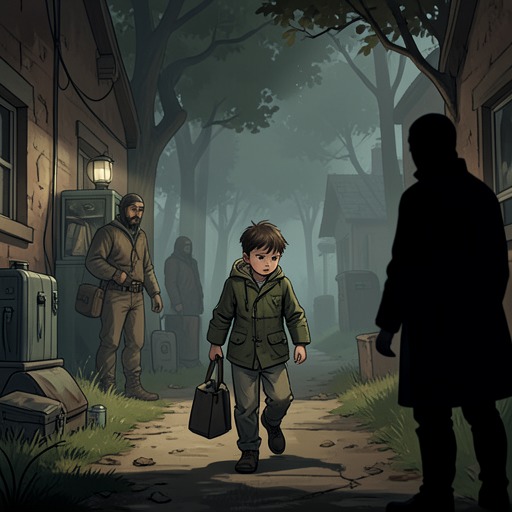
Digory’s quest for the apple
The Magician's NephewDigory’s quest for the apple is the task Aslan gives him to repair the harm caused by bringing Jadis into Narnia. It turns Digory’s personal grief over his mother’s illness into a journey undertaken for the new country’s protection: he must reach a distant garden, take an apple, and return it to Aslan without making the fruit his own. The journey’s first test comes not on the mountain road but at the garden gate, where the command to take fruit for others confronts the desire awakened by the apple itself.
The charge and its stakes
Aslan begins by asking Digory whether he is ready to undo the wrong he has done to Narnia on the very day of its birth. Digory initially protests that he does not see what he can do, since the Queen has run away; Aslan repeats the question, making readiness, rather than an explanation, the immediate issue. Digory agrees. For a moment he considers offering to help only if Aslan will promise to help his mother, but recognizes that a bargain is not possible. The thought of her illness and of his fading hopes brings tears to his eyes.
When Digory asks whether Aslan can give him something to cure his mother, the Lion bends close and answers his distress with tears of his own. Aslan acknowledges that grief is great and that, in Narnia, only the two of them yet know it. But he also sets Digory’s private hope against the future of the country: Jadis, whom Digory has brought into this world, will return to Narnia, though not immediately. Aslan intends to plant a tree that she will not dare approach, giving Narnia many years of safety and a long, bright morning before danger returns. Digory’s assignment is to fetch the seed from which that protection will grow.
The task thus joins consequence to service. Digory is not told that the journey will cure his mother, and Aslan does not make his obedience conditional on such a promise. Instead, the quest is framed as a way to answer for the Witch’s arrival and to protect a land whose future extends beyond Digory’s own immediate need. His acceptance comes while that need remains painfully present.
The western route and Fledge’s transformation
Aslan directs Digory to look west. Digory sees the river falling over a cliff, green hills and forests beyond it, darker mountain ranges farther on, and distant snowy peaks. Aslan explains that Narnia ends at the waterfall; beyond the cliff lies the Western Wild. Digory must cross the mountains to find a green valley containing a blue lake surrounded by ice-covered mountains. At the lake’s far end stands a steep green hill, with a garden at its summit and a tree at the garden’s center. Digory is to pluck an apple from that tree and bring it back.
Digory agrees, although he has no idea how to climb the cliff or navigate the mountains. He admits that the return may take time, and Aslan reassures him that he will have help. That help is the horse standing nearby. Aslan commands the horse to become winged and to be the father of all flying horses, and gives him the name Fledge. Wings burst from Fledge’s shoulders; after rising and circling above Aslan and Digory, he lands, awkward but delighted. Aslan then asks him to carry Digory to the mountain valley.
Fledge’s new ability makes the commanded journey possible by air, while his willingness turns Aslan’s promise of help into practical companionship. He is no longer merely the horse who had once pulled a hansom: as Fledge, he becomes Digory’s mount for the expedition. When he accepts the immediate flight, he recalls having carried creatures like Digory long ago, in the time of green fields and sugar.
Arrival at the garden
Fledge brings Digory and Polly down in wide circles as the icy peaks rise around them. The air grows warmer and sweeter as they descend, and Fledge glides toward the steep green hill, landing on its slope. The children roll onto the warm grass without injury, then climb toward the summit. Fledge uses his wings to balance himself and help him on the ascent.
A high wall of green turf encloses the trees at the top. Their leaves show green, blue, and silver when the wind stirs them. The travellers circle outside the wall until they find the tall golden gates, shut and facing east. The place seems unmistakably private; Polly and Fledge no longer expect to enter with Digory, and Digory understands that he must go in alone. The change from shared flight to solitary entry marks the point at which the expedition becomes a test of his own choice.
Silver letters on the gates set out the conditions: “Come in by the gold gates or not at all,Take of my fruit for others or forbear.For those who steal or those who climb my wallShall find their heart's desire and find despair.” Digory reads the instruction to take fruit for others as a warning not to eat any himself, though he does not understand the final line. He touches the gates, which swing inward silently, and enters. Inside, the garden is quiet; even its fountain makes only a faint sound. Its beauty is accompanied by a seriousness that distinguishes it from an ordinary stopping place on the journey.
The apple and the first temptation
Digory recognizes the right tree by its position at the garden’s center and by the light cast from the great silver apples hanging on it. He walks directly to it, plucks one, and puts it in the breast pocket of his Norfolk jacket. The object he has been sent to obtain is now in his keeping, but the act of taking it does not end the trial: he cannot resist looking at and smelling the fruit before putting it away.
The apple’s presence brings on a terrible thirst and hunger, along with a longing to taste it. Digory hurriedly pockets his own apple, but notices that there are many more on the tree and begins to reason around the instruction he has just read. Perhaps the notice was advice rather than an order; perhaps eating one would not undo his obedience, since he has already taken an apple for others. The temptation is therefore presented as a struggle over the meaning of the command as well as a craving for the fruit: Digory has followed its literal direction, but begins to search for permission to put his own desire first.
His quest has reached the garden, but the available evidence leaves its immediate outcome unresolved. Digory has taken an apple for Aslan’s purpose and has not yet been shown eating it. As he considers whether to taste another, he looks up through the branches and sees a large, vividly colored bird perched above him, apparently almost asleep with one eye barely open. The next pressure on his decision arrives within the garden itself, after the journey has delivered him to the object he came to retrieve.