Discovery of the World-Pools
The Magician's NephewThe Discovery of the World-Pools is the turning point at which Digory and Polly begin to understand the Wood between the Worlds as a passageway rather than a world in its own right. A shallow pool first appears to offer no route at all; the children’s experiments then expose the limits of Uncle Andrew’s explanation of the Rings and establish the Wood’s pools as possible entrances to other worlds. The discovery transforms their attic-born habit of exploration into a practical, risky geography: worlds may be reached through pools, but a way back must be identified and preserved.
From attic exploration to a world between worlds
The idea grows from the children’s earlier explorations of the houses adjoining Polly’s home. During an unusually wet, cold summer, they use an attic tunnel behind the cistern as a route for exploring between houses. To estimate when they might have crossed into the next house but one, they count rafter-spaces, allow for the passage between attics, and calculate the length of the intervening rooms and house. The method is approximate, but it treats unfamiliar space as something that can be mapped by routes, intervals, and boundaries.
In the Wood, Digory applies the same model on a larger scale. He proposes that it is not a world like the ones reached through it, but an in-between place: just as the attic tunnel is not itself one of the houses, yet provides access to them, the Wood may connect many worlds without belonging to any. Its stillness makes sense within this comparison. The children think of it as a quiet passage behind the inhabited rooms of reality, while the pools function like doors out of that passage.
The first pool and a failed return
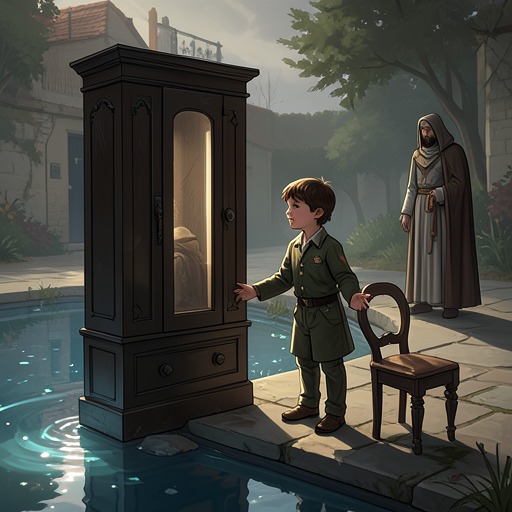
When the children first try to use a pool, they take hands, count together, and jump. They emerge still standing in the Wood, only ankle-deep in water; the pool proves to be scarcely more than a few inches deep. The failure is disorienting, though the Wood’s peacefulness keeps Polly from becoming as frightened as she might otherwise have been.
Digory immediately attributes the failure to their yellow Rings. He believes those Rings are for the outward journey and that green Rings will take them home, so the children change Rings and return to the water. But before they jump again, he asks what the other pools might lead to. If this pool can take them home, he reasons, perhaps another could open into a different world. The question changes the aim of the experiment: instead of simply retracing their route, they may be able to choose among destinations.
Polly insists that they first establish how to get safely back to their own world. Digory would rather explore, but agrees to her condition. They plan to use the green Rings for the return and to change to yellow as they near their world; Polly, rather than Digory, is to call the warning. Their successful test carries them through a fleeting view of London: roofs and chimneys appear around them, with St. Paul’s visible, while the houses’ walls remain transparent. Uncle Andrew’s shadowy figure gradually comes into focus. Before he becomes fully real, Polly calls for the change, and the London scene fades as the green light strengthens. In less than a minute, they are back in the Wood.
Marking a way home
The successful return does not yet make exploration safe. Digory is ready to try another pool, but Polly stops him to ask whether they have marked the one that leads to their own world. The pools and trees look alike. Without a landmark, they recognize, the odds of finding the correct pool again would be a hundred to one against them.
Digory’s hand shakes as he opens his penknife and cuts a long strip of turf from the bank. The exposed reddish-brown soil contrasts with the green around it, making the return pool distinguishable from its look-alikes. This small act of practical attention establishes a rule for their exploration: knowledge of a possible destination is not enough; they must also preserve the route back. The scene turns mapping into a safeguard, and shows why Polly’s caution matters even when Digory’s curiosity is pulling them onward.
What the Rings actually do
A jump into another pool with their yellow Rings also leaves the children in the Wood, wet rather than transported. Digory wonders what has gone wrong, because he still trusts Uncle Andrew’s division between yellow Rings for going outward and green Rings for coming home. The explanation supplied by the narrative corrects that assumption. Uncle Andrew has misunderstood the Rings, despite presenting their use as a system he can explain.
The Rings’ effects depend on the origin and tendency of their material. The substance in the yellow Rings comes from the Wood and draws its wearer into that in-between place, back toward where the material belongs. The green Rings contain material that is trying to leave the Wood; they carry their wearers out of it and into a world. Neither colour, therefore, simply means outward or homeward. Uncle Andrew is working with forces he does not understand, and Digory has not yet fully grasped the truth either. When the children discuss what has happened, they decide to test green Rings at the unfamiliar pool.
The discovery opens a larger map
The next jump is poised between apprehension and renewed curiosity. Polly agrees to try, while privately feeling sure that neither Ring will work at the new pool and that another splash is all they risk. They are more cheerful than before as they put on the green Rings, take hands, and jump. That decision carries their exploration beyond the secure test of returning to their own world: the Wood’s pools may connect to other worlds, but the Rings’ operation is more complicated than their uncle’s instructions suggested.
The discovery is also a practical lesson in the difference between apparent routes and reliable ones. Their attic passage had taught the children to infer unseen spaces from rafters, rooms, and distances; in the Wood, the green Ring gives them a way out, while the marked turf helps ensure they can find a way back. Curiosity proposes the map, but attention to boundaries and landmarks makes exploration survivable. The world-pools consequently stand for both possibility and exposure: every indistinguishable pool might lead elsewhere, and losing the one known route home could strand them among worlds they have not yet learned to navigate.