Golden bell and hammer of Charn
The Magician's NephewThe Golden bell and hammer of Charn are the focal objects of an enchanted chamber and the instruments through which Digory Kirke awakens Jadis. A carved warning makes the bell a test of choice: its sound begins as a sweet note, swells into a force that shakes the room, and ends in ruin and revelation. The hammer’s brief tap changes the children’s adventure, while the bell’s unanswered mechanics preserve uncertainty about whether its sound or magic brought down the chamber’s roof.
Form, Setting, and Inscription
The objects stand in the middle of a room lined with robed figures. The central structure is not quite a table but a square pillar about four feet high, topped by a small golden arch. A little golden bell hangs from the arch, and beside it lies a little golden hammer. The arrangement gives the objects a formal, almost ceremonial prominence: after Digory and Polly have surveyed the silent figures, they return to this structure as the chamber’s most immediate mystery.
Letters cut into the side of the pillar initially look strange and unreadable. As Digory and Polly study them, however, they find that they can understand the writing even though the letters’ shapes do not change. The inscription addresses an adventurous stranger and sets out two alternatives: strike the bell and accept danger, or keep wondering what would have happened. The message does not explain what the danger will be, so the objects offer a choice without giving the children enough information to judge its consequences.
The Choice and the Awakening
Polly refuses the bell’s invitation, saying that they do not want danger. Digory sees a different risk in leaving the choice unresolved: he believes they will always wonder what would have followed if they had struck it. Their disagreement escalates into a quarrel, and Polly moves toward her pocket to take out her yellow Ring and leave. Digory grabs her wrist, restrains her other arm, picks up the hammer, and gives the bell a light, smart tap. His action is not a considered experiment made in agreement with Polly; he strikes while preventing her from walking away, and she is left furious and hurt.
The note begins sweetly and not very loudly, but it does not fade. It grows steadily in volume until the children could not hear each other even by shouting. The sound remains continuous and on a single note, yet its sweetness acquires something horrible; the air throbs and the stone floor trembles beneath them. A second, disastrous noise seems to approach, followed by the crash of falling masonry. About a quarter of the roof at one end of the room falls in, blocks of stone tumble around the children, and the walls rock. Then the bell stops, the dust clears, and silence returns.
The sequence links the bell’s sound with the destruction but leaves the precise cause open. It is never established whether magic brought the roof down or whether the sustained note happened to strike a pitch the crumbling walls could not withstand. The distinction matters: the bell’s power is unmistakably consequential, but the narrative does not turn the chamber’s collapse into a fully explained mechanical rule.
Jadis and the Bell’s Consequences
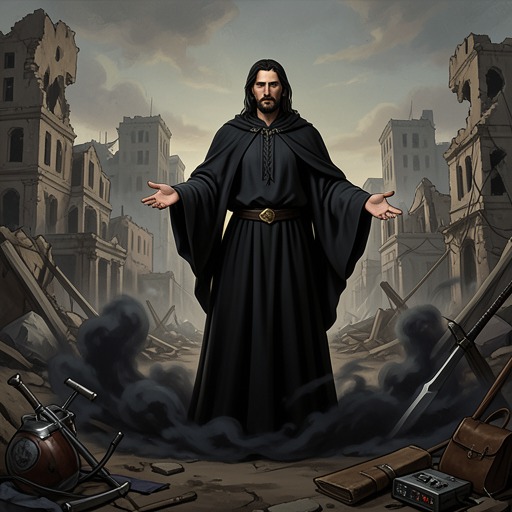
Once the bell has fallen silent, the children hear a soft noise from the undamaged end of the room. The farthest robed figure—the woman Digory had thought beautiful—rises from her chair. Standing, she proves taller than they had supposed; her crown, robes, flashing eyes, and expression reveal her as a great queen. She strides toward them and asks who has awakened her and broken the spell. Digory answers that he thinks he did it. The bell’s effect is thus made personal and immediate: the choice awakens Jadis from her enchanted sleep, and the children’s encounter with the queen begins in the wreckage their action has accompanied.
The paired implements have different roles in this turning point. The hammer is the handheld means by which Digory makes the choice irreversible; the bell carries that choice outward as sound, damage, and awakening. The inscription frames striking as a decision made under uncertainty, and the aftermath demonstrates that the danger is not merely an abstract possibility. Yet the bell does not reveal its full workings: its power remains partly mysterious even after its consequences have changed the course of the children’s journey.
Provenance and Misunderstood Magic
The objects belong to a broader pattern in which magical things pass through human hands without being properly understood. Andrew Ketterley recounts that Mrs. Lefay, shortly before her death, entrusted him with a small box retrieved from a secret drawer in an old bureau. She had him promise to burn it unopened, with certain ceremonies, after her death. He broke that promise, claiming that the prickling sensation he felt on picking up the box told him he held a great secret. The account establishes a history of concealed magical objects and Andrew’s willingness to place his curiosity above an obligation; it does not identify the box itself with the bell and hammer.
Andrew later presents a theory of the Magic Rings to Digory. He says a yellow Ring makes its wearer vanish from this world and expects a green Ring to carry someone back from the Other Place. His instructions depend on a distinction between outward and homeward travel that he has not tested. In fact, the materials of both kinds of Ring come from the Wood between the Worlds: yellow material draws a wearer into that Wood, while green material carries a wearer out of it and into a world. The narrator makes the broader point explicit: Andrew is working with things he does not really understand. That account provides a useful contrast with the bell episode. The bell’s inscription openly warns that its effects are dangerous but withholds their nature; Andrew, by contrast, mistakes conjecture for knowledge and gives directions as though his assumptions were facts.
The bell’s aftermath also anticipates the novel’s recurring attention to material objects that travel, change, and retain traces of other worlds. The Witch tears a bar from a London lamp-post; in Narnia it sinks into the ground and grows into a young lamp-post. Digory recognizes the connection by the bar’s transformation, while Andrew immediately imagines turning such growth into a commercial source of railway engines and battleships. Later, the tree grown from the Apple that Digory planted in his garden is blown down in a storm. Its wood still holds magic, and Digory has part of it made into a wardrobe. These later transformations show how objects and materials can connect worlds beyond the moment of their first use. Unlike the bell, whose decisive action is a sudden sound and awakening, the lamp-post and the tree’s wood continue their work through growth and inheritance.
Narrative Significance
The bell and hammer concentrate the difference between curiosity and responsible choice. Digory’s desire not to live with the question of what might have happened pushes him to act, but he does so by overpowering Polly rather than respecting her refusal. The scene therefore makes the cost of curiosity more specific than the inscription’s generalized warning: his decision harms their friendship in the moment, helps awaken a dangerous queen, and draws both children into consequences neither has mastered.
At the same time, the objects do not function as a transparent machine with a fully specified set of rules. The inscription supplies a warning; the hammer supplies a simple physical action; the bell’s note produces a series of visible effects, yet the collapse’s cause remains uncertain. That combination gives the objects their narrative force. They turn an unexplained possibility into an irreversible act, while leaving the children—and the reader—to reckon with magic whose effects can be witnessed more clearly than its operation.