Ketterley house
The Magician's NephewKetterley house is both an ordinary London home and the threshold from which the book’s journeys between worlds become possible. Its connected attics and hidden passages give Polly Plummer and Digory Kirke a way to explore beyond the rooms they know; later, the house receives the Witch and becomes the point of return from which Digory carries the Apple of Life to his mother.
Setting and Hidden Passages
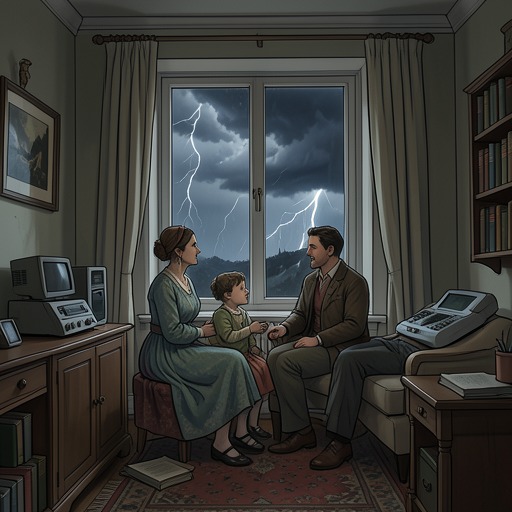
The house stands in a row of joined London homes. At the beginning of the story, its household consists of Andrew Ketterley and his sister, Aunt Letty; there have been no children living there before Digory arrives. Digory’s presence at the garden wall surprises Polly, who lives next door, and their meeting begins a friendship that soon brings them together in the houses’ concealed spaces.
A spell of unusually wet, cold summer weather keeps the children indoors and turns exploration into a practical project. In Polly’s house, a little door in the box-room attic leads to the cistern and a dark tunnel beneath the roof. The children reason from that familiar passage—neither a proper room nor quite part of any house—that a route running behind walls and above ceilings might connect places otherwise separated. Their exploration of Ketterley house is therefore not merely a matter of discovering rooms: they use the architecture itself to imagine how access between worlds might work.
That reasoning has consequences. The children plan their route by estimating the number of rafters in a room, allowing for the passage and the maid’s bedroom, and calculating the length of a house. Their method brings them toward the attic of the apparently empty house, but the larger adventure soon teaches them that finding a way through is not the same as knowing how to get back. In the Wood between the Worlds, Digory recognizes a resemblance to the tunnel under the slates: a quiet in-between space from which different worlds can be reached.
Andrew Ketterley and the Household
Andrew’s rooms reveal a less adventurous, more compromised aspect of the house. After being frightened by the Witch, he retreats to his bedroom, locks himself in, and drinks from a bottle hidden in his wardrobe, where Aunt Letty cannot find it. He then dresses for an imagined social triumph: a stiff high collar, patterned white waistcoat, gold watch chain, best frock-coat, polished tall hat, flower in his buttonhole, scented handkerchief, and eyeglass with a black ribbon.
His self-regard quickly displaces his fear. Once the Witch is no longer in the room, Andrew dwells on her beauty and imagines that she may fall in love with him; he even persuades himself that his own magic brought her from unknown worlds. The drawing room, where he finds Aunt Letty kneeling on a mattress she is mending, brings that fantasy into collision with the household’s actual arrangements. He asks her for five pounds, presenting the request as urgent entertaining expenses, but she refuses without looking up from her work.
The refusal rests on a history of financial dependence. Andrew has managed Aunt Letty’s business matters, done no work, and accumulated substantial bills for brandy and cigars, which she has repeatedly paid. The narrator indicates that this conduct has left her considerably poorer than she was thirty years earlier. The house is thus not just a setting for magical discovery: its rooms also contain a long, ordinary history of unpaid obligation and unequal control over money.
Intrusion and Return
When Jadis attacks Aunt Letty in the drawing room, Letty falls onto the mattress and escapes with bruises rather than broken bones. After a few minutes’ rest, she takes charge: she sends the housemaid, Sarah, to the police station to report a dangerous lunatic at large, while she herself carries lunch upstairs to Digory’s mother. The response sets two kinds of danger beside one another—the household’s immediate disruption and Digory’s knowledge that the Witch has formidable powers and intends to conquer the human world.
The children later return to Ketterley house from the adventure in Narnia. The pavement outside the front door is still crowded around the damaged policeman; the lamp-post has lost one arm, and the hansom cab lies wrecked. The Witch, the horse, and the Cabby are gone, while the crowd seems not to have noticed the children’s departure or return. Andrew’s disordered clothes and honey-smeared face make him unrecognizable, and the open front door allows the children to hustle him indoors before anyone asks questions.
Andrew rushes upstairs, alarming the children briefly because they fear he means to hide his remaining rings. His actual concern is the bottle in his wardrobe: he locks himself in his bedroom, later emerges in a dressing gown, and goes straight to the bathroom. In contrast, Digory asks Polly to retrieve the other rings, then pauses to regain his breath before entering his mother’s room.
The House as Threshold and Place of Care
From the house, Digory’s attention turns away from Andrew’s private retreat and toward his mother’s illness. He enters her room quietly and finds her propped against the pillows, with the pale, wan face he has seen there many times. He takes the Apple of Life from his pocket. Against the bedroom’s counterpane, wallpaper, sunlight, and his mother’s pale-blue dressing jacket, the fruit makes everything else seem faded; its brightness throws light onto the ceiling, and its scent transforms the atmosphere of the room.
The sequence completes the house’s movement from hidden route to place of return. Its attic architecture first helps the children conceive passage between worlds; its rooms expose Andrew’s dependence and vanity, then absorb the disturbance caused by Jadis; finally, a familiar bedroom becomes the setting for Digory’s attempt to heal his mother. The extraordinary does not erase the domestic setting. It returns to it, bringing the consequences of the children’s journey into the household that first made their exploration possible.