Magic
The Magician's NephewMagic is the power by which otherwise unreachable worlds can be connected, but it is not a system that its practitioners necessarily understand. Uncle Andrew turns a mysterious substance into experimental devices and mistakes what they do; the children’s journeys expose the difference between his confident theories and the rings’ actual operation. Against this uncertain, procedural magic stands Jadis’s plainly destructive force, which reduces massive doors to dust and makes power a threat as well as a means of escape.
Other Worlds and the Atlantean Dust
The source of Uncle Andrew’s experiments is a small box entrusted to him by Mrs. Lefay, who had been allowed out before her death and asked him to retrieve it from a secret drawer in an old bureau. She made him promise to burn it unopened, with certain ceremonies, once she had died. He broke that promise: the box’s contents mattered more to his curiosity than his obligation to her. His defense is that exceptional thinkers are exempt from ordinary rules, a self-serving claim that anticipates the harm his experiments will cause.
The box contained fine, dry dust brought from another world when this world was only beginning. Uncle Andrew insists that this other world is not simply another planet: it belongs to another universe and could be reached only by Magic. He believed that, if the dust could be put into the right form, it would draw someone back to the world from which it came. The idea gives magic a material basis in the story, but not one that guarantees mastery. Andrew’s excitement at possessing a fragment of elsewhere outstrips his understanding of what it can do.
Experiment and Ethical Cost
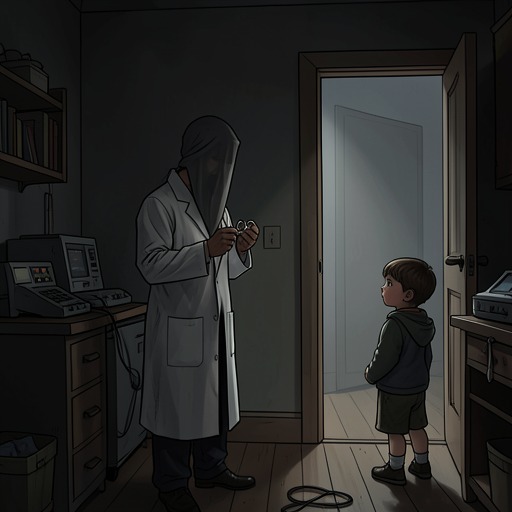
Andrew’s work is presented as experimentation with living creatures, not as harmless speculation. Before making the rings, he tested failed versions on guinea pigs; some died and some exploded. Digory objects to the cruelty, but Andrew treats the animals as experimental material he purchased and dismisses the objection as irrelevant to the scientific point. His ability to produce extraordinary effects is therefore inseparable from his refusal to treat the costs as morally significant.
At last Andrew made the yellow rings. He was fairly sure that touching one would send a creature into the Other Place, but he could not see how to bring an explorer back to report what had been found. His difficulty exposes the gap between initiating a magical effect and controlling its consequences. Andrew wants knowledge of another world, yet designs his experiment around sending others into it; Digory, by contrast, immediately asks what would happen to them if they could not return.
What the Rings Actually Do
The children’s first attempts to use the rings show the limits of Andrew’s instructions. At one pool, the yellow rings do not take them to a new world: the water proves to be only a puddle, leaving them with wet feet and splashed legs. Digory assumes something has gone wrong because Andrew had described yellow as the outward-travel ring. But Andrew, who knows nothing of the Wood between the Worlds, has assigned the rings the wrong functions.
The distinction rests on the material from which each ring is made. The stuff in the yellow rings wants to return to its own place, the Wood between the Worlds, and draws a wearer into the Wood. The stuff in the green rings strains to leave its own place, so a green ring takes someone out of the Wood and into a world. Yellow and green are not simple outward and homeward switches in the sense Andrew imagined; their effects follow the direction in which their material tends. The explanation also qualifies the children’s understanding: Digory does not grasp the truth clearly at first, and only comes to do so later.
After another pool also turns out to be merely a puddle, the children decide to try their green rings there. Polly agrees, though she privately feels sure that neither kind will work in the new pool and that another splash is the worst likely result. The episode makes the rings’ operation something discovered through trial, not something secured by Andrew’s confident account. The difference between his mistaken model and the actual rule turns passage between worlds into a problem of knowledge as much as a matter of power.
Jadis and Destructive Power
Jadis offers a stark contrast to Andrew’s experimental magic. In the great hall of her city, she reaches the main entrance, where high, heavy doors of ebony or an unfamiliar black metal bar the way out. She raises an arm, speaks words the children cannot understand, and makes a throwing gesture. The doors tremble as though made of silk, then crumble away until only a heap of dust remains on the threshold.
The act is both an escape from a physical barrier and a demonstration of what happens to resistance in Jadis’s path. She takes Digory’s hand again and asks whether his master magician, his uncle, possesses power like hers; she also warns Digory to remember what he has seen. Andrew’s theories depend on an incomplete grasp of other worlds and on devices whose consequences he cannot reliably manage. Jadis’s power, by contrast, is presented through an immediate and irreversible transformation of matter. Together, these forms of magic make the concept more than a synonym for wonder: it can open routes between worlds, but it can also expose the danger of ignorance or turn obstruction itself to dust.