Silver Apple Tree
The Magician's NephewThe Silver Apple Tree stands at the center of Digory’s western quest: its fruit is the remedy he is sent to bring back, and its life-giving power ultimately links Narnia to his own world. The tree is not merely a source of a precious object. Its fruit, seed, and remembered Narnian origin form a chain through which magic survives beyond the original adventure and helps make later journeys between worlds possible.
The Tree and Its Garden
Aslan directs Digory west beyond the end of Narnia, where the land gives way at a waterfall to the Western Wild. He describes a green valley enclosed by mountains of ice, a blue lake, and a steep green hill; on its summit stands a garden, with the tree at its center. Digory is to pluck an apple and bring it back to Aslan. The errand gives the tree a precise place in the larger landscape: it is the destination of a deliberate journey beyond Narnia’s borders, not an object encountered by chance.
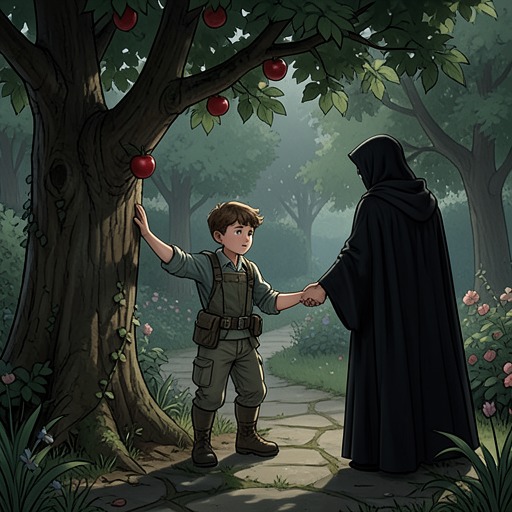
At the garden, a high wall of green turf surrounds trees whose leaves show green, blue, and silver in the wind. The gold gates face east and stand shut. Their inscription permits entry through the gates, not over the wall, and distinguishes taking fruit for others from taking it for oneself. Digory understands that the task is to carry the fruit for another person and enters alone; Polly and Fledge recognize the garden as private and remain outside. The boundary and its warning frame the tree’s abundance as a moral test as well as a reward.
The Silver Fruit and Digory’s Choice
Digory identifies the right tree by its place at the garden’s center and by the great silver apples covering it. They shine with their own light, illuminating shadowed places beyond the reach of sunlight. He picks one and puts it in the breast pocket of his Norfolk jacket, but first he looks at and smells it. That moment of proximity sharpens the temptation: hunger and thirst seize him, and he considers whether the gate’s words might be advice rather than an order, or whether taking one apple for himself would still be compatible with bringing another for others.
The fruit’s importance is confirmed by the purpose of the quest. Digory has been sent to bring an apple back to Aslan, and the fruit he carries can restore his dying mother. The episode sets the tree’s healing power beside the danger of treating its fruit as private gratification. Its abundance does not erase the distinction between a gift entrusted for another and a prize taken for oneself; the inscription, Digory’s wavering, and the apple safely placed in his pocket make that distinction the scene’s central pressure.
A Living Connection Between Worlds
The fruit’s influence continues after the quest in the apple core Digory plants in the back garden at home. The resulting tree grows into a fine English tree, but its apples are not equivalent to the Narnian fruit: they are exceptionally beautiful and good for people, yet cannot revive a dying woman. The difference is tied to where the tree grows. In English soil, far from Aslan’s voice and Narnia’s young air, its fruit is not fully magical.
Yet the tree retains an inward connection to its Narnian counterpart. Its sap, as the narration puts it, does not forget the other tree to which it belongs. It sometimes moves without any wind in England; the account connects that motion, tentatively, with high winds rocking the Narnian tree. The relationship is therefore presented not as a simple duplication of the original’s powers but as a persistent bond across worlds, visible in the English tree’s unusual movement and in the magic still lodged in its wood.
The Tree’s Legacy
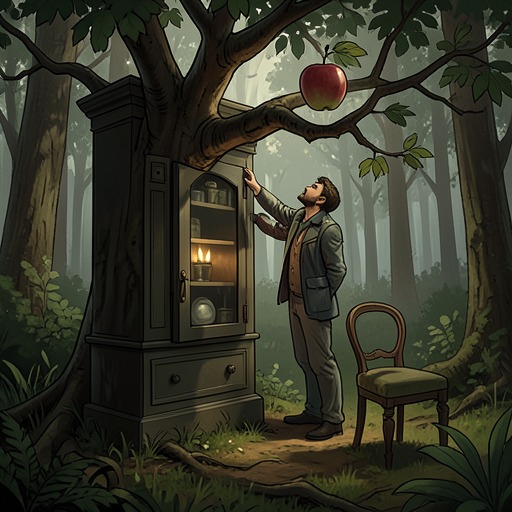
When Digory is middle-aged, a great storm blows down the English tree. He cannot bear to have it chopped up for firewood, so he has some of its timber made into a wardrobe for his country house. He does not discover the wardrobe’s magical properties himself; someone else does. The wardrobe begins the later comings and goings between Narnia and the human world, extending the tree’s history far beyond the life of its fruit.
The tree’s legacy thus passes through distinct forms: Narnian fruit carried on a quest, a planted core growing in England, and timber fashioned into an ordinary household object that proves to contain magic. Each change preserves a connection while altering what that connection can do. The Silver Apple Tree’s decisive significance lies in this material continuity: a seed taken from its fruit allows the history of Narnia’s creation to endure in another world, where its wood becomes the threshold to further adventures.