The Accidental Arrival in Narnia
The Magician's NephewThe Accidental Arrival in Narnia is the accidental passage of Digory Kirke, Polly Plummer, Jadis, Andrew Ketterley, the Cabby, and the horse Strawberry into a new world. It begins with an improvised effort to use the Rings to escape the Witch’s reach, but the chain of hands and Strawberry’s thirst carries the whole party instead into darkness and then into Narnia at the moment of its creation. The crossing turns a narrow escape into the beginning of a world: a sun rises over bare land, vegetation spreads, animals emerge, and the Witch arrives among the first witnesses to Narnia’s life.
Causes and Circumstances
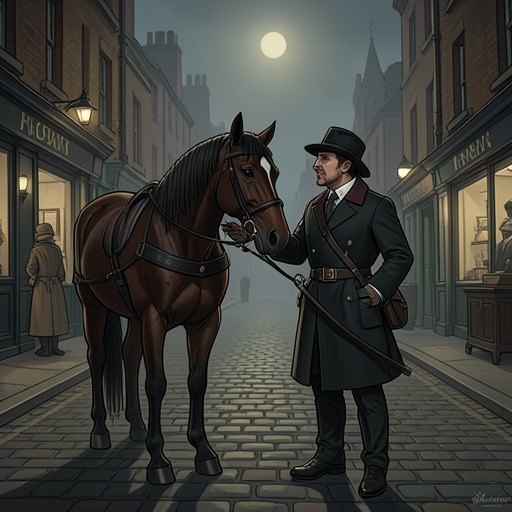
The travelers have just emerged into the wood from a pool, with Strawberry and the others brought along with them. Jadis, pale and sickened by the wood, bends until her face touches the horse’s mane; Andrew is still shivering, while Strawberry recovers. His ears, previously flattened, return to their proper position, and the fire goes out of his eyes. The Cabby steadies him with a hand on his neck. The change in the horse’s condition gives the party a brief pause before the next crossing.
Thirsty, Strawberry walks to the nearest pool and steps into it to drink. The travelers are connected by touch: Digory is holding Jadis’s heel, Polly holds Digory’s hand, the Cabby has hold of Strawberry, and Andrew has just seized the Cabby’s other hand. Polly sees the green Rings and tells Digory to use them. The horse never gets his drink. Instead, their linked grasp carries everyone into darkness. The episode’s accidental quality lies in the mismatch between the immediate action and its result: a horse’s ordinary movement toward water becomes the means by which the entire party changes worlds.
From Charn to an Empty World
The crossing places the travelers against the memory of Charn, whose ruined city had stretched across the land beneath a huge, old red sun. Its temples, towers, palaces, pyramids, and bridges cast long shadows; the river that had once crossed the city had vanished, leaving a ditch of grey dust. That scene of former grandeur emptied of life supplies a stark contrast for what follows. The travelers first wonder whether they have returned to Charn at night, but Jadis corrects them: this is not Charn but an empty world, Nothing.
The darkness is total: there are no stars, the travelers cannot see one another, and shutting their eyes would make no difference. Beneath them is a cool, flat surface, neither grass nor wood; the air is cold and dry, without wind. Jadis announces that her doom has come upon her. The crossing thus does not immediately deliver the party into a recognizable country. It suspends them in a void, with Charn’s lifeless history behind them and Narnia’s creation still to come.
Narnia Appears
A voice begins singing in the darkness. At sunrise, the travelers see a new landscape: a broad, swift river runs east toward the sun, with mountains to the south and lower hills to the north. The land is still only earth, rock, and water, with no tree, bush, or blade of grass. Its many-coloured ground looks fresh and vivid. The sun itself appears young beside the weary red sun over Charn, making the new world’s first light a direct visual reversal of the dead city’s last landscape.
The Lion’s song changes the valley. Grass spreads from him across the ground and climbs the hills; heather and other green growth follow. Small, spiky shoots rise with startling speed, until Digory recognizes them as trees. Creation is presented not as a completed scenery change but as an unfolding process, heard and watched by the newcomers. The party has crossed into a world whose landscape is coming into being before them.
The First Animals and the Witch’s Place
As the song changes again, grassy ground swells into humps of different sizes, from molehills to shapes as large as cottages. The earth breaks open and animals emerge. Moles and dogs come up as they would from holes; stags’ antlers appear before the rest of their bodies, making them look at first like trees. Frogs head straight for the river, while big cats clean themselves and sharpen their claws against trees. Birds pour from the branches, butterflies flutter, and bees set to work on the flowers. An elephant rises from the largest mound as the growing chorus of animal calls overwhelms the song.
Strawberry also joins the animals, no longer looking like the poor, old slave he had been in London but trotting with his head erect. The Lion goes among the creatures, touching pairs of animals on their noses. In this newly created community, the horse who led the party across by seeking a drink finds a new place among the beasts. The Witch, by contrast, calls the world terrible and urges the others to fly. Her response places her in immediate opposition to the life gathering around her.
The arrival’s consequences extend beyond the moment of crossing. After Digory plants the apple, a tree grows during the coronation. Aslan tells the Narnians to make guarding it their first care, because it is their shield: the Witch has fled into the far North and will grow stronger in dark Magic, but the tree will keep her from coming within a hundred miles. Its scent means joy, life, and health to the Narnians, but death, horror, and despair to her. Digory then admits that the Witch has already eaten an apple of the same kind. The accidental arrival has therefore brought the future threat into Narnia at its beginning, while the living world’s protection is also established as part of the story that follows.