the Cabby
The Magician's NephewThe Cabby is a London cabman whose plain-spoken steadiness becomes a model for leadership in Narnia. Drawn into the new world alongside Digory, Polly, Uncle Andrew, the Witch, and Strawberry, he responds to danger not with grand claims but with care for those around him. Aslan recognizes that character and names him the first King of Narnia, charging him to rule justly and protect its creatures.
Identity and First Arrival
The Cabby enters Narnia by way of the pool with the other travelers, unexpectedly finding himself in the green wood after the journey through the pools. Polly notes that the horse and Mr. Ketterley have come with them too, and calls the situation a muddle. For the Cabby, the transition is not an occasion for abstract wonder so much as a sudden practical problem: the travelers are together, but they do not know where they have arrived or what might happen next.
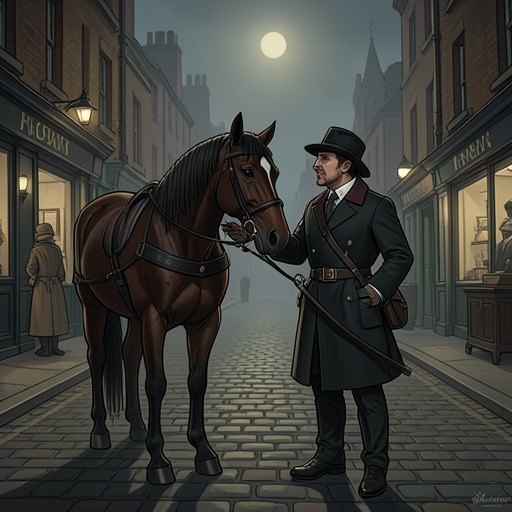
The Witch reacts to the return to the wood by turning pale and bending over the horse’s mane, visibly sickened. Uncle Andrew shivers. Strawberry, by contrast, shakes his head and gives a cheerful whinny; the fire leaves his eyes, his ears return to their proper position, and he becomes quiet for the first time Digory has seen him. The Cabby responds with a familiar, affectionate gesture, clapping Strawberry’s neck and urging him to take it easy. The moment establishes a bond that matters later: the Cabby meets the horse not as a possession or curiosity, but as a companion whose distress and relief deserve notice.
Calm in a Strange World
When the party is left in uncertainty, the Cabby becomes its firmest voice. He checks whether anyone has broken a bone and treats survival itself as something for which to be thankful. He offers ordinary explanations for their predicament, imagining that they might have fallen into excavations for a new Underground station and that someone will eventually get them out. He also allows for the possibility that they are dead, but answers that possibility with plain acceptance rather than panic: everyone must die sometime, and a decent life leaves no reason for fear.
His response is not to insist that the situation is harmless. Instead, he finds an action everyone can share: he proposes singing a hymn to pass the time and begins a harvest thanksgiving hymn about crops being safely gathered in. The choice is comically ill-suited to a place that seems never to have grown anything, but it is the hymn he can remember best. He has a fine voice, and the children join him; the singing cheers them. Uncle Andrew and the Witch remain silent. In a scene full of bewilderment, the Cabby’s song makes fellowship practical: people who cannot explain their surroundings can still hold together through a familiar act.
This steadiness contrasts with Uncle Andrew’s response. While the Cabby speaks openly to the group, Uncle Andrew cautiously draws Digory away and whispers to him. The Cabby does not appear to demand authority or special knowledge. His influence comes from doing what the moment requires—checking for injuries, giving people a reason not to despair, and bringing them into a shared song.
Choosing to Stand with Digory
The Cabby’s care for others becomes active again when Digory decides to approach the assembly of talking animals. Digory says that he has to go because of his mother: if anyone could give him something that would do her good, it would be Aslan. Polly says she would not dare go with him. The Cabby volunteers to accompany them, explaining that he likes the animals’ looks, does not expect them to attack, and wants a word with old Strawberry.
The three set out boldly, or as boldly as they can, toward the gathering. The animals are so occupied with talking and making friends that they do not notice the humans until they are close. Uncle Andrew, trembling in his buttoned boots some distance away, shouts for Digory to return and claims to forbid him from going farther. The Cabby’s choice places him beside the children rather than beside the frightened adult who tries to command them. It also joins personal loyalty to a larger act of trust: he is willing to approach a community whose nature he cannot yet fully know, partly because he has already seen the horse among them and hopes to speak with him.
Recognition and Appointment
When Aslan addresses the assembled creatures, he explains that evil has entered the new world, awakened and brought there by Digory. He tells them not to despair: the consequences lie far ahead, he will see that the worst falls upon himself, and Adam’s race must help heal the harm it has caused. He then calls Polly and the Cabby closer. The Cabby has arrived with her, and Polly stares at Aslan, holding the Cabby’s hand tightly.
The Cabby removes his bowler hat when he looks at the Lion. No one has yet seen him without it; without the hat he appears younger and nicer, more like a countryman and less like a London cabman. This small outward change accompanies a larger moment of recognition. Aslan tells him that he has known him long and asks whether the Cabby knows him. The Cabby cannot say that he knows Aslan in an ordinary way, but senses that they have met before. His answer conveys recognition as an intuition rather than an explanation, and he addresses Aslan with the respectful reserve of a man who knows he is in the presence of someone greater than himself.
Aslan then names the Cabby and his wife the first King and Queen of Narnia. The Cabby opens his mouth in astonishment, while his wife turns red. Their appointment is not presented as a reward for worldly status or a claim to dynastic power. It follows the Cabby’s demonstrated composure, generosity, and willingness to accompany others into uncertainty. Aslan gives the new monarchs concrete duties: they are to rule and name the creatures, do justice among them, and protect them from enemies when those enemies arise. He warns that an evil Witch is already in the world.
Character and Narrative Significance
The Cabby’s authority begins before he receives a crown. In the strange wood he responds to fear with practical reassurance, and when Digory takes a risk for his mother, he chooses to go with the children rather than stand back. His manner is neither heroic display nor expert command; it is the steady attention of someone who notices injuries, comforts a horse, and understands the value of keeping people together. The later appointment makes those earlier acts legible as preparation for rule.
His movement from London cabman to Narnia’s first King also gives the creation story a deliberately ordinary human presence. A world newly made is not entrusted to someone whose importance is already established by rank or spectacle. Instead, the Cabby’s recognizable habits—kindness, courage, and an instinct for fairness—become the basis for the office Aslan assigns him. The responsibilities of that office extend his everyday decency into public life: he must govern, administer justice, and defend Narnia’s creatures. The Cabby’s astonishment at the appointment preserves the scale of the change, while his response to Aslan suggests that he can accept a calling he did not seek without pretending to understand it completely.