Baltese Cathedral
The Magician's ElephantBaltese Cathedral is both a commanding landmark in the city of Baltese and the lasting repository of a small but consequential image: a boy leading an elephant while carrying a girl, followed by the people who became connected through their journey. Its height, its grimacing gargoyles, and the procession carved among them make the cathedral a place where the city’s story is preserved in stone.
Landmark Above the City
From the attic room at Apartments Polonaise, Peter Augustus Duchene can see the cathedral’s spire and the gargoyles crouched along its ledges. The view sets the great building against the surrounding city: the prison’s turrets, the noble homes high on the hill, and the shops and crooked-roofed streets below. The cathedral is not simply an isolated monument in this panorama; its spire rises among the places shaping Peter’s sense of distance and of what he cannot yet find.
The cathedral is described as the city’s largest and most magnificent. Its height gives it a distinctive presence in Baltese, but its stonework also carries a more intimate history: the work and later legacy of Bartok Whynn, who once laboured there as a stonecutter.
Bartok Whynn and the Gargoyles
Before taking up his perpetual place behind the elephant with a bucket and shovel, Bartok worked high atop the cathedral, coaxing gargoyles from stone. His creations were frightening, each different from the others and, in the account of his work, more horrifying than the one before it. Seen from below by Peter, the figures glower from the ledges; seen through Bartok’s history, they are the products of a craft practised at a perilous height.
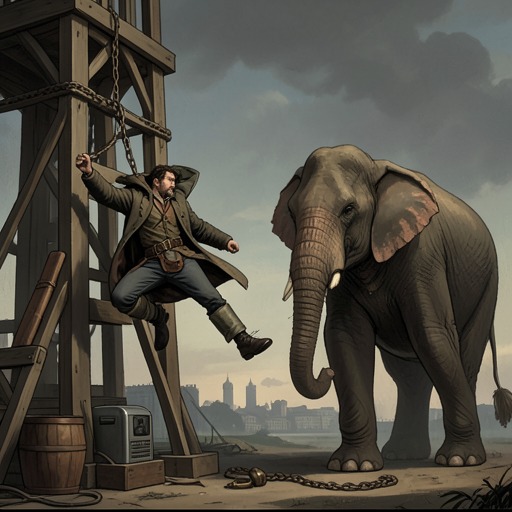
In late summer, the summer before the elephant arrived in Baltese, Bartok was working on the most gruesome gargoyle he had conceived when he lost his footing and fell. The height made his descent long enough for him to think. He first believed he was going to die, then became absorbed in the sense that he knew something, though he had yet to grasp what it was. The cathedral’s height is therefore bound to both his dangerous work and the moment of reflection that precedes the truth he eventually leaves there in stone.
The Carving Among the Gargoyles
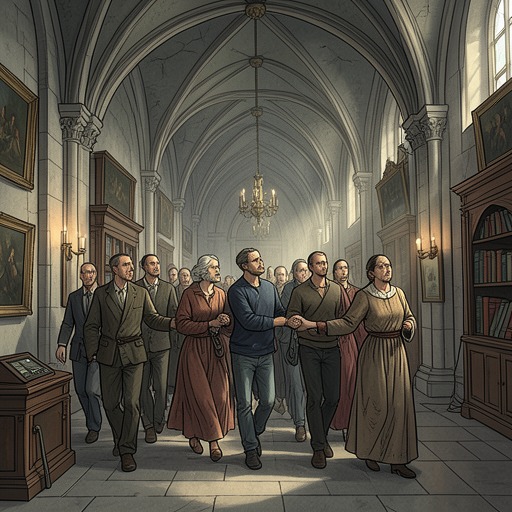
High among the cathedral’s glowering gargoyles, hidden from ordinary view, is a carving of an elephant led by a boy carrying a girl. One of the boy’s hands rests on the elephant. Behind them are a magician and a policeman, a nun and a noblewoman, a manservant, a beggar and a dog; at the end of the line is a small, bent man. The arrangement preserves the company gathered around the elephant, not merely the animal alone.
The figures are linked: each person holds another, and all face forward, their heads angled as if toward a bright light. The carving turns a procession through the snowy city into a durable image of connection. Bartok’s hidden work offers a visual record of a story whose participants might otherwise have dispersed, and its elevated, obscured position makes discovering it a matter of being led to the cathedral and shown where to look.
Narrative Significance
The cathedral gathers two different kinds of stonework into one setting. Its gargoyles look down with a frightening, watchful aspect, while the concealed procession among them records a shared passage through the city. That contrast makes the building’s height more than a measure of scale: the same ledges that hold Bartok’s fearsome figures also shelter an image of people bound to one another.
The carving is described as small evidence that the marvellous events really happened, and as the truth Bartok left behind. Its final place in the story gives the cathedral a role as both landmark and keeper of memory. What Peter once saw from afar—the spire and the figures above the streets—contains, when approached and read, a record of the journey that brought the city’s separate lives together.