The magician summons an elephant
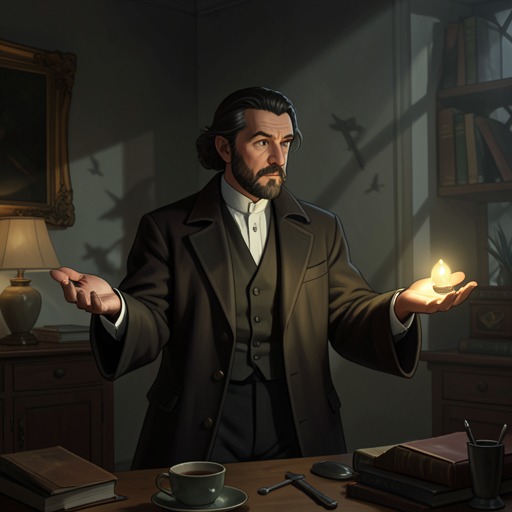
The Magician's ElephantThe magician’s summoning of an elephant turns a failed attempt at a modest stage trick into a public calamity, and makes the animal’s arrival the source of several later conflicts. The magician had intended to present lilies, but, dissatisfied with the prospect of another forgettable performance, he spoke a spell entrusted to him by his teacher. The elephant came through the roof of the Bliffendorf Opera House, injuring Madam Bettine LaVaughn and forcing the city to confront an impossible question: what should be done with a creature that had caused devastation without choosing to appear?
Causes and Background
The performance took place in Baltese, where the magician’s reputation was failing and the audience expected little from him. The spectators were waiting for the real attraction—the music of a virtuoso violinist—and the magician understood that his own act would be treated as a small diversion before it. His intended conjuring of lilies belonged to that ordinary, limited performance.
Onstage, however, he was abruptly struck by the thought that he had wasted his life. Wanting something spectacular, he combined the sleight of hand meant to produce lilies with words from a spell his magic teacher had given him long ago. He knew the words were powerful and that using them in these circumstances was ill-advised. The summoning was therefore not simply an accidental failure of a flower trick: the magician deliberately invoked a force he understood to be potent, in a moment when he wanted to do something that mattered.
The Summoning and Its Immediate Cost
The spell brought an elephant into the opera house with violent, physical consequences. She crashed through the ceiling amid falling plaster and roofing tiles and landed in the lap of Madam Bettine LaVaughn, the noblewoman to whom the magician had meant to give the lilies. Her legs were crushed. She was confined to a wheelchair afterward and repeatedly returned to the astonishing fact of her injury, even in conversations that had nothing to do with elephants or roofs.
The catastrophe also transformed the magician’s performance into a scene of public alarm. Before screams, sirens, and accusations took over, he stood beside the enormous animal, took in her smell—dried apples, mouldy paper, and dung—and placed a hand on her chest. He felt her heart beating solemnly beneath it and recognized that he had caused this presence. His wonder at having achieved something spectacular existed alongside the harm that achievement had already inflicted.
The crowd’s expectations sharpen the reversal. In a later conversation recounted at the fishmonger’s, people emphasize that nobody had expected anything special from the magician, least of all an elephant. Peter Augustus Duchene hears the impossible word spoken aloud and is startled by it. The tale of the accident thus reaches beyond the opera house: for Peter, the elephant’s arrival is not merely a public spectacle but a fact that suddenly enters his thoughts about his sister and his own precarious circumstances.
Failed Reversal and the Question of Responsibility
After the accident, the city’s authorities commanded the magician to send the elephant back, or otherwise make her disappear. He dutifully spoke the spell and its words backward, as the magic required for reversal. Nothing happened. The elephant remained, and her continued presence served as evidence that the magician had exercised real power, even though he could not undo its consequences.
The chief of police, who believed firmly in the letter of the law, searched the police handbook for guidance. It said nothing about a beast appearing from nowhere, destroying an opera-house roof, and crippling a noblewoman. With no rule to apply, he asked his subordinates what to do. One policeman treated the elephant as a criminal who should be tried and punished; Leo Matienne challenged the premise. He argued that the elephant had not asked to crash through the roof and compared blaming her to blaming a rock for breaking a window after a magician threw it. His distinction separates causal involvement from moral culpability: the animal was present in the disaster, but had neither chosen nor intended it.
Custody and Wider Consequences
The authorities’ failure to send the elephant home did not give her control over her own fate. Countess Quintet arranged to have her brought to the countess’s residence. Because no existing door was large enough, a dozen craftsmen worked around the clock; within a day, they had knocked down a wall and installed an enormous, brightly painted, decorated doorway. The chief of police escorted the elephant there under cover of night, ushered her through the new entrance, and left after tipping his hat to the countess.
The door was locked behind the elephant, who became the countess’s property. Countess Quintet had paid the opera-house owner enough to repair and retile the roof many times over, and she also wrote to Madam Bettine LaVaughn expressing sympathy and offering support for the further prosecution and punishment of the magician. Her generous contribution to the policemen’s fund helped place the elephant’s fate in her hands. The spectacular accident therefore led not to a public remedy for the animal but to private ownership and confinement: she belonged to the countess, lock, stock and barrel, and was installed in the ballroom for visiting nobles and royals to gather around.
The elephant’s arrival also enters Adele’s recurring dreams at the Orphanage of the Sisters of Perpetual Light. In the dream, she comes to the orphanage door asking Sister Marie for the child called Adele and saying that the girl belongs elsewhere. Sister Marie cannot understand her speech and closes the door; Adele watches the elephant walk away. The dream persists so strongly that Adele later repeats the elephant’s words to herself during the day. In this way, the spell’s consequences extend beyond the opera house and the countess’s locked residence: the summoned elephant becomes a figure of possible rescue in the imagination of a child who has never left the orphanage.