The relationship between the elephant and Countess Quintet
The Magician's ElephantThe relationship between the elephant and Countess Quintet begins as a remedy to a public crisis and becomes an arrangement of private ownership. The Countess pays for repairs, expresses sympathy to the injured Madam LaVaughn, and offers support for prosecuting the magician; at the same time, she has the elephant brought into her home and displayed to visitors. The contrast is central: the Countess can describe and manage the elephant’s fate, while the elephant is far from home, unable to choose where she goes or who approaches her.
From public crisis to private possession
The elephant’s arrival through the roof of the opera house leaves the authorities without a clear legal precedent. The chief of police searches the handbook but finds no instruction for dealing with a beast that has appeared from nowhere, damaged the building, and crippled a noblewoman. One policeman proposes treating the elephant as a criminal and punishing her. Leo Matienne objects to that reasoning: the elephant did not choose to crash through the roof, and he argues that an animal should not be blamed for harm she did not intend. The dispute exposes how little room the officials make for the elephant’s own interests; the question is framed chiefly as how to settle the disruption she has caused.
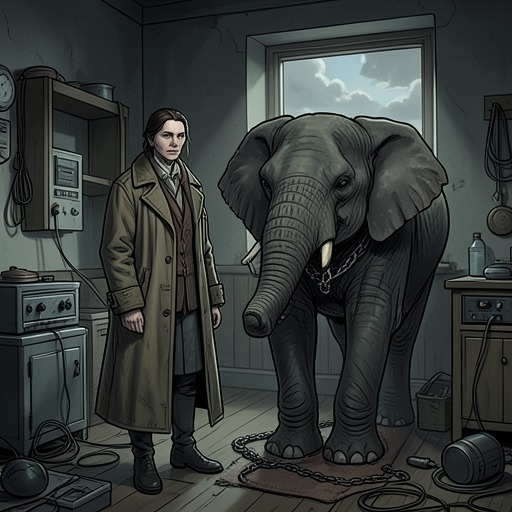
The Countess’s answer is possession. At her home there is no doorway large enough for an elephant, so she hires a dozen craftsmen, who work around the clock. Within a day, they knock down a wall and install an enormous, brightly painted, decorated door made expressly for her. The chief of police escorts the elephant there under cover of night, ushers her through the new entrance, and leaves once she has been delivered. The door is then shut and locked. A structure built to welcome the elephant into the Countess’s home also becomes the threshold that confines her there.
The Countess pays the opera-house owner enough to repair and retile the roof many times over, and the narration emphasizes that the elephant has become her property. She has also written to Madam LaVaughn at length, expressing sorrow over the tragedy and offering enthusiastic support for the magician’s prosecution. These acts show that the Countess responds to the damage and to the injured woman with money and formal sympathy. They do not, however, make the elephant a participant in the decision about where she will live. The compensation settles the financial loss to the building’s owner; the elephant’s transfer is treated as settled once she has been brought through the Countess’s new door.
Ownership and spectacle
The Countess’s claim is made emphatic: the elephant belongs to her completely. Her payment to the opera-house owner and her generous contribution to the police fund place money behind that claim, while the police escort gives the transfer official force. The relationship therefore joins private wealth to public authority. The Countess can provide a destination and the means to alter her house; the police can deliver the elephant there; neither arrangement gives the elephant a say in her own fate.
Once installed in the ballroom, the elephant attracts an audience of high-ranking guests: dukes and duchesses, princes and princesses, and counts and countesses. Her new surroundings are presented as lavish, but their luxury belongs to the people looking at her, not to her. The ballroom makes the elephant available as a wonder for visitors, and her presence becomes a source of novelty and entertainment. The Countess’s ownership is thus not only a legal or domestic condition; it determines how the elephant is presented to others and what they feel entitled to do in her presence.
The Countess also advertises public access, distributing posters and leaflets across the city. Leo Matienne reads one on his way home from the police station and recognizes that it may let Peter Augustus Duchene see the elephant. A beggar nearby turns Leo’s words of thanks into a song, and Leo gives him a coin before walking on, thinking about what might happen if the Countess grows tired of the novelty of owning an elephant—or if the elephant remembers that she is a creature of the wild. His thoughts reveal the uncertainty beneath the Countess’s control: her possession depends on continuing interest, while the elephant’s nature and longing are not made to fit the role assigned to her.
The elephant’s experience of the relationship
The narration explicitly distinguishes the citizens’ desire to see the elephant from her own feelings: the people of Baltese may long for her, but she does not long for them. Being placed in the Countess’s ballroom is a terrible turn of events for her. The chandeliers, orchestra, loud laughter, roasted meat, cigar smoke, and face powder make her surroundings feel not welcoming but almost impossible to believe. She tries to will the scene away and keeps her eyes closed, yet each time she opens them, nothing has changed. The Countess’s lavish home cannot answer the elephant’s homesickness.
The human visitors’ treatment makes the imbalance physical. As they file past, they touch her, pull at her, lean against her, spit, laugh, weep, pray, and sing. The elephant stands broken-hearted amid these competing gestures, with too many things she cannot understand. Her first questions are not about the Countess or the grandeur of the room, but about where her family is: her brothers and sisters, and her mother. The crowd sees an extraordinary possession; the elephant experiences separation and intrusion. That difference is the emotional measure of the relationship.
Meaning and limits of Countess Quintet’s care
The Countess’s actions combine provision with control. She commissions a doorway large enough for the elephant, pays a substantial sum toward repairing the opera house, expresses sorrow to Madam LaVaughn, and offers help in pursuing the magician. Those details prevent the arrangement from being described simply as neglect: the Countess acts decisively to manage the aftermath of the accident and presents herself as a generous supporter. But the evidence of the elephant’s experience sharply limits what such gestures mean for her. A purpose-built entrance does not make the destination a home; financial compensation does not restore the elephant’s freedom; and sympathy directed to an injured noblewoman does not relieve the elephant’s own distress.
Leo’s response to the Countess’s advertisement briefly imagines that the public spectacle might create an opportunity for Peter to see the elephant. Yet his further thought—that the Countess could tire of owning her, or that the elephant could act according to her wild nature—also points to the instability of a relationship founded on possession. The Countess can lock the door and command the room, but she cannot make the elephant desire the city, the visitors, or captivity. Their relationship is therefore less a bond of mutual recognition than a conflict between the Countess’s power to claim and display the elephant and the elephant’s enduring need for family, freedom, and home.