Winter of the Elephant
The Magician's ElephantWinter of the Elephant names both a season in Baltese and the temporal frame for a story in which an extraordinary arrival unsettles the city’s laws, households, and private hopes. The season is not a neutral backdrop: its drawn-out darkness and cold make confinement palpable, while the eventual passage through snowy streets gathers previously separated people into a shared journey. Against winter’s apparent stillness, the plot moves from bewilderment and possession toward release, reunion, and a changed sense of belonging.
Seasonal Frame and Weather
The winter is described as exceptionally miserable. Thick, lowering clouds obscure the sun, leaving Baltese with days that resemble one unending dusk; the cold is described as beyond belief, and darkness prevails. The emphasis on duration matters: this is not a brief storm interrupting ordinary life but an enveloping season that makes the city itself seem suspended. The repeated deepening of cold and darkness reinforces that impression. Even when worsening weather seems impossible, it becomes colder and darker still.
The narrative’s weather shifts are not perfectly smooth. At one point, the narration insists that it will not snow; later, people hurry through snowy streets, and Peter Augustus Duchene leads the group through them. That contrast marks a change in the conditions surrounding the story’s movement. The season first presses characters into rooms, dormitories, and places of confinement; by the time the group travels together, snow is underfoot and the city’s streets have become a route toward home.
The winter’s chronology also reaches backward. In late summer, before the winter in which the elephant arrives in Baltese, Bartok Whynn is working high above the city on a cathedral gargoyle when he loses his footing. During the long fall, he thinks he is going to die. His earlier accident is a distinct prehistory to the winter: it explains how a former stonecutter, once occupied with coaxing frightening figures from stone, comes to serve at the elephant’s rear with a bucket and shovel. The season therefore gathers not only events that happen during it but lives already altered before its arrival.
A City Under Strain
The elephant’s appearance gives winter a civic crisis as well as a meteorological one. The chief of police of Baltese is devoted to the letter of the law, but repeated consultation of the police handbook yields no instructions for a beast that has appeared from nowhere, destroyed an opera-house roof, and crippled a noblewoman. Unable to find a rule that fits, he reluctantly asks his subordinates what should be done. The unusual event exposes the limits of the handbook precisely because the elephant’s arrival does not fit an ordinary category.
One proposed answer is to treat the elephant as a criminal and punish her as one. Leo Matienne challenges that reasoning by separating the damage caused from the elephant’s intention: she did not choose to crash through the roof, and, as he argues, an unwilling animal cannot sensibly be held guilty for it. The dispute gives the winter’s disorder a moral dimension. The question is not only how the authorities can manage an unprecedented event, but whether the person or creature who causes harm is necessarily culpable for it.
The answer reached in practice is shaped less by a clear legal principle than by authority and property. Countess Quintet has no doorway large enough for the elephant, so she hires a dozen craftsmen, who knock down a wall and install an enormous, brightly painted, decorated door within a day. The chief escorts the elephant there under cover of night and leaves after she has been brought inside. The door is locked behind him. The countess pays the opera-house owner enough to cover the roof repairs many times over, writes to Bettine LaVaughn to express regret and offer support for prosecuting the magician, and contributes generously to the policemen’s fund. The elephant is then treated as the countess’s property, installed in her ballroom, and displayed to visiting dignitaries. In the depth of winter, a dispute about responsibility ends in confinement secured by money, a rebuilt entrance, and a locked door.
Private Rooms and Persistent Longing
The season’s public gloom is mirrored in private interiors. During Vilna Lutz’s fever, his words and behavior lose their ordinary military order; when the fever recedes, he trims his beard, rises from bed, and arranges lead soldiers on the floor to explain a battle strategy to Peter Augustus Duchene. The small, precise military exercise contrasts with the larger confusion of the city outside. Peter answers his guardian respectfully, even as the surrounding events have made the boundaries of his life uncertain.
Adele’s experience of winter is shaped by a persistent dream of the elephant. In the cold, dark dormitory of the Orphanage of the Sisters of Perpetual Light, she continues to dream of the encounter between the elephant and Sister Marie. Adele learns to repeat the elephant’s promise verbatim and says it to herself during the day, treating the words as a poem, blessing, or prayer. When Lisette asks whom she is talking to and insists that nobody intends to come for them, Adele’s repetition sets hope against the orphanage’s expectation of abandonment. The winter is therefore not only a period of physical deprivation; it is also the time in which a promise survives by being remembered and repeated.
That inward persistence has a counterpart in the elephant’s effort to remember herself. She says her own name repeatedly, trying to hold on to her identity and to the knowledge that she is known and loved elsewhere. The parallel does not erase the difference between Adele’s dream and the elephant’s captivity, but it connects two isolated figures through memory and longing. In a season defined by darkness and enclosure, remembrance keeps the possibility of another place alive.
The Crowd and the Journey Through Baltese
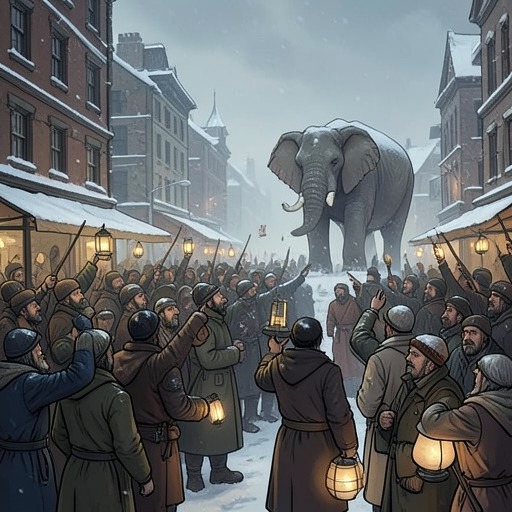
Winter also brings the inhabitants of Baltese together around the elephant. On the first Saturday of the month, a line extends from Countess Quintet’s home into the street and down the hill. It includes people of many occupations and circumstances: candle makers, washerwomen, babies, old men leaning on canes, milliners, lamplighters, street sweepers, priests, and fortunetellers. The crowd is not united by rank or a shared practical purpose. Each person arrives carrying private hopes, wishes for revenge, or desires for love, and many secretly expect the mere sight of the elephant to make those wishes come true. The public gathering turns the elephant’s confinement into a focus for the city’s otherwise separate longings.
The change from spectatorship to shared action is visible in the later journey. Hans Ickman pushes Bettine LaVaughn’s wheelchair, while Leo Matienne holds Peter’s hand; the four move quickly through snowy streets toward Countess Quintet’s home. After the elephant is taken away, Peter walks in front carrying Adele, with Leo beside him. Behind the elephant are Bettine LaVaughn in her wheelchair, pushed by Hans, followed by Bartok Whynn, Tomas, Iddo, and Sister Marie. For the first time in fifty years, Sister Marie is not at the door of the orphanage. The procession gives physical form to a change in relations: people once marked by separate troubles now travel together, and the long-standing duty that kept Sister Marie at the doorway is interrupted by her participation in the journey.
As Peter leads them through the city, familiar objects—the lamp posts, doorways, trees, gates, and bricks—seem to return the fortuneteller’s words and the hope that Adele is alive. The journey ends not in an abstract escape from winter but in bodily closeness: the elephant’s breath is warm on Peter’s cheek. After the magician has gone, Bettine LaVaughn feels a great weight leave her, laughs, and embraces Adele. Her attention turns at once to the child being cold and the need to go inside. Winter’s hardships have not vanished, but the ending replaces isolated waiting with movement, recognition, and care.
Narrative Significance
The season’s central contrast is between being shut away and finding a way toward others. The elephant is locked inside a ballroom; Adele lives in an orphanage and sustains hope through a remembered dream; Peter’s life remains shaped by separation and uncertainty. Meanwhile, the cold, dark city repeatedly gathers people at thresholds: a newly made door, the orphanage entrance, the line of visitors, and finally the streets crossed together. These settings make winter a framework for both enforced enclosure and passage.
The story also tests what the city does when customary rules fail. The police handbook cannot tell the chief how to handle the elephant, and the debate over criminality briefly recognizes the difference between an unwanted consequence and a guilty intention. Yet possession and institutional influence determine the elephant’s immediate fate. Against that outcome, the later collective journey offers a different kind of response: a group of people, including those previously defined by their duties or vulnerabilities, move together rather than leaving the elephant to the countess’s private ownership. Winter thus holds both the failure of ordinary categories and the possibility of altered relations. Its darkness does not itself promise rescue; the decisive change comes when people act on the hopes that the season has forced them to carry in isolation.