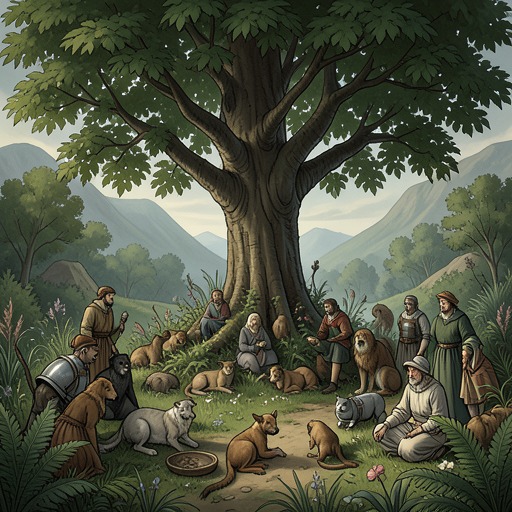
Aslan’s Charge to the Talking Beasts
The Magician's NephewAslan’s Charge to the Talking Beasts is the founding instruction that defines the animals’ place in Narnia: they are given the land and its abundance, but must cherish the Dumb Beasts and guard against losing their own speech. Its paired command to laugh and fear not makes language not merely a mark of awakening, but the basis of a community capable of both justice and joy.
The Gift and Its Conditions
Addressing the creatures after their awakening, Aslan gives them Narnia forever, including its woods, fruits, and rivers, as well as the stars and himself. The grant is generous, but it is not permission for careless dominion. The Dumb Beasts, whom Aslan has not chosen, are also placed in the Talking Beasts’ care: they must be treated gently and cherished.
The charge makes the boundary between the two groups a continuing responsibility rather than a settled privilege. Aslan warns the Talking Beasts not to return to the ways of the Dumb Beasts, because they came from them and can return to them. Their speech is therefore both a gift and a condition of their identity; the newly awakened animals answer together that they will not abandon it.
Speech, Justice, and Laughter
Aslan links speech to more than the ability to communicate. He tells the creatures that, now they are no longer dumb and witless, they need not always be grave: “For jokes as well as justice come in with speech.” The instruction gives humor a place in the moral and social life of Narnia, rather than treating solemnity as the only proper response to their new status.
The point becomes immediate when a jackdaw blurts out “No fear!” after the creatures’ collective promise. The bird’s timing leaves its words exposed in a sudden silence; embarrassed, it hides its head beneath its wing. The animals then laugh in their own distinctive way. When Aslan tells them, “Laugh and fear not, creatures,” they release their merriment, and the jackdaw regains its courage enough to perch on Strawberry’s head and wonder whether it has made the first joke. The scene enacts the charge: speech opens the way not only to solemn obligation but also to comic mistakes, shared laughter, and renewed confidence.
Meaning and Consequences
The rule of care sets a limit on the Talking Beasts’ power over the animals who remain Dumb Beasts. Their elevated status does not erase their kinship with those creatures; Aslan’s warning that they came from them makes gentleness and cherishing obligations grounded in a shared origin. The possibility of losing speech likewise gives their awakening a consequence: it is a state to preserve through how they live, not simply a permanent distinction to enjoy.
The charge also gives the new community a compact moral and social order. Narnia is theirs to inhabit, but its gifts come with duties toward other creatures and with a prohibition against abandoning the qualities that make them Talking Beasts. By placing laughter beside justice, Aslan frames the use of speech as both ethical and communal: it can guide conduct, and it can make room for delight.