Come in by the gold gates or not at all
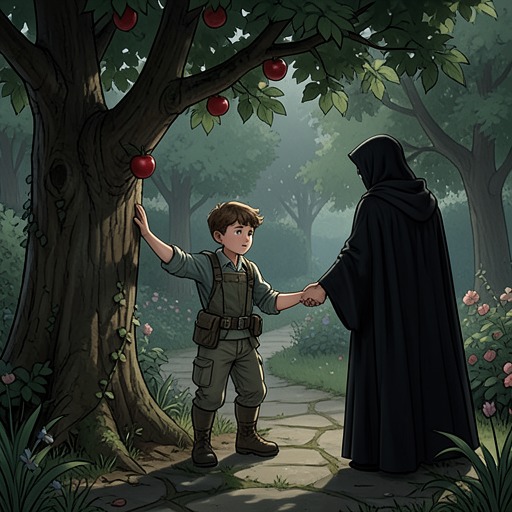
The Magician's Nephew“Come in by the gold gates or not at all” is the first command in a silver inscription on the golden gates of the garden where Digory must take an apple. The words make the route part of the moral test: the fruit is to be taken for others, not stolen for personal desire. Digory enters through the gates and carries out his errand, but the Witch’s wall-climbing and his own temptation show why the warning joins method, purpose, and consequence.
The inscription and its terms
The message is written in silver letters on the gold gates at the top of a hill enclosed by a high wall of green turf. It tells the visitor to enter by the gates, to take the fruit for others or abstain, and warns that those who steal or climb the wall will find both their heart’s desire and despair. The gates open inward without a sound when Digory lays a hand on them, allowing him to enter by the permitted way.
The lines establish more than a convenient entrance. They distinguish an authorized act from taking the fruit by force or for oneself, and attach a cost to violating that distinction. The warning’s paired promise and punishment becomes concrete when the Witch appears inside the garden after climbing over the wall.
Digory’s test in the garden
Digory understands that the apple is meant for someone else and puts it in the breast pocket of his Norfolk jacket. Looking at and smelling it brings on a terrible hunger and thirst. He begins to reason that the gate’s message might be advice rather than an order, or that he has already fulfilled its demand by taking one apple for others. The inscription’s wording thus becomes a pressure point: he is not simply unaware of the rule, but tries to reinterpret it while desire makes disobedience attractive.
A great bird, larger than an eagle, watches from a branch above him, with a saffron breast, scarlet-crested head, and purple tail. As Digory turns to leave, he sees the Witch only a few yards away, throwing away the core of an apple she has eaten. Her appearance makes the inscription’s warning immediate: she seems stronger and prouder, even triumphant, yet her face is deadly white. Digory infers that she climbed the wall and recognizes in her condition the promise of desire joined to despair.
The Witch’s temptation and the rule’s meaning
The Witch pursues Digory out of the garden and tries to make him stop and listen. She knows his errand because she overheard the children’s plans in the woods; she identifies the fruit in his pocket and says that she has tasted it. She describes it as an apple of youth and life, claims it will keep her from aging or dying, and urges Digory to eat it with her so that they can rule forever. Her offer turns the fruit’s power into a temptation to abandon the errand and claim its benefit for himself.
Digory refuses. He says he does not want to live on after everyone he knows has died and would rather live an ordinary span and die. The choice matters beyond personal restraint: Aslan later explains that the fruit works, but that anyone who takes it on their own initiative does not receive its benefit happily. Even an apple stolen and planted to protect Narnia would have made it a strong, cruel empire like Charn, rather than the kind land Aslan intends.
The rule also governs the alternative the Witch presses on Digory: taking an apple home to heal his mother. Aslan confirms that it would have healed her, but that the outcome would not have brought joy to either of them; in time, both would have wished she had died of the illness. The gate’s command therefore links rightful use not merely to who receives the fruit, but to the manner and purpose for which it is taken. Its warning gives the garden scene an ethical structure: desire can be fulfilled, yet fulfillment gained by the wrong act may carry its own misery.