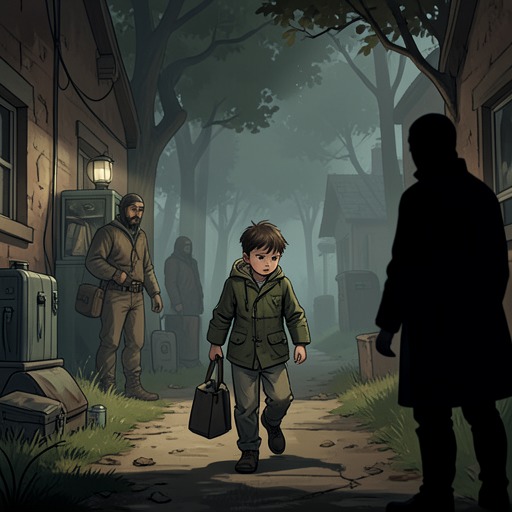
Digory's mother's illness
The Magician's NephewDigory’s mother’s illness is the intimate human loss at the center of Digory’s choices: it brings him from the country to London, makes him desperate for a cure, and gives Jadis a way to tempt him away from his task. Her condition is described as grave, but Digory’s hope that another world may hold healing fruit turns his grief into a quest—and makes his eventual refusal to steal the apple a painful moral choice rather than an easy one.
Identity and Family Circumstances
Digory explains his distress by laying out what has changed in his life: his father is away in India, and he has had to leave the country, its pony and river at the bottom of the garden, to live with an aunt and uncle in London. The reason for this upheaval is that his relatives are looking after his mother, who is ill and, as he struggles to say, going to die. The move and the illness are inseparable in his account. His sense of exile from the familiar country life is sharpened by the fear that his mother may not recover.
When Digory tells Polly about his mother, he cannot finish the word die without his face betraying the tears he is trying to hold back. Polly had not known the seriousness of the situation; she apologizes humbly. The exchange briefly turns their meeting from irritation into a moment of sympathy, and it establishes that Digory’s anger and misery arise from an immediate family crisis, not simply from disliking his new home.
Hope of a Cure
While Digory waits in the dining room and watches for Jadis, a lady brings grapes for his mother. From the open doorway he overhears his aunt say that the fruit is lovely, but that it would take fruit from the land of youth to help his mother now; nothing in this world will do much. The remark is not intended as a promise or a plan. Its force comes from what Digory already knows: other worlds exist, and he has been in one.
He begins to imagine that a real land of youth might exist somewhere among those worlds, and that its fruit might cure his mother. The hope arrives with its own resistance: he has been disappointed before and almost fights against believing that the possibility could be true. Yet he has the magic rings and thinks there must be worlds reachable through the pools in the wood. He imagines searching them all and returning with his mother well, with everything right again. At the thought, he forgets his watch for the Witch and reaches for the yellow Ring—until the sound of galloping interrupts him.
The overheard phrase thus changes the direction of Digory’s attention. A general expression about miraculous fruit becomes, for him, a concrete possibility because his recent experience has made other worlds real. The illness remains beyond the reach of ordinary remedies, while the existence of the rings gives his hope a means of action. His longing is neither a certainty that a cure exists nor a claim that he has found one; it is the fragile possibility that sends his thoughts toward a search.
Grief and Aslan’s Charge
Later, when Aslan asks whether Digory is ready, Digory briefly considers bargaining: he might offer to help if Aslan promises help for his mother. He recognizes that Aslan is not someone to bargain with, answers yes, and then feels the hopes he had cherished dying away. Only then does he ask directly whether Aslan can give him something to cure her.
As Digory looks up, he sees tears in Aslan’s eyes. The moment does not remove the grief or offer an immediate cure. Instead, Aslan acknowledges it, calling Digory his son and saying that, in this newly made land, the two of them alone yet know grief. Aslan’s sorrow meets Digory’s on terms that Digory did not expect: for an instant, the Lion seems even sorrier about Digory’s mother than Digory himself is.
Aslan then sets the illness beside a larger danger. The Witch whom Digory has brought into Narnia will return, though not at once. To protect Narnia for many years, Aslan intends to plant a tree the Witch will not dare approach, and he asks Digory to obtain the seed. Digory does not yet know how he can do so, but Aslan’s kiss gives him fresh strength and courage. The charge does not replace Digory’s love for his mother; it places that love within a decision that also concerns the safety of Narnia.
The Apple and the Temptation
Jadis turns Digory’s private hope into an argument for disobedience. She reminds him that the apple in his pocket could heal his mother and describes a rapid recovery: color returning to her face, pain ending, sleep without drugs, and, in time, a happy home again. She makes the proposed act sound immediate and almost complete in its benefits, while emphasizing that Digory and she are alone and Aslan far away.
The appeal strikes at the exact wound behind Digory’s quest. Jadis presents taking the apple not as selfishness but as a son’s duty, asking what his mother and father would think if he could end her pain and save his father’s heart from breaking but chose not to. Digory gasps and puts a hand to his head; he understands that the choice is terrible. The apple’s promise is therefore powerful precisely because it is bound to a real illness and a real family separation, not an abstract desire for gain.
The episode also distinguishes hope from certainty. Earlier, Digory imagines that fruit in another world might save his mother; Jadis now claims that one bite of the apple would do so. Her detailed assurance is part of her temptation, not a demonstrated recovery. What is established is the moral pressure she exerts: Digory must weigh the possibility of relief for his mother against the task Aslan has entrusted to him and the protection of Narnia. His mother’s illness makes that conflict personal, costly, and impossible to dismiss.