Dwarfs
The Magician's NephewThe Dwarfs are one of the peoples of Narnia, appearing first among the beings who emerge as Aslan’s song calls the new world into life. Their place in the founding story is active and civic: they help free the growing landscape, enter the circle charged with Narnia’s safety, and use their smithcraft to make the crowns placed on Frank and Helen. Their work carries creation from a song and a living landscape toward the beginnings of an ordered kingdom.
Emergence in the New World
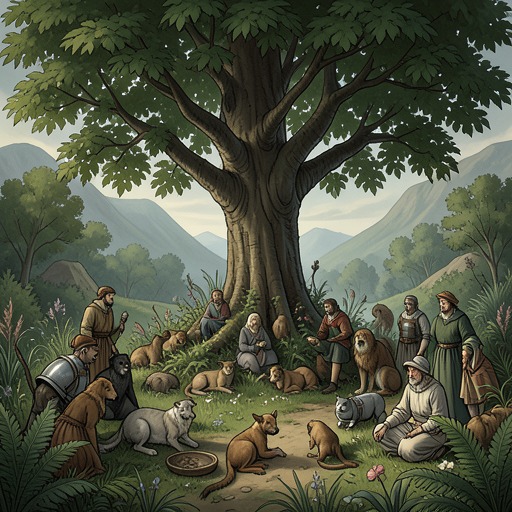
Before the Dwarfs appear, the new land changes in stages. Aslan’s first song brings stars and sun; a gentler song spreads grass over the valley, and trees spring up from the soil. Then the ground itself swells and breaks open, releasing animals into the living country. The Dwarfs belong to the further awakening that follows: when Aslan calls Narnia to wake, think, love, and speak, figures emerge from the trees alongside the woodland gods and goddesses, Fauns, and Satyrs. Their arrival is part of a gathering of distinct speaking peoples, not merely another detail in the landscape.
The Dwarfs also appear among the animals and other beings who answer Aslan’s awakening with an affirmation of life and speech. Creation here is not only the provision of land and creatures; it establishes a community capable of hearing a summons and responding. The Dwarfs are included in that community from its beginning, before their later craft gives them a particular part in the new kingdom’s public life.
Council and Responsibility
Once Narnia has awakened, Aslan turns from creation to its protection. Though the world is not yet five hours old, he says that evil has already entered it and calls selected representatives to his council. The chief Dwarf is among those summoned, together with the River-god, Oak, the He-Owl, both Ravens, and the Bull-Elephant. The selection places the Dwarfs within Narnia’s earliest deliberations about danger and governance, rather than leaving them as distant observers of Aslan’s rule.
That council follows the discovery that the Witch has entered the new world. Later, Aslan explains that she has fled north and will grow stronger in dark Magic; the Tree of Protection is to be guarded because its life-giving power keeps her at a distance. The Dwarfs’ presence at the council connects their standing in Narnia to a task larger than individual workmanship: the protection of a world whose beauty and safety are already under threat. The evidence identifies the chief Dwarf as a councillor, without detailing what he says or what decisions he makes there.
Craft and the Coronation
At the coronation, the Dwarfs’ practical skill becomes visible. Aslan orders some of the gathered people to undo a cage made by lacing the branches of four trees together. Two Elephants use their trunks, while several Dwarfs work with their small axes, and the enclosure is soon opened. Inside are two young metallic trees and Uncle Andrew, hunched in muddy clothes. The scene shows the Dwarfs working alongside other peoples to solve a physical problem; their tools and labor help reveal what the makeshift wooden cage has concealed.
The Dwarfs’ most consequential work follows when Aslan asks them to show their smithcraft and make crowns for Frank and Helen. They strip leaves and branches from the golden tree that has grown where sovereigns fell from Uncle Andrew’s pocket. Its gold is real and soft, and the sudden workshop is assembled from brushwood, an anvil, hammers, tongs, and bellows. The speed and delight of the smiths are emphasized as the fire blazes, the bellows roar, and the hammers ring. Their craft converts a material trace of Uncle Andrew’s arrival into regalia for Narnia’s rulers.
The crowns are not made as cumbersome ornaments. Under the Dwarfs’ fingers they become light, delicate circlets, shaped to be worn comfortably and to make their wearers look better. The King’s crown is set with rubies; the Queen’s with emeralds. After the crowns are cooled in the river, Aslan places them on Frank and Helen and declares them King and Queen of Narnia, charging them to rule justly, mercifully, and bravely. The Dwarfs do not confer sovereignty themselves, but their workmanship gives its public ceremony a tangible form.
Place in Narnia’s Founding
Across these scenes, the Dwarfs are associated with both collective responsibility and skilled labor. The chief Dwarf is called into the first council; other Dwarfs help open the branch cage and make the crowns. Those actions are distinct but joined by a common effect: the people of Narnia help protect, reveal, and establish their world rather than simply receiving it complete. Aslan creates and assigns the kingdom, while its inhabitants take part in the practical work of bringing its institutions into being.
The crown-making also gives the founding a material continuity. The gold tree grows from objects dropped by Uncle Andrew, whose dealings in magic and whose arrival in Narnia belong to the world’s already troubling history. The Dwarfs’ craft does not erase that origin; it redirects its material into the coronation of rulers charged to govern with justice and mercy. In this way their work helps turn a chance remnant of the intrusion into an emblem of Narnia’s new political order.