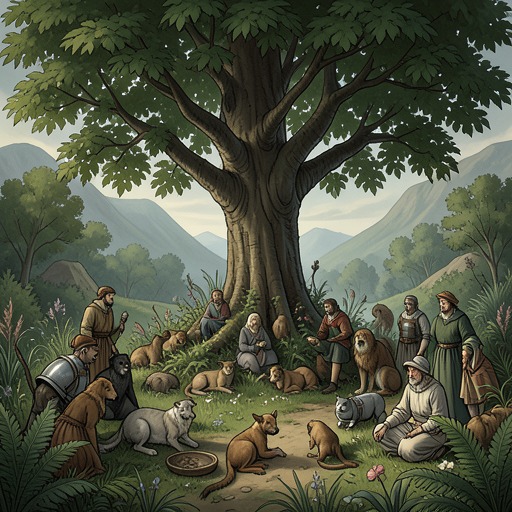
Frank and Helen Are Crowned King and Queen of Narnia
The Magician's NephewFrank and Helen Are Crowned King and Queen of Narnia marks the founding of Narnia’s monarchy and defines its authority through duties to its people. Aslan appoints them the first king and queen, but the honor is inseparable from a charge: they must do justice, protect their subjects, and rule the Talking Beasts as free people rather than slaves. The coronation therefore offers a direct contrast to Jadis’s claim that a ruler stands beyond ordinary moral limits.
Appointment and the Duties of Rule
Aslan announces the appointment after Digory has thrown the apple that is to become the seed of Narnia’s protective tree. He fixes his eyes on Frank and Helen and declares them the first King and Queen of Narnia. The Cabby is astonished; Helen blushes. The ceremony begins not with an inherited claim or a display of force, but with Aslan’s recognition and an explanation of what their office requires.
Aslan tells them they will rule and name the creatures, do justice among them, and protect them when enemies arise. He makes the danger plain: an evil Witch is in the new world. He then tests Frank’s fitness in practical as well as moral terms, asking whether he can use a spade and plough and raise food from the earth. Frank says he can do some such work, having been brought up to it. Aslan also asks whether he can rule kindly and fairly, remembering that the Talking Beasts are not slaves like the Dumb Beasts of the world Frank came from, but free subjects. Frank answers that he will try to do right by them, and Aslan asks whether he will teach the same principles to his children and grandchildren. Kingship is presented as labor, justice, protection, and a responsibility meant to continue across generations.
The Coronation and Its Emblems
The children notice Frank and Helen in their coronation clothes: rich robes trail behind them, held by four Dwarfs for the king and four River-Nymphs for the queen. Helen’s hair is loose, but their changed appearance comes from more than dress. The narrator observes that the sharpness, cunning, and quarrelsomeness Frank had acquired as a London cabby seem washed away, while the courage and kindness he had always possessed are easier to see. The change may have come from the air of the young world, from speaking with Aslan, or from both. Fledge recognizes the difference too, remarking to Polly that his former master has become a real master.
After Aslan puts Uncle Andrew to sleep and has him carried aside, he orders the Dwarfs to make crowns. They strip leaves and branches from the Golden Tree, whose growth sprang from the sovereigns that had fallen from Uncle Andrew’s pocket when he was turned upside down. Using an anvil, hammers, tongs, and bellows, the Dwarfs melt the gold and shape two light, delicate circlets, not the heavy, ugly kind of crown the narrator contrasts with them. Rubies adorn the king’s crown and emeralds the queen’s. The crowns are cooled in the river before Aslan places them on the kneeling pair.
The Coronation Charge and Public Recognition
Aslan’s crowning words make the office both public and conditional in its moral substance. He names Frank and Helen king and queen, and calls them the father and mother of many kings who will rule in Narnia, the Isles, and Archenland. He charges them to be just, merciful, and brave, and gives them his blessing. The assembly answers with a collective celebration: creatures cheer, bay, neigh, trumpet, or clap their wings. Frank and Helen stand solemn and a little shy, their shyness adding to rather than diminishing their dignity.
The scene gives Narnian sovereignty a standard sharply different from Jadis’s. In Charn, Jadis had defended the destruction of her people by insisting that they existed to do her will; she claimed that what would be wrong for common people was permissible for a great queen, whose supposedly lonely destiny freed her from rules. Aslan’s charge reverses that logic. A ruler’s authority is measured by justice toward subjects who are free, by protection against enemies, and by mercy and courage—not by exemption from obligation. The coronation makes the difference visible in both its words and its actions: Frank and Helen are raised to rule only after being asked what they can do for the people entrusted to them.
Change and Founding Significance
The ceremony does not merely give Frank and Helen new titles. Their changed faces disclose qualities that had been present beneath the Cabby’s acquired sharpness and quarrelsomeness, while their response to Aslan’s questions shows them accepting a continuing duty rather than claiming privilege. Their future children and grandchildren are included in that obligation from the outset, extending the founding act beyond the first pair of monarchs.
The coronation also places the new monarchy within Narnia’s larger beginning. The protective tree’s seed has just been thrown into soft earth, and the golden wood used for the crowns connects the royal ceremony to the world’s newly growing life. Frank and Helen’s rule is thus established beside a protection intended for Narnia itself: they are charged to defend its people from enemies, while the tree will guard the land against the Witch. The gathered creatures’ acclamation closes the appointment as a shared public event, joining Aslan’s commission to the community whose freedom and welfare are to define the work of its first sovereigns.