Mountain Garden
The Magician's NephewThe Mountain Garden is a walled, private orchard whose silver apples place life, obedience, and desire in direct encounter. Digory enters under a charge to take fruit for others, and the apple he carries from the garden becomes both the seed of Narnia’s protection and a test of whether power will be received as a gift or taken for private gain.
Setting and Appearance
The garden crowns a hill enclosed by a high wall of green turf. Trees rise within it, their branches reaching over the wall; their leaves show green, blue, and silver when stirred by the wind. The gates are high, gold, shut, and face east. Their evident privacy makes Digory’s companions understand that they cannot accompany him: this is not a place to enter casually, but one he has been sent to reach on particular business.
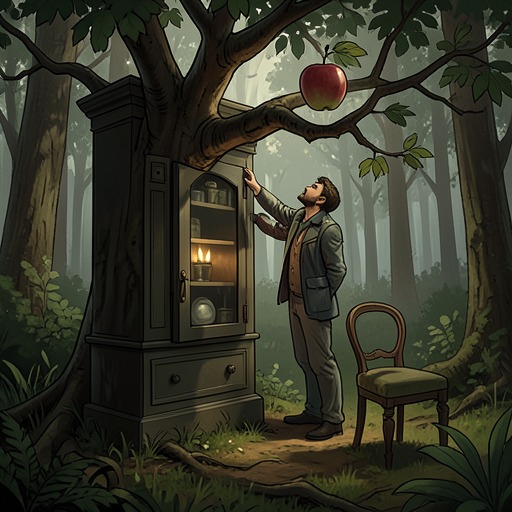
Inside, quiet and solemnity replace the open hillside. A fountain rises near the centre, making only the faintest sound, and the air carries a lovely smell. The silver-apple tree stands at the garden’s very centre. Its fruit shines with a light of its own, illuminating shadowed places beyond the reach of sunlight. Digory knows at once which tree he has come for, picks an apple, and places it in the breast pocket of his Norfolk jacket; before putting it away, he looks at it and smells it.
The Gate and the Errand
The gold gates bear a verse that makes entry conditional on both manner and purpose: “Come in by the gold gates or not at all,Take of my fruit for others or forbear.For those who steal or those who climb my wallShall find their heart's desire and find despair.” The inscription defines the garden’s ethics in practical terms: the fruit is not simply forbidden, but must be approached openly and taken for others. The gates swing inward without a sound when Digory touches them, giving him entry without trespass.
Digory reads the instruction as a limit on his own appetite: he understands that he must not eat the fruit himself and intends to carry it back untasted to Aslan. That purpose matters because the apple is not merely a prize in a quest. The garden’s rule distinguishes service from possession, and the promise of desire joined to despair anticipates what happens when fruit is taken in the wrong way.
Fruit, Temptation, and Consequences
Jadis confronts Digory after he leaves the garden. She says she knows his errand because she overheard the counsels in the wood, identifies the apple in his pocket, and urges him to eat it. Having tasted one herself, she calls it the apple of youth and life and claims it will prevent age and death. She offers Digory an imagined future of endless life and rule with her, in this world or his own.
The temptation sharpens when Jadis invokes Digory’s ill mother. Digory refuses the offer of immortality, saying he would rather live an ordinary span and die than outlast everyone he knows. Aslan later explains that taking an apple home would indeed have healed his mother, but not to the joy of either of them: the eventual result would have made them wish she had died of the illness. The fruit’s power is real, but its effect cannot be separated from the way it is chosen and used.
When Aslan sees the Tree of Protection grow from the apple’s seed, he tells the Narnians that the Witch has fled north and will not come down into Narnia while the tree flourishes. She dares not approach within a hundred miles, because the tree’s fragrance—joy, life, and health to the Narnians—is death, horror, and despair to her. Jadis has already eaten fruit of the same kind, and Aslan explains that fruit taken at the wrong time and in the wrong way becomes hateful to its eater. It nevertheless grants what it is meant to grant: Jadis gains unwearying strength and endless days, but her evil heart turns that long life into prolonged misery.
Meaning and Legacy
Aslan’s account makes the garden’s rule more exact than a simple distinction between lawful and unlawful picking. The fruit always works, but it does not work happily for those who take it by their own will. Had a Narnian stolen an apple and planted it to protect the country, the protection would have come at the price of making Narnia another strong, cruel empire like Charn, rather than the kind land Aslan intends. The garden’s fruit can sustain life, but the motive and manner of its use shape the world that life produces.
The garden’s apple therefore joins Digory’s private family hope to Narnia’s public future. He resists Jadis’s offer to redirect the fruit toward his mother, carries it back for Aslan’s purpose, and sees its seed become a living defence against the Witch. Its power is neither a simple reward nor a neutral resource: the same kind of fruit can bring protection, healing, or unending misery, depending on how it is received and what desire governs its use.