Narnia
The Magician's NephewNarnia is a young world made habitable and alive through Aslan’s song, then given a community, a monarchy, and a future shaped by both protection and danger. Its creation stands in stark contrast to the lifeless ruins of Charn: where that older city lies beneath a dying sun and beside a dried river, Narnia begins as a vivid valley and grows into a land of grass, trees, rivers, and speaking creatures. The world’s founding is not merely a change of scenery; it establishes the moral and ecological order that governs its first history and reaches, through a tree and its wood, into later journeys between worlds.
A world born from contrast
Narnia first appears at sunrise as a valley of earth, rock, and water, bounded by mountains to the south and lower hills to the north. A broad, swift river winds eastward towards the sun. The land is brightly coloured and full of promise, but at this first sight it has no tree, bush, or blade of grass. Its emptiness differs sharply from the vast, dead city of Charn: there, temples, towers, palaces, pyramids, and bridges cast long shadows beneath an enormous red sun, while the river has dwindled to a ditch of grey dust. The contrast makes Narnia’s beginning feel like an answer to a world in which life and water have been exhausted.
Aslan’s creation unfolds through music rather than construction. While he sings and walks across the empty valley, grass spreads outward from him like a pool, climbs the hills like a wave, and reaches the lower mountain slopes. Heather darkens the heights; rougher green growth appears in the valley. Small, spiky shoots grow with astonishing speed until Digory recognizes them as trees. The scene presents landscape as an active process: vegetation does not merely decorate Narnia but emerges in response to the Lion’s song, transforming bare ground into a place where life can take root.
The change continues when the earth itself begins to swell and break open. Humps rise across the grassy land, from molehills to cottage-sized mounds, and animals emerge from the loosened soil. Moles and dogs come out much as they might in England; frogs near the river plunge into it, while deer, birds, insects, and larger animals enter the newly green world. An elephant rises from the largest mound. The varied arrivals give Narnia a population and a living environment at once: river, grass, trees, flowers, and creatures develop together, and the creation scene shifts from quiet song into a chorus of animal sounds.
The awakening of speaking creatures
Aslan moves among the animals and touches selected pairs, including two beavers and two leopards, as well as a stag and a deer. The creatures change in scale and bearing: smaller animals grow larger, the biggest grow somewhat smaller, and many sit upright with their heads tilted as if trying to understand. Aslan breathes upon them, and the moment culminates in his call for Narnia to awake and for its inhabitants to think, speak, and live as talking beasts. The change is both physical and moral: the animals are not simply present in the land but are addressed as beings capable of thought and speech.
The former London cab-horse is among those awakened. Once he can speak, the horse—whom Polly calls Strawberry—says that the creatures do not yet know very much. The Cabby recognizes the familiar animal’s sense, while the horse’s new voice marks the difference between his old life as a tired, exploited cab-horse and his place among Narnia’s speaking inhabitants. Their meeting also links the land’s new community to the human visitors who witnessed its beginning.
Aslan gives the speaking creatures Narnia’s woods, fruits, rivers, stars, and the land itself, while also warning them to treat the Dumb Beasts gently. They are not to return to the ways from which they were raised, because they could lose their speech and become like those other animals. The charge therefore joins possession to responsibility: the creatures receive the world, but their distinction depends on how they live within it. When a jackdaw’s overconfident reply leaves it embarrassed in the sudden silence, the others laugh; Aslan welcomes laughter alongside justice. Speech gives Narnia’s inhabitants room for play as well as seriousness, making communal life more than obedience to a solemn founding decree.
The first reign and the protection of the land
Narnia’s first kingship arises alongside the world’s early institutions. After Digory returns with the apple Aslan required, Aslan tells him to throw it onto the soft riverbank, where it will become the seed of a tree that protects the country. Digory obeys, and the small thump of the apple landing in the mud is followed by the announcement of a coronation. The sequence ties the making of a shield for Narnia to the establishment of its rulers: the land’s future safety and its political order are presented as parts of the same beginning.
Frank and Helen, formerly associated with London, are crowned King and Queen of Narnia. The ceremony gives their new status a visible form: Dwarfs make light, delicately shaped crowns from the gold that has grown into a tree where coins fell, setting Frank’s crown with rubies and Helen’s with emeralds. Aslan crowns them and charges them to be just, merciful, and brave, naming them the parents of future kings in Narnia, the Isles, and Archenland. Their transformation is apparent in their faces: the sharpness, cunning, and quarrelsomeness Frank had acquired as a London cabby have given way to a clearer expression of courage and kindness. The coronation therefore establishes not only a pair of rulers but a standard of conduct for the dynasty they are to found.
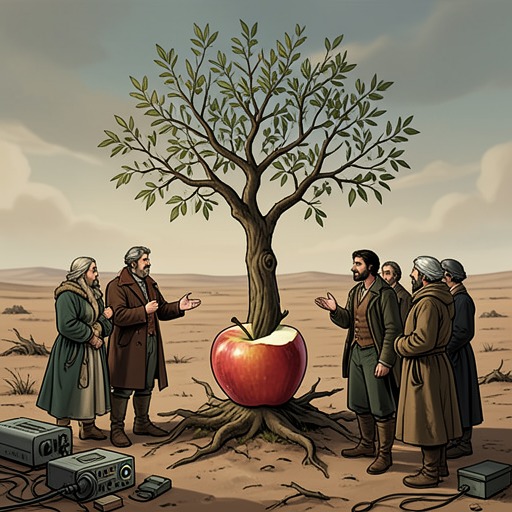
While the crowd is occupied with the coronation, the apple seed has grown into a tree bearing silver fruit. Its spreading branches seem to give light rather than shade, and the scent draws the gathered creatures’ attention as powerfully as its appearance. Aslan declares that the tree is Narnia’s shield and commands the Narnians to make guarding it their first care. The Witch has fled north and will grow stronger in dark Magic, but she will not dare approach the tree within a hundred miles: to the Narnians its scent means joy, life, and health, while to her it means death, horror, and despair. The tree thus converts a single journey’s prize into a durable boundary against a returning enemy.
That protection is not a promise that danger has been destroyed. Digory reveals that the Witch has already eaten an apple of the same kind, and Aslan’s earlier warning makes clear that she will return to Narnia in time. The tree gives the country a long, bright morning before that threat arrives, not permanent immunity from it. Narnia’s founding therefore contains both hope and foreknowledge: its first peace is real, but it must be guarded, and the danger beyond its border remains part of the land’s future.
A long peace and a lasting connection
The protection of the tree holds. For many hundred years, Narnia’s Beasts live in peace and joy, and neither the Witch nor another enemy troubles the pleasant land. Frank and Helen live there with their children; their second son becomes King of Archenland, extending the founding family’s history beyond Narnia itself. The later marriages of their sons and daughters to nymphs, wood-gods, and river-gods further root the royal line in the world’s supernatural and natural communities.
One remnant of the Witch’s arrival becomes part of Narnia’s enduring landscape. The lamp-post she planted without understanding what it would become continues to shine day and night in the forest, and the place is eventually called Lantern Waste. Centuries later, a child from the human world finds its light still burning on a snowy night. The lamp-post’s survival gives Narnia a landmark that carries its history forward: an object introduced by an intruder becomes a point of orientation for a later visitor and links the founding adventure to another passage into the country.
The connection runs through another tree as well. The apple that Digory plants in his own garden grows into a fine tree, but it does not produce fruit with the power to revive a dying woman; its apples are exceptionally beautiful and wholesome, but not fully magical. The tree nevertheless retains, in its sap, a relation to the silver apple tree in Narnia. Its mysterious movement in still air is associated with the Narnian tree swaying in strong winds, suggesting a shared life across the distance between the worlds.
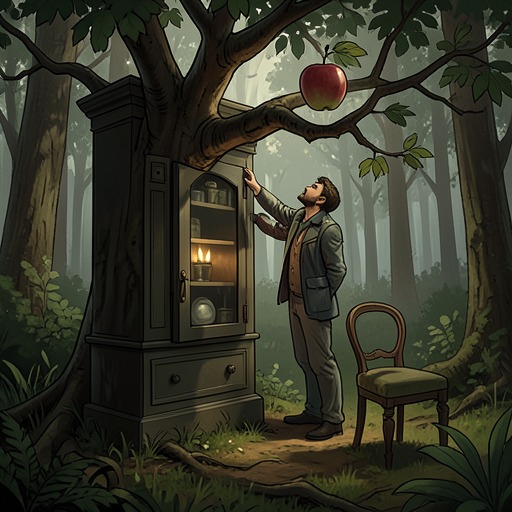
When Digory is middle-aged and the old Ketterley house belongs to him, a storm blows the English tree down. He cannot bear to have its timber turned into firewood, so he has some of it made into a wardrobe for his country house. Its wood still carries magic, although Digory does not discover the wardrobe’s properties himself. Someone else does, and that discovery begins the later comings and goings between Narnia and the human world. The world created by song thus reaches beyond its own borders: its first history leaves behind living traces in trees, a lamp-post, and finally a piece of furniture that opens the way to further adventures.