Rules for How the Magic Rings Work
The Magician's NephewThe magic rings are not simple outward and homeward devices, as Uncle Andrew supposes, but a material means of moving between worlds whose actual direction of travel depends on what each ring is made of. Yellow draws its wearer into the Wood between the Worlds; green takes someone from the Wood into a world. The rings can also carry people through contact with another traveler, a rule that turns their power into both a route and a risk.
Design and Intended Use
Uncle Andrew explains that a ring works only when it touches skin. Gloves let him pick up a ring without triggering it, and a ring carried in a pocket is inert unless the wearer accidentally touches it. He gives Digory two green rings for the return journey, placing them in his right-hand pocket, and tells him to remember the side by the mnemonic that green and right begin with the same letter. Digory is to wear a yellow ring to leave his own world; Uncle Andrew believes that a green ring will bring him home from elsewhere.
The arrangement is practical but founded on guesswork. Andrew has not tested the rings’ behavior in the other place, and he presents his expectation as a theory rather than knowledge. The distinction matters: the rings do work, but not according to his account of their colors and directions.
Material and Direction of Travel
The Wood between the Worlds supplies the material of both kinds of ring. Their effects follow whether that material is drawn toward its source or away from it: the stuff in a yellow ring wants to return to the Wood, so touching one draws a traveler into the in-between place. The stuff in a green ring is trying to leave its own place, so it carries a traveler from the Wood into a world. Thus the colors do not mean outward and homeward in the ordinary sense Andrew assigns them; the Wood itself is the reference point that makes their operation intelligible.
This corrected account also clarifies the limits of the rings. They do not, by themselves, select a particular destination. The children must choose a pool in the Wood as the point through which to enter a world, and the pools look alike. Before trying another, they cut a strip of turf beside the pool that leads to their own world, recognizing that without a landmark they might have little chance of finding it again. The rings enable passage; navigating the Wood remains a separate problem.
Contact and Shared Passage
The rings’ power can extend beyond the person wearing or touching one. When Jadis follows Polly and Digory out of a pool, still gripping Polly’s hair, the children discover that touching someone who is in contact with a ring is enough to be carried between worlds. The narrator compares the effect to a magnet lifting one pin together with another pin touching it. Andrew had not described this rule because he did not know it.
That shared effect makes the rings less controllable than Andrew’s instructions suggest. A traveler need not choose to use a ring directly to be brought along: physical contact can join another person to the journey. Jadis’s arrival in the Wood with the children demonstrates the consequence in action, converting a private means of travel into a route by which an unwanted companion can cross worlds.
Knowledge, Consequences, and Legacy
The rings expose the gap between possessing a magical object and understanding it. Andrew has built his instructions around an imagined distinction between outward and homeward rings, while the Wood’s material logic explains their real operation. His confidence does not amount to mastery; the children, through trial and observation, learn more about how the devices work than their maker has established for himself.
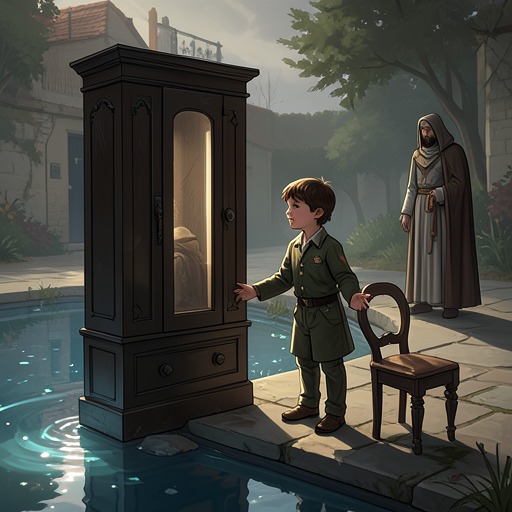
The rings belong to a wider chain of material consequences in the story. Andrew’s account begins with a box entrusted to him by Mrs. Lefay, whom he had promised to burn it unopened after her death; he broke that promise because he sensed a secret in the box. Later, the iron bar Jadis tore from a London lamp-post takes root in Narnia and grows into another lamp-post. Much later, an apple tree grown from the Narnian apple planted by Digory retains magic in its wood even after growing in the English garden; when a storm blows it down, Digory has part of it made into a wardrobe. These objects differ in function, but together they show magic persisting through material and changing use: a device for crossing worlds belongs to the same narrative of objects whose origins and transformations connect distant places and times.