Tree of Protection
The Magician's NephewThe Tree of Protection is the silver-apple tree that springs up in Narnia from the seed Digory planted. It turns his earlier act of planting into a lasting defense: Aslan names it the Narnians’ shield and explains that Jadis cannot approach it, while its distant counterpart in Digory’s world eventually supplies the wood for the Wardrobe.
Appearance and Arrival
The tree reveals itself just after the coronation of King Frank and Queen Helen. It has grown silently while the crowd’s attention was on the ceremony, rising as swiftly as a flag pulled up a staff. Its spreading branches seem to cast light rather than shade, and silver apples shine beneath the leaves like stars. The tree’s fragrance is so powerful that it arrests the crowd’s attention even more completely than its appearance.
The sudden growth completes the consequence of Digory’s planting: a seed brought from the Mountain Garden has taken root in Narnia and become a living presence there. The tree is not merely a new landmark. Its bright branches and silver fruit make visible the protection that Aslan says Digory has helped establish for the country.
Protection of Narnia
Aslan makes guarding the tree the Narnians’ first care and calls it their shield. Jadis has fled far north, where she will grow stronger in dark Magic, but while the tree flourishes she will never come down into Narnia. Its scent is joy, life, and health to the Narnians; to Jadis it is death, horror, and despair. She dares not come within a hundred miles of it.
The tree’s protection depends on its continued life, so Aslan’s instruction gives the new kingdom a lasting duty rather than a one-time victory. Its presence does not destroy Jadis or end the threat she represents; it keeps her at a distance while the tree flourishes. The tree thus stands between the Witch’s growing power and the newly founded Narnia.
The Apple and Its Cost
When Digory admits that Jadis has already eaten an apple of the same kind, Aslan explains why the Witch recoils from the tree’s remaining fruit. The fruit is good, but taking and eating it at the wrong time and in the wrong way makes its goodness hateful to the eater. Jadis has nevertheless gained what she wanted: unwearied strength and endless days. Her immortality remains, but with an evil heart it means a lengthened misery, not happiness.
This distinction separates the tree’s protective gift from the Witch’s use of its fruit. The apple’s power works according to its nature, but the outcome depends on how it is taken: the same fruit that can serve life becomes a source of revulsion to Jadis, even as it grants her enduring strength. The tree consequently protects Narnia not by undoing the Witch’s choice, but by making its fruit’s opposing effects part of the conflict between them.
The Tree in Digory’s World
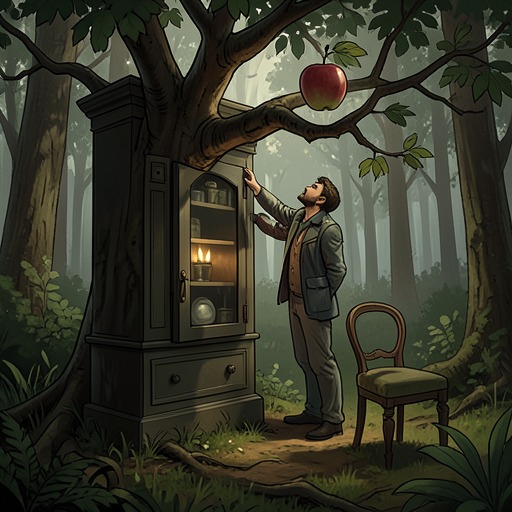
The apple Digory planted also grows into a fine tree in the soil of his own world. Far from Aslan’s voice and Narnia’s young air, it does not bear apples capable of reviving a dying woman as the original fruit revived Digory’s mother. Its apples are exceptionally beautiful and good for health, but not fully magical. Even so, the tree retains a connection to its Narnian counterpart: its sap, as the narrator describes it, never forgets the other tree to which it belongs. It sometimes moves mysteriously without any wind in England, in correspondence with strong southwesterly winds rocking the Narnian tree.
That connection persists in the timber. When Digory is middle-aged, a storm across southern England blows the tree down. Unable to bear having it simply chopped up for firewood, he has some of the wood made into a Wardrobe for his country house. Digory does not discover the Wardrobe’s magic, but someone else does; the object becomes the beginning of the later comings and goings between Narnia and the human world.
Material Legacy
The tree’s story links protection, healing, and passage between worlds through a single chain of living matter: an apple is planted, a tree grows in Narnia, and its counterpart takes root in England. The English tree is diminished in magical power, yet it is neither an ordinary copy nor an inert souvenir; its lingering kinship with the Narnian tree survives both in its strange movements and in its wood. The Wardrobe’s later role therefore begins with Digory’s planting, even though he cannot foresee what the timber will make possible.