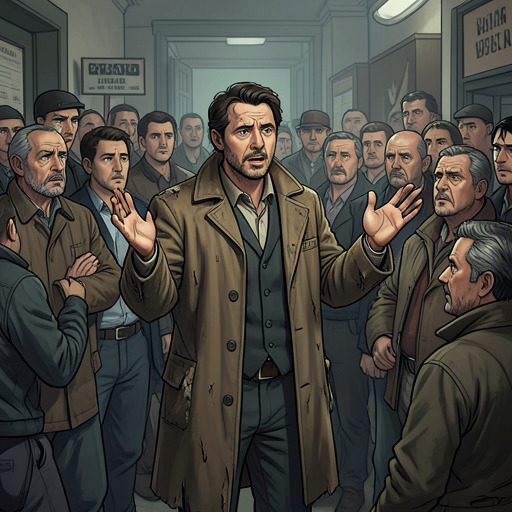
“I am a voice. Mankind is a mouth, of which I am the cry.”
The Man Who LaughsGwynplaine’s declaration that he is a voice for humanity transforms the meaning of his fixed smile. First made a public spectacle by an appearance that provokes laughter, he later presents that same face before the peers of England as evidence of suffering imposed on people by those in power. The expression links his personal history to a collective indictment: he speaks not as an observer of deprivation but as someone who has lived through it.
From spectacle to speech
Gwynplaine’s face draws laughter even though his thoughts and feelings do not. The expression is involuntary and enduring; emotion cannot undo it, and sorrow only makes the visible appearance more misleading. As a mountebank, he becomes famous for the response he provokes. Spectators laugh, then turn away; the reaction that brings him attention also leaves him an object of discomfort and avoidance. His outward expression therefore speaks falsely about his inner life, making the distinction between appearance and experience central to the later declaration.
The account leaves open whether nature alone could have produced his unusual features, and suggests that his face may have been deliberately shaped in infancy. It also emphasizes the contrast between that altered face and his otherwise well-made, agile figure. The expression does not arise from a chosen performance: the face appears to laugh independently of the person who bears it. That separation gives the phrase its force. Gwynplaine’s voice can explain what the face, read superficially, conceals.
The declaration in Parliament
Addressing the peers of England, Gwynplaine casts himself as the cry issuing from humanity rather than as a private speaker pleading only for his own advancement. He presents his knowledge as experiential: he has known poverty, hunger, winter, contempt, and illness. His sudden passage from mountebank to peer sharpens the contrast between his former life and the assembly in which he now speaks. Although he has acquired a noble title, he insists that his deeper authority comes from having lived among the poor.
The speech makes that authority explicit: “As for me, I am but a voice. Mankind is a mouth, of which I am the cry.” The metaphor distributes speech across a larger body of people. Gwynplaine is the voice, but the suffering belongs to the many whose scattered pleas, he says, have overwhelmed him. His address turns the chamber into a hearing in which the people, though politically subject, are represented as the true sovereign and the peers as answerable to them.
The face as political sign
When a peer asks what the monster is doing there, Gwynplaine answers by refusing the category of exception. He claims to represent the people rather than to stand apart from them, and recasts the laughter attached to his appearance as a sign of pain and enforced silence. The statement “I laugh, and that means I weep!” condenses the conflict between what observers see and what the face cannot express. The audience’s laughter continues, although it becomes more subdued after his reply; the gap between the speech and its reception remains part of the scene.
Gwynplaine extends the comparison from himself to society: as his face bears a mask of joy, he argues, the people suffer beneath an appearance that conceals their condition. He describes his own visible difference as the result of a king’s action and makes it an emblem of wider political deformation. The image does not erase his individual experience; it makes that experience the ground from which he challenges his listeners to recognize suffering that their position keeps out of view.
Significance of the expression
The expression’s movement is from imposed spectacle to chosen testimony. The fixed smile once seems to speak for Gwynplaine, provoking a response before he can explain himself. In Parliament he gives it another meaning, naming the pain and silencing it has come to signify and using his speech to contest the peers’ account of who represents the nation. His claim to be humanity’s cry is therefore both metaphorical and political: it makes his personal voice answerable to the suffering of others, while exposing how readily a powerful audience can mistake an outward sign for an inner truth.