“I laugh, and that means I weep!”
The Man Who Laughs“I laugh, and that means I weep!” is the defining paradox of Gwynplaine’s appearance and public life: a fixed expression makes him an object of amusement while concealing the grief and seriousness of the person beneath it. The phrase becomes more than a description of his face when he uses it in the House of Lords to connect his own experience to the suffering of the poor.
The smile and the person
Gwynplaine’s face has been altered into an apparently laughing expression, while the rest of his body remains well made and agile. The contrast makes his appearance seem less like a natural variation than the result of deliberate human intervention. The grimace is permanent: his feelings cannot simply change what others see.
The separation between face and inward feeling governs the expression’s meaning. Gwynplaine does not laugh merely because his face appears to laugh. Astonishment, suffering, anger, and pity all intensify the same outward effect; even tears would be read as laughter. The phrase names the painful gap between his involuntary expression and his actual emotional state.
A public spectacle
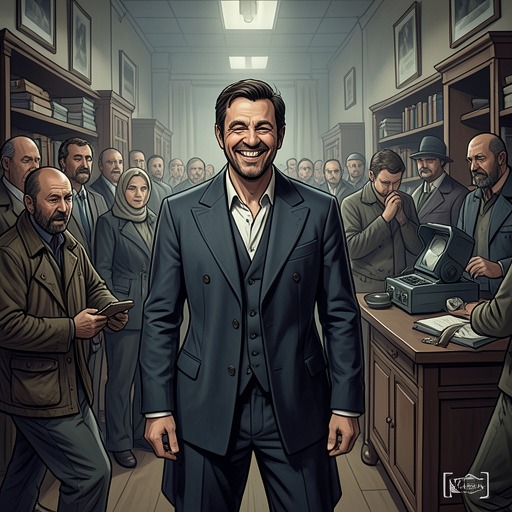
As a mountebank, Gwynplaine displays himself before crowds, and the effect is immediate: spectators laugh, including people who otherwise have reason to be solemn. His success rests on an involuntary response elicited by his face, not on a happiness he shares with his audience. Once their laughter has passed, many turn away, and women in particular recoil from the sight. The response shifts from amusement to avoidance, leaving Gwynplaine both publicly conspicuous and socially rejected.
The same contradiction shapes his performance in Chaos Vanquished. When a beam of light reveals his face, the audience erupts in laughter and applause, and the performance achieves great success among the crowds who can attend for a penny. Yet the crowd’s delight does not mean that it understands Gwynplaine’s inner life. His face supplies the spectacle; his own thoughts remain separate from the laughter it provokes.
The phrase in the House of Lords
During his speech to the House of Lords, Gwynplaine appeals to the peers to recognize the suffering beneath the social order. His emotion breaks into an uncontrollable fit of laughter, and the assembly’s mood turns from apprehension to delight. The peers laugh, clap, and insult him. His body thus repeats the public performance even while his words condemn the conditions that have made him an object of ridicule.
Gwynplaine answers by naming the laugh as both punishment and testimony. He says that a king placed it on his face and presents it as an expression of enforced silence, rage, and despair. The phrase “I laugh, and that means I weep!” makes the contradiction explicit: the visible sign that entertains the powerful also carries the suffering they refuse to hear.
Personal paradox and political symbol
Gwynplaine extends the meaning of his expression beyond himself. He describes his face as a symbol of a people whose suffering is masked by an appearance that permits those in power to overlook it. The peers’ laughter at his speech enacts the very division he identifies: his words appeal to their conscience, while his face diverts their attention into amusement.
The expression therefore joins bodily circumstance to political argument without making them identical. Gwynplaine’s experience gives him a concrete basis for speaking about suffering, but the parliamentary scene also shows how easily an audience can turn that suffering back into entertainment. His laughter is not proof of joy; it is the involuntary surface against which the novel sets grief, protest, and the demand to be understood.