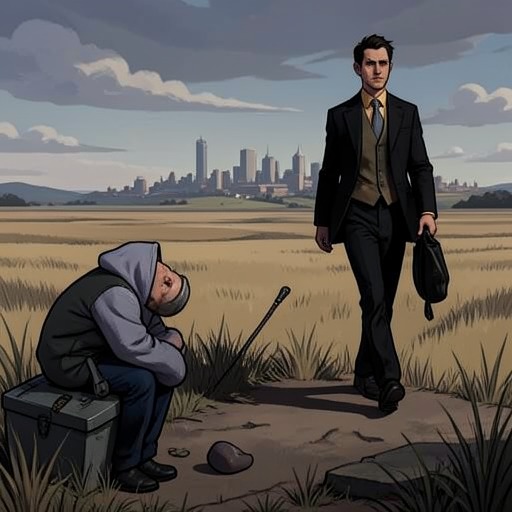
“Society is the stepmother, Nature is the mother.”
The Man Who Laughs“Society is the stepmother, Nature is the mother.” is Gwynplaine’s compressed judgment on the two forces he sees shaping human life: society, which imposes deprivation and despair, and nature, which offers inward sustenance and the possibility of renewal. The expression gathers his personal history into a broader contrast between outward injury and inward life.
The Judgment Behind the Expression
Gwynplaine reaches this formulation while taking stock of the world and of himself. His inventory is built from opposed pairs: marriage without love, family without brotherly affection, riches without conscience, beauty without modesty, justice without equity, order without equilibrium, authority without right, and power without intelligence. The repeated gap between an institution’s name and its missing substance makes the sentence a verdict on social arrangements, not simply a complaint about private misfortune. He then sets society against nature as two different destinations. Society belongs to the bodily world and tends toward the grave; nature belongs to the soul and tends toward expanded wings, morning light, ascent, and new life. The expression gives this contrast the form of a family relation: society is a stepmother, while nature is the mother. One is associated with deprivation and an ending; the other with succour and the prospect of transformation.
A Personal History Made into a Social Argument
The distinction has particular force in Gwynplaine’s life. His face bears a permanent expression of laughter that he did not choose and cannot remove. To spectators, the expression provokes laughter; after laughing, they turn away, and women especially shrink from looking at him. His body is otherwise well made and agile, but his face determines how strangers respond to him. The difference between his outward appearance and inward feeling makes the social act of looking a source of exclusion. His public speech makes the personal and political meanings of that imposed appearance explicit. Gwynplaine argues that the laugh on his face was placed there by a king and calls it both the people’s torment and a sign of their condition under powerful masters. He presents his own altered appearance as a figure for a society in which justice, truth, reason, and intelligence have also been deformed, while suffering is concealed beneath a smiling surface. The later expression about society and nature extends this argument: social life can disguise harm as order, whereas nature remains the source of inward life that such appearances cannot wholly extinguish.
Nature as Succour and Renewal
The expression does not end in condemnation. As Gwynplaine reviews what society and nature have done to him, he recognizes that although society has taken his features, the soul has, in his view, given them back. He connects that restoration to Dea, the blind girl who cannot see his ugliness and sees his beauty instead. Her perception offers a counter to the public gaze that reduces him to an appearance and turns his face into a spectacle. Nature’s restorative power here is not a cure of Gwynplaine’s face or a reversal of what happened to him. It lies in the inward recognition that survives the world’s judgments and in the bond through which he experiences himself as beautiful. The phrase’s image of nature as mother thus gives the reflection a source of consolation while preserving its severity toward society.
The Expression’s Wider Significance
The sentence condenses the contrast between social identity and inward worth that runs through Gwynplaine’s story. The face that makes crowds laugh is at once his public mark and a mask for suffering; society reads the visible sign, while Dea’s blindness allows a different kind of recognition. In this contrast, the expression links social exclusion to the novel’s concern with the limits of outward judgment. Its movement from the grave toward morning light also makes the line more than a contrast between cruelty and kindness. It sets two possible accounts of human life against one another: one bounded by social power, bodily circumstance, and death; the other oriented toward spiritual renewal. Gwynplaine’s judgment remains rooted in loss, but its final emphasis falls on the possibility that what society has obscured may still be recognized and restored in the life of the soul.