“The farming of the unhappy by the happy”
The Man Who Laughs“The farming of the unhappy by the happy” is the novel’s name for a social order in which the secure and powerful derive comfort, amusement, or material advantage from those made vulnerable. The idea moves from the literal buying and reshaping of children to the crowded spectacle of poverty witnessed by Gwynplaine, and finally into his appeal to the House of Lords. Across these settings, deprivation is not presented as an isolated misfortune: it is made useful to other people, while those who endure it are left with little power to alter the conditions that produce it.
The trade in human vulnerability
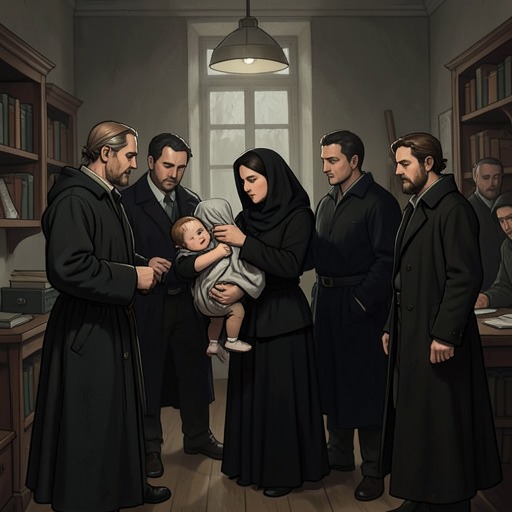
The narrator introduces the phrase as the title of a chapter in a terrible book: an account of people who are happy at the expense of the unhappy. The surrounding discussion gives that indictment a literal form. In the seventeenth century, children could be treated as material for a trade, acquired young, altered for the amusement of others, and sold again. The narrator describes a society that valued the child as a human toy, with deliberate bodily difference made into a source of entertainment. The point is not simply that cruelty existed, but that it could be organized as a skilled practice and joined to a market.
The Comprachicos are presented as participants in this commerce. They bought children, worked on what the narrator calls the raw material, and resold them. Their suppliers ranged from a desperately poor father seeking to rid himself of a family member to a master disposing of someone from a supply of enslaved people. The variety matters: the trade drew on unequal power in private households as well as on the larger acceptance of human beings as property. The child’s vulnerability made the transaction possible; the buyer’s desire supplied its purpose.
The narrator sets this commerce within a broader history of selling people. As an example, the account recalls the Elector of Hesse selling his subjects to the King of England for military service in America. It also describes James II giving the wives and daughters of men executed after the Monmouth rising to his queen, who then sold them to William Penn. Penn’s need for women to populate a settlement is offered as the explanation for his purchase, not as an absolution: the language of practical necessity exposes how easily a person could be recast as an instrument for someone else’s plans. The claim that the young were sold at a higher price sharpens the picture of a market measuring human lives by their usefulness to buyers.
Wealth beside deprivation
An early display places the idea of satisfaction for those who have nothing beside a description of extraordinary aristocratic wealth. Henry Auverquerque, Earl of Grantham, is said to receive a hundred thousand a year and to possess Grantham Terrace, a marble palace whose labyrinth of passages includes corridors distinguished by color and costly stone. The detailed inventory makes luxury visible as an elaborate, almost excessive arrangement of surfaces and spaces. Set against the declaration about those with nothing, it presents abundance and deprivation not as unrelated conditions but as opposing sides of the social picture.
Later, Gwynplaine encounters that opposition nightly through the Green Box. Its low prices draw poor and vulnerable spectators, who come for a pennyworth of forgetfulness. From the platform he reads in their faces the effects of want, shame, anger, and despair. Some children have not eaten; workers have strength but lack tools and employment; an old woman bears the signs of starvation, while a young woman’s prospects have been narrowed by exploitation. He sees people pushed toward crime by ignorance and indigence, and goodness worn down into resentment by social pressure. These are distinct lives, but the recurring misery around them gives the crowd the appearance of one continuing condition.
Gwynplaine also recognizes the pressure of a class system in which those above move freely while those below are trodden upon. Beside his private happiness with Dea, he sees families ruined, workers without work, the costs of war, and people driven toward what the narrator calls a return to animalism by the weight of others’ prosperity. The contrast does not make his happiness false; it makes him increasingly unable to regard it as sufficient. His position as an entertainer offers the poor a temporary escape, but it does not remove the circumstances that send them to him.
Amusement, relief, and its limits
The poor spectators’ laughter has a double place in this account. Their attendance supports the Green Box, while the performance gives them a brief respite from their circumstances. Gwynplaine understands that he can make people laugh and thereby help them forget. The relief is real, and the novel recognizes him as a benefactor for providing it; yet forgetting is not the same as changing the conditions from which the audience seeks escape. The same social order that leaves people hungry or idle can also make their momentary amusement a commodity.
This tension gives the concept a particular relation to performance. Gwynplaine is both a performer whose act attracts a paying audience and an observer who sees the distress behind that audience’s response. He feels compassion for the people around him and imagines helping the poor on a much larger scale. At first, the wish seems beyond his reach: he regards himself as an insignificant person who can do nothing. The narrative turns that judgment around by recognizing the limited but genuine value of the laughter he can offer. His work eases suffering for a time, even as his vision of the crowd reveals how little such relief can accomplish on its own.
From the crowd to political responsibility
When Gwynplaine later addresses the Lords, the miseries he has observed become the substance of a political accusation. He cites miners in Newcastle-upon-Tyne who chew coal to stave off hunger, declining towns, closed manufactories, and fishers who eat grass when their catch fails. He also points to poor families without beds, forced idleness, and the burdens imposed by taxation. The examples extend his earlier view of individual faces into a wider indictment: want is distributed across places and occupations, while decisions made by the powerful help determine who bears its cost.
His argument is that the poor are made poorer to increase the riches of the rich, and that laws and taxes cannot be separated from the suffering they produce. He asks the Lords to look below them and to recognize that the division between oppressor and oppressed is a difference of position within a faulty social structure. His plea for pity is therefore also a warning about shared consequence: a society cannot treat the distress of its lower ranks as a private misfortune safely contained below the lives of the powerful. The image of a vessel in danger makes the same point—the wreck of some threatens all.
The Lords’ laughter intensifies the contrast between Gwynplaine’s appeal and the response it receives. His words carry the burden of the misery he has witnessed, while his comic appearance pulls the assembly toward amusement. That collision makes the concept more than an account of economic exploitation: it exposes how suffering can be converted into entertainment even when the sufferer is trying to speak about it. The novel’s movement from the child traded for amusement, through the poor audience seeking forgetfulness, to the ignored plea in the Lords shows how the unhappy may be used, watched, or laughed at without being heard. The phrase binds those scenes together as an indictment of a society that enjoys its advantages while leaving the people who sustain its comfort to bear the consequences.