Barkilphedro—Gwynplaine
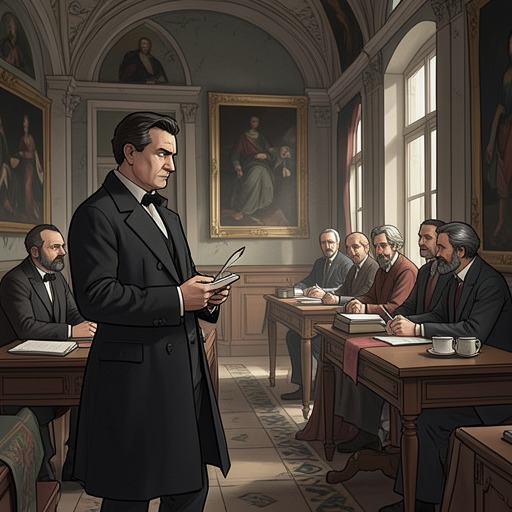
The Man Who LaughsBarkilphedro—Gwynplaine is a relationship formed at the moment Gwynplaine’s hidden identity becomes a public legal fact. As an Admiralty officer, Barkilphedro manages the procedures that establish Gwynplaine as Lord Fermain Clancharlie; as a court aspirant, he intends to turn that service into personal influence over the new peer. His intervention changes Gwynplaine’s status, but the prospect of service conceals a design for dependence: Barkilphedro hopes to become the adviser and protector of a lord who will owe him everything.
The Face and the Recognition
Gwynplaine’s altered face is essential to the circumstances in which the two men meet, but not evidence that Barkilphedro caused it. The face produces laughter in those who see him, while Gwynplaine himself does not share that laughter; his thoughts and feelings remain distinct from the expression fixed upon him. His public identity has consequently been shaped by a visible sign that others mistake for his inward state. Barkilphedro enters the story of that sign later, as the official who handles the document that reveals Gwynplaine’s birthright.
The decisive encounter follows the opening of Hardquanonne’s flask and the confrontation between Hardquanonne and Gwynplaine. Barkilphedro explains that the flask was found on the beach and brought to him in the course of his Admiralty duties. He opened it in the presence of two sworn jurors of the Jetsam Office; they deciphered and attested its contents, and joined him in signing the affidavit. He then reported the matter to Queen Anne. By the queen’s order, the required legal procedures were carried out, culminating in the confrontation that confirms Gwynplaine’s identity.
Barkilphedro presents the consequences in a startling list: Gwynplaine is entitled to an income of £40,000 a year, recognized as a peer, and destined to enter public life as a legislator and judge; he is also due to marry a duchess, the daughter of a king. The information overwhelms Gwynplaine, who faints. The exchange marks a sharp imbalance between them: Barkilphedro can explain the machinery of the transformation, while Gwynplaine is still struggling to comprehend that it has happened to him.
Administrative Assistance and Concealed Design
The restoration itself is described as legally straightforward because Gwynplaine is the legitimate heir in the direct line. Unlike disputed claims requiring the House of Lords to resolve a question of descent, this case presents no comparable uncertainty. The queen, assisted by the Lord Chancellor, can recognize and admit the new peer. Barkilphedro nevertheless manages the affair, keeping the secret from Josiana and Lord David Dirry-Moir until the necessary formalities are complete.
That secrecy has consequences beyond Gwynplaine’s recognition. Josiana does not see the change approaching, while Lord David Dirry-Moir is sent to sea and remains unaware that he is about to lose his peerage. Queen Anne even substitutes his name for a proposed vice-admiral, giving him a naval advancement as he faces the loss of rank. These arrangements show Barkilphedro acting within a larger court process: he controls the timing and concealment of the news, but the formal recognition belongs to the queen and the legal authorities.
His competence does not make his service selfless. Barkilphedro regards the upheaval as vengeance against Josiana, but the reversal also gives him a new opportunity. Lord David Dirry-Moir owes him nothing, whereas Gwynplaine, in Barkilphedro’s calculation, will owe him everything. He anticipates moving from dependent courtier to protector of a peer, shaping Gwynplaine’s first impressions and becoming a consequential presence in his household and affairs. His hoped-for authority rests on the very assistance that has restored Gwynplaine’s standing.
The Patronage He Expects
Barkilphedro imagines Gwynplaine’s unusual appearance as an advantage at court. He expects that it will please Queen Anne even as it repels Josiana, and believes that service to the newly recognized peer could advance his own position. His ambition reaches beyond simple material reward: he has a vague longing to become a bishop. The relation is therefore prospective as well as administrative. Barkilphedro has already helped produce a decisive change in Gwynplaine’s life, but he also plans to make that change the foundation of his own rise.
When Gwynplaine encounters him in his new clothes, Barkilphedro identifies himself again as an Admiralty clerk and claims that he opened Hardquanonne’s flask and drew Gwynplaine’s destiny from it. He compares his role to a fisherman releasing a giant from a bottle. The image makes the disparity between the men sound almost magical, yet the transformation depends on evidence, affidavits, royal direction, and legal procedure. Barkilphedro’s flourish casts him as the agent of Gwynplaine’s release, though the procedure, rather than Barkilphedro alone, confers the title and inheritance.
Gwynplaine’s Answer to Power
The limits of Barkilphedro’s anticipated influence become clearer in the House of Lords, where Gwynplaine’s restored rank brings him before the aristocracy. When a peer calls him a monster, Gwynplaine answers by identifying himself with the people and treating his face as the mark of a wider political wrong. He says that a king placed the laugh upon his face and that it expresses enforced silence, anger, and suffering. His speech presents his appearance not as a courtly novelty to be used for advancement, but as evidence against the power that made him what he is.
That public protest does not directly recount Barkilphedro’s private ambitions, nor does it establish that Barkilphedro caused Gwynplaine’s condition. It does, however, expose the difference between the role each man assigns to the transformation. Barkilphedro sees Gwynplaine’s new status as a possible instrument of patronage and advancement; Gwynplaine turns the attention fixed on his face toward the suffering of the people. The relationship thus binds a practical benefactor to a would-be dependent, while the beneficiary’s own political purpose resists being reduced to the courtier’s design.