British peerage privileges and rules of etiquette
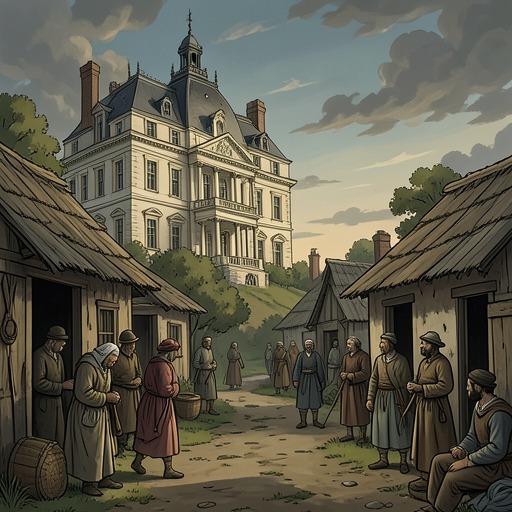
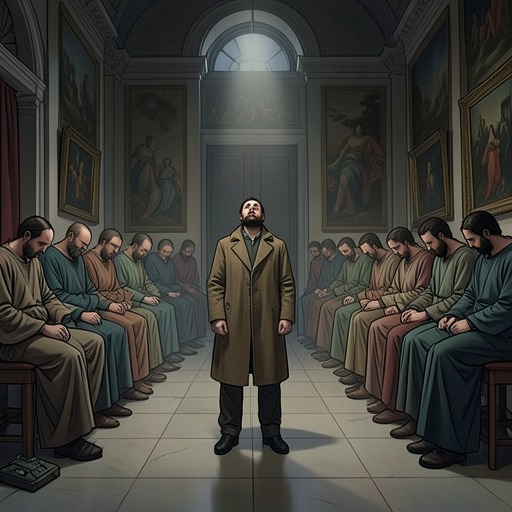
The Man Who LaughsBritish peerage privileges and rules of etiquette are presented as a system in which inherited rank governs not only ceremony but access to law, political authority, and protection from punishment. The catalogue’s decisive implication is that a peer’s title can function as a shield and a jurisdiction of its own, while people outside the order remain exposed to procedures and penalties from which peers are exempt.
Rank, Title, and Inherited Status
The account begins from distinctions among peerage ranks and between peers and people who merely bear lordly titles by courtesy. Dukes, marquises, earls, viscounts, and barons receive different forms of address, while the dignity of being a peer is treated as more substantial than the courtesy title itself. The hierarchy is made visible in the language used for each rank: the forms of address convey status before any particular action or office is considered.
A barony is described not simply as a title but as a tenure held from the king by full barony. Its stated extent is thirteen knights’ fees and one third, each fee valued at twenty pounds sterling, amounting altogether to four hundred marks. The head of a barony is a castle passed by inheritance. If there is no son, the inheritance may descend to daughters, with the eldest daughter taking precedence and provision made for her sisters. Rank is thus tied to land, hereditary succession, and a legally defined relationship to the Crown.
The rules extend status through a peer’s family. Every daughter of a peer is called a Lady, in contrast to other English girls, who are styled Mistress. The eldest sons of peers precede knights of the garter, while younger sons do not; the eldest son of a viscount follows all barons but precedes all baronets. These distinctions make family position a public and finely graded matter. A peer’s social identity is inherited and displayed not only by the peer but by the forms of address and precedence assigned to relatives.
Parliament and Public Ceremony
The House of Lords is described as both a legislative chamber and a court of justice. Its relationship with the Commons is staged through sharply unequal forms of access and deference. When summoned to the bar of the Lords, the Commons appear bareheaded while peers remain covered. Members of the Commons present bills through a delegation of forty, bowing three times; the Lords send bills down through a clerk. If the two Houses disagree, they meet in the Painted Chamber, where peers sit covered and the Commons stand bareheaded. Procedure turns political difference into a visible bodily hierarchy.
The same principle governs movement through public space. Peers travel to Parliament in coaches in file, and some go to Westminster in open four-wheeled chariots. Coaches and chariots bearing coats of arms and coronets are reserved to peers as part of their dignity. A peer is also expected to appear with a substantial train of household gentlemen rather than walk the street followed by only two footmen. These rules do not merely distinguish personal taste: they make rank legible through transport, heraldry, attendants, posture, and the right to occupy space differently.
The peerage’s judicial standing is likewise expressed in ceremonial and occupational comparisons. Barons rank with bishops, and all judges rank below peers. Ermine is reserved for the king and peers, whereas judges wear a patchwork fur garment and serjeants a lambskin tippet. A peer is said never to take an oath to Crown or law, because the peer’s word is treated as sufficient. The formula locates a peer’s credibility in personal honor, while placing ordinary legal forms beneath that privileged status.
Immunity and Material Privilege
The catalogue presents legal protection as one of the defining benefits of peerage. It states that a peer who kills without premeditation is not prosecuted, and that peers’ persons are inviolable. A peer may be detained only in the Tower of London, and a writ of supplicavit cannot be granted against one. Peers cannot be put to the rack, even for high treason, or branded on the hand. The claim that a peer is legally a clerk even if unable to read makes the privilege especially stark: legal status is attributed by rank, not by demonstrated learning.
The financial and civic exemptions are similarly specific. A peer may be fined only by peers, ordinarily for no more than five pounds, with a duke’s maximum set at ten. Peers are exempt from presenting themselves before the county sheriff and from assessment for the militia. They may retain six foreign-born servants, while other Englishmen may retain only four; they may also take wine free of customs duties, with an earl entitled to eight tuns. The privileges reach from criminal process and taxation to household size and consumption.
Political and local powers accompany these protections. A peer may raise a regiment and give it to the king, as the account says the Dukes of Athol, Hamilton, and Northumberland did. A peer may hold only of another peer, and in a civil case may demand an adjournment if the jury contains no knight. Peers appoint their own chaplains, with the number rising by rank: three for a baron, four for a viscount, five for an earl or marquis, and six for a duke. A peer summoned by the king may kill one or two deer in a royal park, and a peer’s castle may contain a baron’s court of justice. The privileges therefore combine exemption from public obligations with powers to command, judge, appoint, and exercise customary rights.
Ceremonial distinctions continue inside the household and at court. A duke may have a canopy or cloth of state wherever the king is absent; a viscount may have one in his own house. A baron has a cover of assay held beneath his cup while drinking, and a baroness may have her train carried by a man in the presence of a viscountess. The account sets such minute distinctions beside severe legal immunities, showing how the same hierarchy regulates both matters of life and death and the arrangement of a drinking ceremony.
Royal Power, Local Law, and Unequal Exposure
The book’s wider account of English law complicates any impression of a single, uniform system. It describes silent arrests as a customary practice that persisted despite the Habeas Corpus Act, particularly in politically delicate cases. Such captures were presented as reserved questions and as an expression of raison d’état: the detained person was taken without explanation while the relevant matter remained obscured. The discussion invokes Norman and German legal customs and historical examples, while also distinguishing disputed historical claims from events the narrator treats as more certain.
Local authority is divided among jurisdictions and offices. The Tower of London is described as outside ordinary county jurisdiction, governed by its own constable, church, court, and administration. County sheriffs receive royal commissions, with stated exceptions for Westmoreland and for London and Middlesex; sheriffs also oversee the escort and protection of judges on circuit. Their officers apprehend and examine accused people and hold them for trial. Against this layered setting, the peer’s immunity from ordinary detention and the special restriction that a peer can be confined only in the Tower acquire institutional significance: the same legal landscape contains overlapping jurisdictions, but rank determines who can claim their protections.
The contrast becomes personal in the history of Gwynplaine. The disclosure of his identity establishes him as the only legitimate son and heir of Lord Linnæus Clancharlie, while stating that he was sold by order of King James II after his father’s death and deprived of his place through the king’s actions. His birthright makes him a potential beneficiary of the hereditary order, but as a child he was treated not as an heir protected by it but as someone the monarch could remove from the succession. The episode exposes the distance between the ideal of inviolable peerage and the vulnerability of a person whose title and identity have been suppressed.
Legal procedure later makes that identity legible. In the confrontation concerning Hardquanonne, the sheriff identifies the bottle bearing his name, recounts his recognition of it and his refusal to answer, and states that the fourth day is the legally designated day for confrontation. Gwynplaine is brought before him, and Hardquanonne recognizes the victim whose identity has been at issue. The scene shows law working through material evidence, compelled procedure, and official declaration; it also contrasts the protections assigned to peers with the harsh process imposed on a prisoner outside that privileged class.
The System’s Political Meaning
The catalogue’s accumulation of privileges turns etiquette into a map of political power. Covered heads, bows, heraldic vehicles, precedence, clothing, courts, exemptions, and immunity are not disconnected curiosities: together they establish that peers occupy a category distinct from the public they govern. The account’s progression from forms of address to legal protection makes ceremony appear as the visible surface of a deeper division in rights and accountability.
That division is sharpened by the claim that a peer is nearly a king and the king nearly a god, followed by the observation that people in England address God as lord. The language compresses social hierarchy, royal authority, and religious reverence into a single upward scale. Read alongside Gwynplaine’s interrupted inheritance and the account of silent arrests, the peerage rules reveal a political order in which legal standing depends heavily on identity and rank. Their literary force lies in the disparity between the elaborate safeguards surrounding aristocratic status and the exposure of those whom power can exclude from it.