Caskets
The Man Who LaughsThe Caskets are a reef defined by the tension between engineered warning and natural peril. Their lighthouse offers a meticulously regulated signal above rocks and submarine caves, yet it cannot guarantee safety: during a violent storm, the Matutina is driven toward the reef and escapes only after a collision unexpectedly turns the vessel away.
The reef and its lighthouse
The Caskets Lighthouse is described as a triple white tower with three light-rooms. Its clockwork makes the chambers revolve with such precision that a watcher at sea can take ten steps while the lights shine and twenty-five during their eclipse. The apparatus centers on an octagonal drum with eight broad lenses arranged in a row and two series of dioptric rings above and below. Glass a millimetre thick protects the mechanism from wind and waves, though sea-eagles sometimes break it by dashing against the lanterns.
The tower and the machinery it houses share the same exact, mathematical character. Its construction is presented as plain, bare, and precise, in sharp contrast to the untamed water and the reefs below. That contrast does not make the light a promise of rescue. For the people aboard the Matutina, its appearance first raises hope and then makes their helplessness more acute: they can see the warning and the danger, but cannot command either.
The Matutina driven toward the rocks
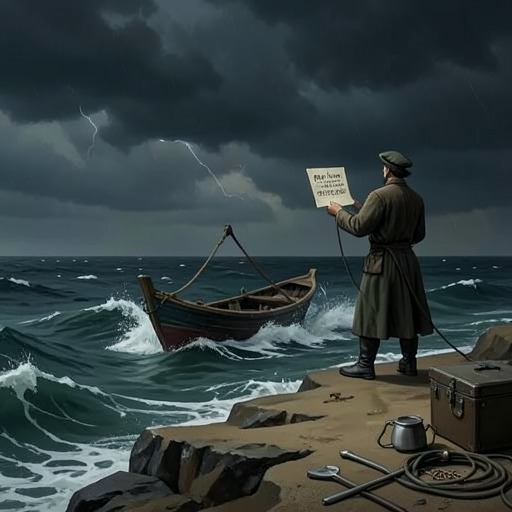
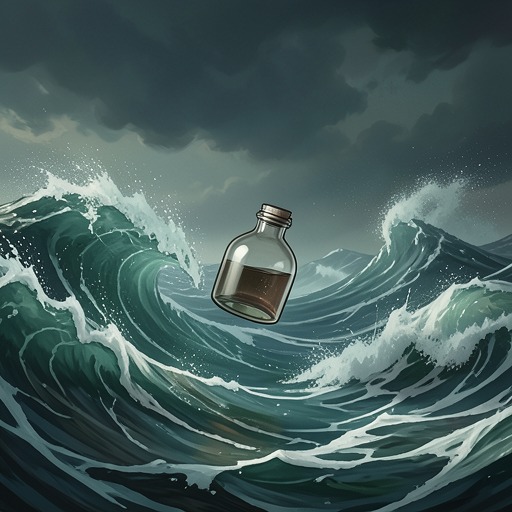
A nor’wester pushes the hooker toward the Caskets, and the crew can find no way to evade them. As the vessel drifts into shallow water, the lead would have shown only three or four fathoms. The shipwrecked people hear waves being sucked into caves beneath the steep rock, while the harbor beneath the lighthouse appears as a narrow cut between granite plates. It is reputed to be filled with the remains of men and ships, and its cavern-like entrance offers little comfort as a refuge.
The storm makes the reef increasingly visible without making it easier to avoid. Rain and hail disturb the mist; fire burns behind an iron grating, casting a ghastly purple light across the weather. Against that illumination, the breakers resolve into jagged peaks and ridges. The great northern rock, Biblet Rock, finally looms so close that it blocks the lighthouse from view, leaving the people aboard with the rock in front of them and the red light behind it. The scene turns the beacon’s earlier reassurance into an image of imminent collision.
The crew’s response reflects the emergency. The Irishwoman tells her beads, while the Basque chief takes charge in place of the skipper, who had served as pilot. As the ship nears the cliff, the chief calls for someone willing to take a rope to the rock and asks who can swim. These details register both the danger and the dwindling room for action: the Matutina is being carried toward the reef, and any attempt to use the rock as part of a maneuver carries obvious risk.
Collision and escape
The Matutina strikes beneath a cloud of foam that conceals the impact. When the spray falls back, six men are tossing about on deck, but the ship is afloat alongside the rock and clear of it. The beam has stood against the rock and turned the vessel; the force of the sea then carries the Matutina away so quickly that, within seconds, the Caskets are behind it.
The escape depends on an improvised lever, not a repeatable maneuver. The beam has done the work of an oar and taken the place of a rudder, but the collision wrenches it from the men’s hands and loses it in the waves. Loosening another beam would risk dislocating the hull. The same impact that threatened to destroy the ship has therefore altered its course, while leaving the crew without the means to use that device again.
Narrative significance
The Caskets scene moves from apparent warning to helpless approach, then to an escape produced by a collision. The lighthouse is an emblem of calculation: its rotations are timed, its lenses arranged, and its structure mathematically designed. The reef and storm, by contrast, resist human mastery. The beacon can reveal the danger but cannot prevent the Matutina from being driven toward it.
Once the ship has escaped, the reef appears on the horizon as a harmless encumbrance, and the lighthouse pales, fades, and disappears. That reversal does not make the danger unreal; it marks how completely the immediate peril has changed. The Caskets remain fixed, but their power over the scene ends when the Matutina clears them. Their looming presence, briefly overwhelming the light itself, gives way to distance and vanishing visibility.