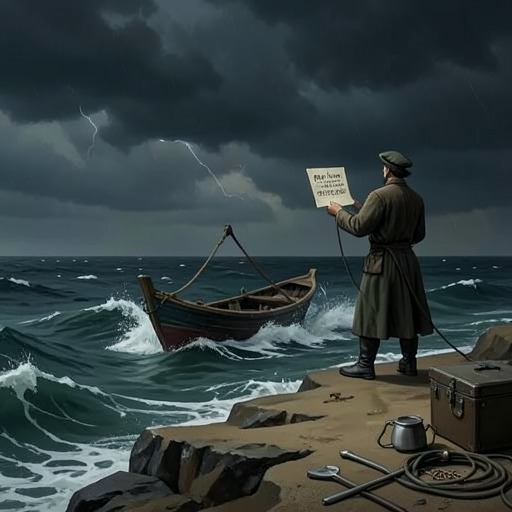
Channel bell buoy
The Man Who LaughsThe Channel bell buoy turns a distant sound into a navigational warning: in the storm, hearing its bell tells the doctor that the ship is on the wrong side of the buoy and being driven toward the breakers of Aurigny. Its toll is both a practical signal and the audible sign of a course gone dangerously astray.
Construction and Function
The buoy lies halfway between Portland and the Channel Islands, moored by chains to a shoal and floating at the water’s surface. An iron trestle fixed to it supports a suspended bell. In bad weather, heavy seas toss the buoy and set the bell ringing, making the structure a caution to vessels navigating those waters.
The bell’s sound depends on wind and position as well as the buoy’s motion. It does not simply announce that a ship is near a hazard: in the doctor’s explanation, the direction from which the sound reaches the vessel helps disclose where the vessel lies in relation to the buoy and the dangerous breakers.
The Bell as a Warning
After the men fall silent, they distinctly hear the bell through the darkness. The doctor explains that the nor’-wester carries its sound to them because they are between the buoy and the breakers of Aurigny, which lie to the east. The same wind that brings the toll is driving the ship toward those breakers. Hearing the bell therefore means that the vessel is on the wrong side of the buoy and out of its course.
The contrast is crucial to the warning. On the safe side, a vessel would be out at sea on a safer course and could pass close to the buoy without hearing it, because the wind would not carry the bell’s sound toward it. The buoy thus supplies an indirect positional test: the toll that might seem reassuring as proof of a nearby marker instead reveals the ship’s perilous alignment.
Dramatic and Symbolic Role
The bell’s warning arrives not as a clear view of the coast but as a sound heard through darkness and storm. The doctor interprets it, converting an otherwise obscure toll into evidence of immediate danger. As he speaks, a lull lets the bell ring slowly, stroke by stroke; its renewed sound seems to confirm his account, and the narration likens it to the knell of the abyss.
The scene makes the buoy a boundary marker between a safe course and shipwreck. Its bell is physically set in motion by the sea, yet its meaning depends on the ship’s position and the wind’s direction. Once the doctor explains those conditions, the sound becomes an alarm: the ship is not merely near the buoy but has already passed to the side from which the wind is carrying it toward danger.