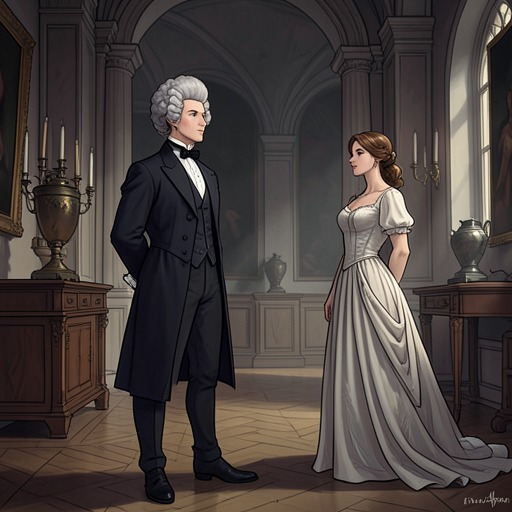
Charles II of England
The Man Who LaughsCharles II of England is portrayed as a genial, admired monarch whose return helped make the English Restoration seem a national deliverance, even as the narrative exposes the comforts, exclusions, and political reversals beneath that public celebration. His reign joins personal charm to royal authority: he is said to govern gently, to enjoy pleasure, and to win the loyalty of people eager to leave republican politics behind. His favor also shaped the fortunes of Lord David Dirry-Moir, the unacknowledged son of Linnæus, Lord Clancharlie.
Identity and Restoration
The account presents Charles II as a king able to govern despite his preference for pleasure. He is described as amiable and essentially a gentleman, admired by his subjects and possessed of a kind of greatness distinct from that associated with Louis XIV. This characterization helps explain why his return could be celebrated not merely as a change of government but as a restoration of familiar social ease. The narrative depicts England as jubilant, with the monarchy again at the center of public life and the court understood as a source of magnificence.
That celebration has a political cost. Whig peers who had served under the republic resumed their places in the House of Lords by swearing allegiance to the king. The narrative sets their accommodation beside the fate of the regicides, whose execution contributed to the public satisfaction attending the Restoration. Charles had granted the Declaration of Breda, which offered a basis for putting the republican period behind the country; yet royal restoration did not mean that the past vanished without punishment. The returned monarchy joined reconciliation to retribution, while the populace was represented as turning away from arguments about rights, liberty, and political participation.
Rule and Public Image
Charles’s style of government is characterized as gentle. The narrative compares it to a slack knot left for the wind to tighten: a ruler may appear not to press matters, while political pressure and popular response eventually do the work. The comparison makes his mildness less a simple virtue than a mode of rule whose effects depend on forces beyond the king’s immediate action. It also contrasts his manner with the coming reign of James II, who is said to have paid closer attention to Linnæus, Lord Clancharlie, a nobleman living in exile.
The account credits Charles with decisions that expressed both policy and personal judgment. He had made war in Hanover for reasons the narrator says were known to no one else, and he sold Dunkirk to France as a maneuver of state policy. These examples complicate the image of an effortlessly successful king: his popularity and charm coexist with choices whose purposes are either obscure or defined as practical statecraft. The narrative does not give a detailed account of the Hanover campaign, but uses it to emphasize the distance between royal decision-making and public knowledge.
Court, Luxury, and Satirical Framing
The Restoration court is described through the language of gaiety, luxury, and renewed custom. The narrative invokes Evelyn’s journal, which records a Sunday evening scene of courtly indulgence, but immediately treats the diarist as a disgruntled Puritan and republican sympathizer. That framing is deliberately ironic: rather than taking the criticism at face value, the narrator mocks a society that can treat vice as useful so long as it sustains luxury and pleasing appearances. Charles consequently becomes more than an individual monarch in the account. His court embodies the restored order’s ability to present pleasure and privilege as signs of national recovery.
The contrast with the exiled Linnæus, Lord Clancharlie sharpens this portrait. While England is imagined as prosperous and the court as gay and magnificent, Clancharlie remains outside the settlement he could have joined by swearing allegiance. The narrative emphasizes how readily other peers adapted, and how Charles’s popularity helped make conformity seem sensible. Against that public ease, Clancharlie’s continued fidelity to the dead republic appears in the narrator’s description as an isolated refusal. The king’s reign is thus shown both as a widely accepted political order and as the setting in which dissenters become objects of ridicule.
Patronage and Lord David Dirry-Moir
Charles’s influence also reaches into the next generation of the exiled nobleman’s family. Linnæus, Lord Clancharlie had a son by a woman of quality; the child was born in England as his father was going into exile and never saw him. The boy later became known as Lord David Dirry-Moir, a courtesy lord through his mother. After Clancharlie’s former lover became Charles’s mistress, the king favored the child, pleased to have won a beautiful woman from the republican side.
That favor took practical form. Charles gave the young David the office of keeper of the stick and provided for his maintenance at the king’s expense. The appointment helped make David an ardent adherent of the Stuarts: unlike his father, whose political fidelity kept him abroad, the son grew up within the royal household and benefited from its patronage. David later served among the king’s bodyguards, first in the company whose members carried great swords and then among the pensioners who bore gilded halberds. He also enjoyed the privilege of laying dishes on the king’s table. The narrative closes this contrast by noting that David prospered under Charles and continued to prosper under James II. Royal favor therefore links Charles’s personal household to the larger family history of exile, inheritance, and political allegiance.