Childhood innocence
The Man Who LaughsChildhood innocence in the novel is not a reward for good conduct but a condition of unknowing purity, set against adult guilt and the threat of suffering. Its clearest expression lies in the children’s vulnerable dependence on one another: a boy risks his own warmth to save an infant, and the two later sleep in peace. The narrator presents their childhood closeness as a fleeting image of purity within a world where adults confront responsibility, death, and uncertain futures.
Innocence and Adult Guilt
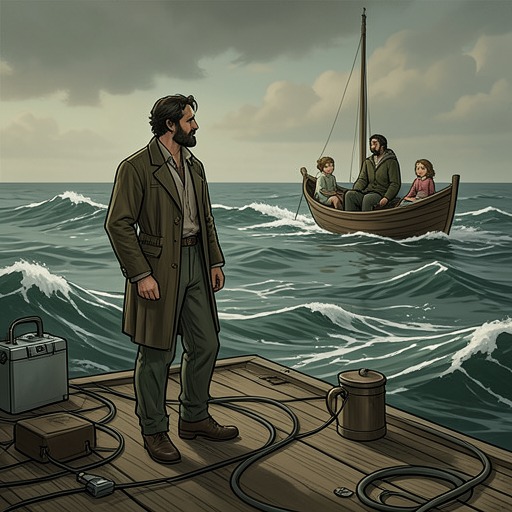
The idea first appears in direct contrast with the remorse of adults implicated in a crime against a child. A doctor urges his companions to seek the child’s forgiveness if the child has survived, or to come to the child’s aid if there is still time. His appeal treats harm done to a child as an offense of particular moral gravity, and makes the child’s vulnerability the measure by which the adults must confront their actions. Innocence here does not excuse or erase what adults have done; it sharpens their responsibility toward the person they have endangered.
The narrator broadens this scene into a reflection on the extremity of dying. As life approaches its end, past wrongdoing and anticipation of what follows converge, and belief or unbelief becomes difficult to hold with certainty. Against that account of adult consciousness—burdened by memory and fear—the children represent a different state. They have not yet acquired the accumulated responsibility that weighs on the dying adults. Innocence is thus a contrast in moral experience, not a claim that children are protected from danger: the child at the center of the later scene is already moving through severe hardship.
The Boy’s Care for the Infant
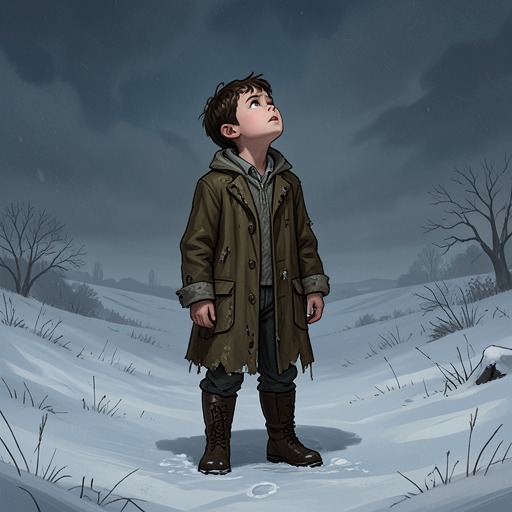
The concept becomes practical when the boy uncovers a living infant beneath the snow beside her dead mother. He takes the little girl in his arms, but her condition makes mere discovery insufficient: she is close to death from the cold. The boy responds with the resources he has. He wraps her in his dry, warm pilot jacket, gives up that protection, and carries her onward under the continuing winter weather. The scene joins innocence to care without making the child’s action a calculated moral performance. The boy acts to preserve the infant’s life, and the cost to himself is explicit in his journey without the jacket.
The infant responds to the warmth and settles against the boy’s cheek before falling asleep. This small exchange gives the rescue an intimate consequence: the boy has not only found her but has become, for the moment, a source of comfort and warmth. The narrator imagines the dead mother as perhaps witnessing his action, extending the scene beyond physical survival into a poetic image of care observed from beyond life. That image remains an imagining, not a change to the scene’s concrete outcome; its function is to mark the rescue as an act of compassion within otherwise bleak circumstances.
Childhood as a Counterimage
Later, the two children lie close together and sleep. The narrator describes their shared rest as peaceful and warm, and makes their childhood the basis for an ideal of purity that adult life cannot easily recover. Their closeness is not presented as a decision or a consciously understood promise. Rather, it belongs to a state of childhood in which the children’s experience remains beyond adult categories and intentions. The passage asks the reader to see innocence as a condition of unknowing, not as the achievement of practiced virtue.
This emphasis also changes the scale of the surrounding hardship. The dead mother, the dangerous sea, and snow-covered bodies belong to a world of loss and exposure; the children’s quiet sleep does not undo that world, but offers a momentary counterimage to it. Their warmth and repose are especially fragile because they occur within such danger. Innocence is therefore neither secure nor triumphant. It can be seen most clearly when threatened, in the infant who needs rescuing and in the children’s temporary peace after rescue.
Meaning and Limits
The novel’s treatment of innocence rests on a distinction between moral purity and moral knowledge. The adults’ response to wrongdoing involves regret, fear, and the effort to repair harm. The children, by contrast, are represented through dependence, immediate care, and sleep. Their purity is not evidence that they have overcome the dangers around them; it is the quality the narrator finds in their unreflecting presence together. This contrast gives the children’s scene its moral force without making their vulnerability itself a virtue.
The narrator leaves the future of the children’s closeness unresolved in this passage, holding out both the possibility of a lasting bond and the possibility of later catastrophe. That uncertainty prevents the peaceful scene from serving as a simple promise of happiness. Childhood innocence is a brief form of hope, but it exists inside the same world of loss and danger that has made the rescue necessary. Its significance lies in what the children’s presence makes visible: the urgency of protecting the vulnerable, the difference between unknowing purity and adult remorse, and the possibility of tenderness without any guarantee that it will endure.