Clancharlie royal patent
The Man Who LaughsThe Clancharlie royal patent was King James II’s instrument for settling the titles and inheritance of the late Linnæus Clancharlie. It named Lord David Dirry-Moir heir in the absence of legitimate issue, but made his succession conditional on marrying Duchess Josiana. The patent gave legal form to a royal conclusion that later proved false: evidence preserved in a different document, carried ashore in a sealed flask, established Gwynplaine as Clancharlie’s legitimate son and heir.
Royal Settlement of the Succession
Before the patent was issued, reports circulated that Linnæus Clancharlie had married Ann Bradshaw, daughter of a regicide, during his exile in Switzerland, and that she had died giving birth to a son. The accounts were explicitly treated as rumor and conjecture. They described a possible child who, if the reports were true, would be the legitimate heir; they did not establish his existence or identity as fact. King James II ended the uncertainty for public and legal purposes by declaring Lord David Dirry-Moir sole heir in default of legitimate issue. The grant was registered in the House of Lords.
The patent instituted Lord David Dirry-Moir in the titles, rights, and prerogatives of Linnæus Clancharlie, but did not make succession unconditional. Lord David was to marry Josiana once she reached a marriageable age. The king had made her a duchess while she was still an infant, and the arrangement joined her future marriage to the transfer of the Clancharlie peerage. Josiana was therefore a peeress until there should be a peer; under the settlement, that peer was to be her husband.
Titles, Lands, and Conditional Possession
The inheritance comprised the baronies of Clancharlie and Hunkerville, with the associated marquisate of Corleone in Sicily. The patent’s settlement concerned more than a title: lands, boroughs, bailiwicks, fiefs, rents, freeholds, and domains attached to the Clancharlie-Hunkerville peerage were provisionally assigned to Lady Josiana. Lord David was to become Baron Clancharlie through marriage to her. The arrangement thus placed the estate under a defined interim holder while specifying the marriage on which his possession and title depended.
Josiana also had a separate personal fortune, distinct from the Clancharlie inheritance. Her wealth included gifts that had passed from Madame Henrietta of England, Duchess of Orleans, to the Duke of York. The distinction matters to the patent’s operation: the Clancharlie lands and rights formed the inherited estate governed by the royal grant, while Josiana’s own fortune was an additional source of wealth.
The Patent’s Basis and Its Reversal
The grant depended on the asserted absence of any legitimate descendant of Linnæus Clancharlie. That premise was challenged years later when officials read a declaration identifying Gwynplaine as the only legitimate son of Linnæus Clancharlie and Ann Bradshaw. The declaration stated that the child had been sold, disfigured, and abandoned, and that he had been made an heir impossible to recognize through his altered appearance and life as a traveling performer. It thereby supplied the identity and history missing from the earlier rumors.
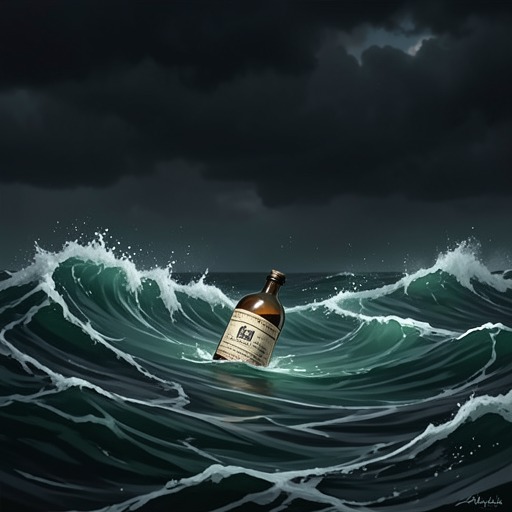
The declaration was found inside a sea-borne flask, not among the registered patents. The ship’s survivors had written it aboard the Matutina, a Biscay vessel, on the back of a royal order that had served as the receipt for the child’s purchase. When the sheriff turned the parchment over, the order appeared as the Latin words Jussu regis and the signature Jeffreys. The document’s two sides connected the child’s sale to royal authority and preserved the survivors’ account of his birth and fate.
From Sea Message to Legal Recognition
The flask’s route into the case ran through the Admiralty’s jetsam office. Ships could send information ashore in sealed bottles; those cast onto land fell within the jetsam officer’s remit. Barkilphedro explained that he had opened this flask in the presence of two sworn jurors of the Jetsam Office, who deciphered and attested its contents, and that he reported the matter to the queen. The formal process brought the recovered declaration into official proceedings, where the sheriff read it and the associated evidence was confronted with Hardquanonne.
The flask itself retained physical features that helped identify its history: a wicker-covered gourd with handles, shells and seaweed adhering to it, a tar ring indicating that it had been sealed, and a red-reed name, Hardquanonne, traced through the wicker. The sheriff said the message had been faithfully delivered by the sea. Once the declaration and the surviving witness were brought together, the claim that there was no legitimate issue could no longer support Lord David Dirry-Moir’s succession. The royal patent had organized the inheritance around the absence of an heir; the recovered record exposed the heir concealed behind that absence.