Compassion and practical charity
The Man Who LaughsCompassion and practical charity are defined here less by tender language than by what people surrender and do. On a snowbound journey, Gwynplaine uses his own clothing to keep the infant Dea warm; at Ursus’s van, Ursus provides the children with heat, dry clothes, and the milk he had been about to drink. The sequence joins two forms of help: a child’s urgent, self-sacrificing response to another child, and an adult’s rough but sustained care that becomes an act of adoption. In each case, need is answered with something concrete.
A child gives up his warmth
Gwynplaine finds Dea beside her dead mother and carries the infant onward. Dea is dangerously cold, and he recognizes her physical need through his own experience of the weather and the warmth of his clothing. He places her briefly on the mother’s body, removes his dry pilot jacket, wraps Dea in it, and takes her back into his arms. He continues through the snow with the infant while wearing almost nothing himself. The act is practical in its means and costly in its immediate consequence: warmth that had protected him is transferred to someone more vulnerable.
The scene presents care as a response made before any explanation or assurance is possible. Dea cannot ask for help, and Gwynplaine does not wait for speech or a promise of future reward. When she reaches his cheek, the warmth soothes her and she falls asleep. Their contact gives the rescue an intimate dimension, but the scene’s ethical force rests on the decision that precedes it: Gwynplaine makes his own body and clothing the means by which the infant can survive the journey. Compassion is not an abstract feeling added to the action; it is enacted through the sharing of limited protection.
Ursus turns shelter into care
The children reach the cramped home of Ursus and Homo, where Ursus first receives Gwynplaine and moves him toward the fire. His manner is brusque, and he complains about the boy’s condition and presence, yet he immediately acts to meet the boy’s needs. He removes Gwynplaine’s wet rags, finds a shirt and knitted jacket, rubs his limbs before the fire, and wipes his feet. The contrast between verbal irritation and careful attention prevents kindness from appearing as mere sentiment: Ursus may grumble, but his hands are already making the child warmer and giving him dry clothing.
When Ursus discovers that the bundle Gwynplaine has carried contains another child, he treats Dea as a person requiring care rather than as an inconvenience to be put aside. He takes out a bandage, sponge, and phial, removes the infant’s wet wrappings, and dresses her in clean, dry linen. He then lays her on fur near the fire. These actions extend the welcome beyond the boy who first crossed the threshold. The shelter becomes meaningful because it is adapted to the distinct needs of both children: one is warmed and clothed, while the infant is also changed into dry coverings and placed near the heat.
Milk, restraint, and the cost of giving
The clearest measure of Ursus’s charity comes when he finds a little milk left in the pot. He is thirsty and raises it to drink, but seeing Dea, he sets it down. Instead, he pours all the remaining milk into the phial and prepares it for her. The detail matters because the supply is limited: helping the infant means relinquishing something he had intended to consume himself. His complaint that he remains hungry and thirsty does not cancel the gift; it makes its cost legible. The scene treats practical generosity not as effortless abundance but as a choice made under want.
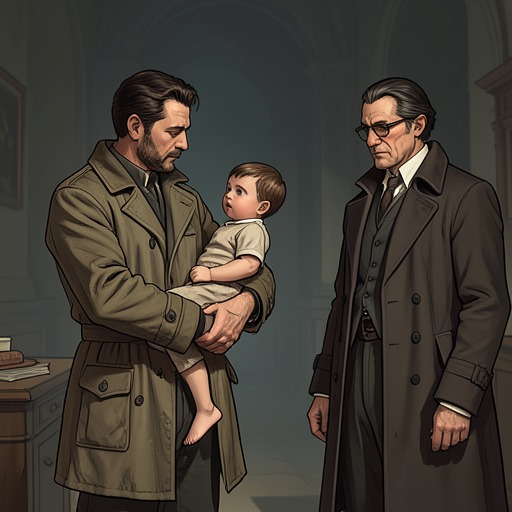
Ursus’s attention also continues after the urgent tasks of clothing and feeding. Homo approaches the stove and gently licks the sleeping infant’s dangling hand without waking her. Ursus recognizes this quiet care and declares that he will be the father and Homo the uncle. He then settles the matter as an adoption. Compassion thus passes from individual acts of rescue into a household relationship: the children are not merely sheltered for a night but received into a family formed around responsibility for them.
From emergency aid to belonging
The episode sets Gwynplaine’s and Ursus’s actions beside one another without making them identical. Gwynplaine, himself a child on the road, gives up his jacket to protect Dea and carries her onward. Ursus, an adult with scarce provisions, provides warmth, clothing, attention, and milk, and then names a lasting bond. In both cases, care is practical because it answers an immediate need with available resources; it is compassionate because the helper accepts some cost rather than treating the vulnerable as someone else’s concern.
The narrative’s emphasis on small transfers—the pilot jacket, dry garments, a phial filled with the last milk—gives charity a material form. Its development is equally important: the first rescue keeps Dea warm through the journey, while Ursus’s hospitality and the adoption of both children establish the prospect of continuing care. Homo’s gentle participation makes the new household a shared responsibility. What begins with strangers responding to cold and hunger becomes a bond of kinship, showing how acts of mercy can move beyond immediate relief toward belonging.