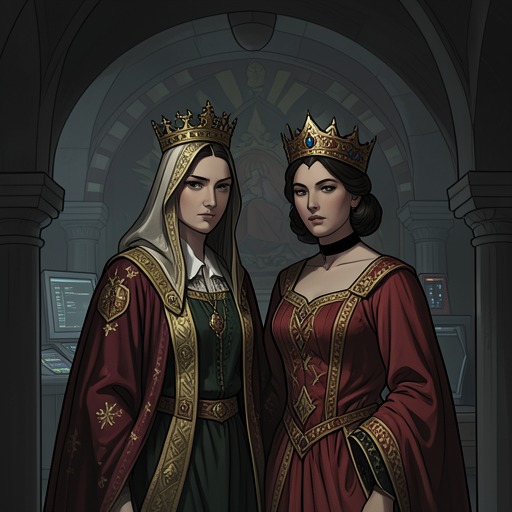
Duchess Josiana and James II
The Man Who LaughsDuchess Josiana and James II are connected by both family and royal policy. James II’s favor shaped his daughter’s rank and future marriage, but their contrasting approaches to Catholicism reveal the limits imposed on her by the very status he bestowed.
Kinship and Royal Favor
James II is identified as Duchess Josiana’s father. While she was still an infant, he created her a duchess; the narrative treats the reason as known, if not formally explained. Her title was therefore not merely a mark of birth but a royal grant with political consequences. James II’s intervention placed his daughter at the center of a settlement concerning the Clancharlie peerage.
The Clancharlie Settlement
After declaring Lord David Dirry-Moir the heir to his natural father, Lord Linnæus Clancharlie, James II instituted him in the late lord’s titles, rights, and prerogatives. The grant carried a condition: David was to marry Duchess Josiana once she reached a marriageable age. Josiana, then only a few months old, was made a peeress until there should be a peer, who would be her husband. In this arrangement, James II’s paternal role is inseparable from dynastic calculation: his daughter’s rank and marriage were made the means by which the succession was organized.
Religious Difference and the Cost of Rank
Duchess Josiana’s religious position contrasted with her father’s. She was secretly Catholic, following the example of her uncle, Charles II of England, rather than James II. Yet James II had lost his crown because of his Catholicism, and Josiana was unwilling to risk her peerage in the same way. She remained outwardly Protestant while reserving Catholic practice for her intimate circle. The contrast shows how the royal favor that elevated her also set the terms within which she could publicly live: her title depended on a performance of religious conformity that her private belief did not match.
The account emphasizes grants, succession, and religious accommodation rather than scenes of personal intimacy between father and daughter. Their relationship consequently appears as a dynastic bond with a clear imbalance of power: James II could confer rank and prescribe a marital future, while Josiana had to protect the position he had given her within the religious order of the realm.