Early-18th-century England's harsh judicial order
The Man Who LaughsEarly-18th-century England's harsh judicial order is depicted as a layered system in which inherited legal forms, royal authority, and local officials could expose people to coercion despite the existence of formal protections. Its defining contradiction is that the law could be venerated in principle, left unrepealed even when obsolete, and administered arbitrarily when power chose to use it. The novel makes that contradiction concrete in Gwynplaine’s history and in the proceedings against Hardquanonne, while its narrator places both within a broader account of English legal custom.
Silent Arrest and Reserved Power
The account begins from a practice that would astonish a modern English reader: arrest without an explanation. The narrator says such captures remained usual despite the Habeas Corpus Act, continuing into the reign of George II, particularly in delicate cases. The practice did not necessarily begin with a clearly stated charge or a conventional warrant. Its defining feature was silence: a person was seized, while the reason for the seizure remained undisclosed. The narrator associates this procedure with Continental customs and with Norman legal texts invoked by English magistrates, presenting it as an inherited method rather than an isolated abuse.
Silence itself carried a message. These arrests stood in contrast to the Clameur de Haro, and indicated that those seized should hold their tongues until concealed matters came to light. The narrator interprets the procedure as a way of reserving questions and identifies in it a measure of raison d’état: the claim that matters of state can warrant withholding explanation. Some arrests might function more like a summons to appear or a process of inquiry than a final warrant, and imposed silence could even be represented as consideration for the person detained. But such distinctions offered little reassurance to ordinary people, who were poorly placed to distinguish one legal shade from another and experienced the procedure as terrifying.
The discussion acknowledges that accusations of arbitrary arrest could themselves be uncertain. It mentions a charge that Walpole caused or permitted Neuhoff to be seized in this way, then notes that the accusation was probably unfounded because Neuhoff was imprisoned by his creditors. That qualification matters: the narrator’s criticism is not that every reported seizure had the same cause, but that the legal order permitted a form of custody whose secrecy made power difficult to scrutinize.
Officials and Overlapping Jurisdictions
The system’s reach depended on officials whose authority combined royal, judicial, and local functions. The county sheriff received a commission from the Crown, apart from stated exceptions such as the hereditary sheriff of Westmoreland and the elected sheriffs of London and Middlesex. The sheriff was responsible for escorting and protecting judges on circuit, and for executing the Queen’s orders. Under the sheriff, the under-sheriff accompanied him, while the justice of the quorum, with the bailiff of the hundred or wapentake, apprehended and examined suspects and imprisoned them for trial. Their targets included thieves, murderers, rebels, vagabonds, and other alleged felons.
The narrator emphasizes that these offices did not operate within neatly separated limits. In the England being described, legal powers and customs had accumulated and shifted; the sheriff’s authority was at once royal and municipal, while police and judicial responsibilities could exceed their proper bounds. The account compares the sheriff’s combined role with the civil and police lieutenants of Paris, underscoring how much practical authority could gather in a single office. It also warns against projecting later arrangements backward: the sheriff, wapentake, and justice of the quorum no longer exercised their functions in the same way, and even the meaning of wapentake had changed. The historical order is therefore marked not only by severity but by blurred jurisdiction and the capacity of officials to act beyond clearly defined limits.
Law, Liberty, and the Unrepealed Past
The narrator places this institutional structure within a broader judgment of England around 1705. Its constitutional features are described as confused and at times oppressive, with arbitrary administration compounding the severity of the laws themselves. Daniel Defoe’s characterization of the social order as the iron hands of the law serves as a measure of that pressure. The narrator recalls writers and public figures who were driven from positions, persecuted, imprisoned, or compelled to flee, and points to the long reach of statutes against seditious libel. The point is not that every case followed one procedure, but that legal authority could be turned against people in public life as well as against those without status.
The account also describes the striking reach of royal power across national boundaries. It recalls writers displeasing Louis XV being arrested in Piccadilly, and George II seizing the Pretender in France, at an opera house. These examples present state authority as able to cross borders even while the ordinary subject’s liberty remained insecure at home. In this view, the period’s idea of liberty was constrained by rulers whose power could reach into another sovereign’s territory.
A related contradiction lies in the survival of old penalties. The narrator describes England as retaining a barbarous code alongside its claims to liberty, and notes that the judicial scene about to unfold could still be carried out under laws not repealed. The survival of a penalty did not mean it was regularly enforced. Instead, laws could be allowed to fall into disuse while remaining formally available: neglect took the place of repeal. The narrator treats this arrangement as a polite evasion, one that left the old law nominally intact and therefore capable of being revived. The image of a tamed tiger captures the distinction: restraint in ordinary practice did not mean that the law’s coercive capacity had been removed.
Gwynplaine and Hardquanonne Under the Law
The novel’s individual histories show what this order could authorize. Gwynplaine’s face bears the consequence of a decision made under King James II: he was sold as a young child, mutilated, disfigured, and abandoned because he stood to inherit his father’s titles and estates. He was then raised and trained as a mountebank. The account describes his face as an imposed, permanent expression that did not reflect his inward feelings; the crowd laughed at him, while the bodily mark itself testified to a royal act. The narrator’s legal and political history thus meets the story’s intimate one: authority could shape a subject’s body and identity in order to remove an inheritance claim.
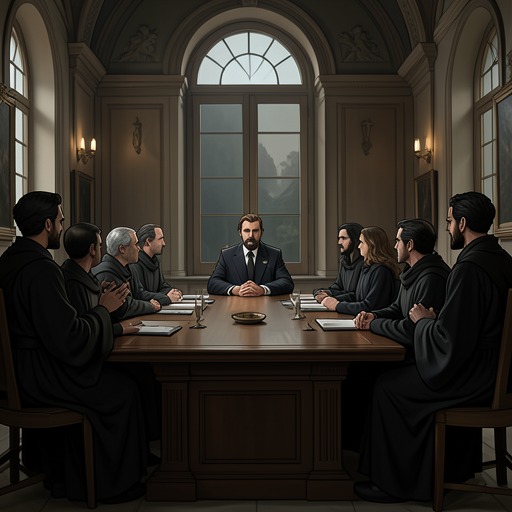
The proceedings against Hardquanonne expose a different stage of the same coercive order. The sheriff tells him that he recognized a bottle bearing his name, then refused to answer after the enclosed parchment was read. The sheriff states that peine forte et dure was applied following this refusal and that the declaration and confession of Hardquanonne’s accomplices had also been read to him. On the fourth day, designated for confrontation, Gwynplaine is brought before him; the sheriff declares that Hardquanonne has recognized his victim. The procedure turns on forced silence, documentary evidence, and a prescribed confrontation, while the prisoner’s recognition connects the legal inquiry to the concealed history of Gwynplaine’s birth and treatment.
Narrative and Political Significance
These episodes make legality an unstable boundary between protection and violence. The same order that classifies arrests, delegates powers, and specifies a day for confrontation can also preserve secret detention and severe penalties. Its complexity does not automatically restrain authority: overlapping jurisdictions and inherited procedures may instead make it harder to identify who is accountable. The narrator’s historical digressions widen the prison scenes into an argument about a society where the law’s formal dignity can coexist with practices that endanger liberty.
Gwynplaine’s later speech in the House of Lords carries that argument from his individual body to the political community. He presents his permanently laughing face as an effect of royal power and as a symbol of people whose suffering is masked from public view. The transformation is central to the novel’s critique: what the crowd first treats as entertainment becomes evidence of the violence behind its amusement. The judicial order is therefore significant not only for the restraints it imposes on particular prisoners, but also for the way legal and political authority can produce lasting harm and then leave its consequences to be misunderstood as spectacle.