Effroc stone
The Man Who LaughsEffroc stone is a short, narrow quay above the Thames, marked by a parapet and a high wall that drops vertically into the dark water. It is where Gwynplaine arrives after finding Tarrinzeau Field emptied of the tents and caravans that had formed his world, and where the riverbank’s downward slope later becomes the path Homo takes with him. The location joins physical geography to a decisive passage from abandonment and inward desolation to the movement of a faithful companion.
Setting and approach
Gwynplaine reaches the quay after searching the deserted fairground yard by yard. From there he turns into crooked streets near East Point and makes his way through lanes bounded by walls and hedges. The fresh air from the water and the river’s dull lapping announce the Thames before he sees the parapet of Effroc stone in front of him. The approach is therefore a transition out of the scoured fairground and its lanes toward an exposed riverside edge.
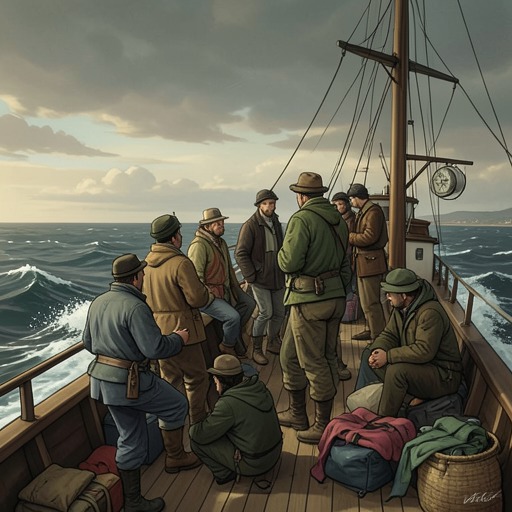
The parapet encloses a quay block described as very short and very narrow. Beneath it, the high wall of Effroc stone descends straight into the dark water. The quay does not end at the parapet: it slopes gradually toward a pier farther off, where several vessels lie moored or at anchor. Small stone or wooden jetties and movable gangways connect them with shore. In the night, the ships and their rigging appear only dimly through the haze, with red lights puncturing the obscurity. This broader harbor setting places the stone beside a working waterway, even as the scene itself is marked by stillness and silence.
Gwynplaine at the parapet
At the parapet, Gwynplaine stops, rests his elbows on it, and lowers his head into his hands to think. The narration distinguishes the dark landscape from the darkness occupying him: his attention is fixed not on the water but on an inward shadow. The blurred ships and spars remain barely perceptible beyond him, while the quay and river form the external setting for a crisis presented as interior.
That crisis follows the clearing of Tarrinzeau Field. The tents, stalls, and caravans have disappeared; the fairground has been searched and emptied, leaving Gwynplaine without the Green Box that had constituted his universe. He compares the darkness around him with the dream he had cherished, and the loss is framed as a crumbling away of the life he knew. Effroc stone thus stands at the point where the vanished encampment’s practical consequence becomes emotional desolation: the river is beneath him, but the scene emphasizes the void within him.
The slope and Homo’s guidance
Later, Homo turns back to check whether Gwynplaine is following, advances when he sees that he is, and continues on, wagging his tail. The route the wolf takes is the slope of the quay beside Effroc stone, which shelves down toward the Thames. Gwynplaine follows him down it. Homo repeatedly looks back to make sure his companion remains behind him, so the slope is not merely a feature of the riverbank but the route along which their companionship is enacted through simple, observable gestures.
The contrast with Gwynplaine’s earlier stillness at the parapet is significant. There, he leans over the water absorbed in his own thought; here, he moves because Homo goes ahead and checks for him. The narrative attributes to the faithful animal an instinct that approaches clear understanding in moments of supreme importance. Effroc stone consequently links isolation with guidance: its vertical wall and dark water frame Gwynplaine’s inward crisis, while its descending slope gives Homo a way to lead him onward.
Narrative significance
Effroc stone gathers the episode’s reversals into a compact landscape. The devastated fairground lies behind Gwynplaine, the dark river lies below, and the vessels farther along the quay remain quiet and indistinct. The parapet marks a place where he stops and reflects on the loss of his former life; the slope marks a place where he resumes movement under Homo’s lead. The contrast does not erase his despair, but it shifts the immediate action from solitary reflection to the care of a companion.
The location’s force depends on its specific arrangement: a narrow quay, a high wall plunging into the river, and a gradual descent connecting it with the water’s edge. Those features make the emotional movement legible without turning the setting into a mere symbol. Effroc stone is both a real point in the geography of the Thames-side scene and the threshold between Gwynplaine’s sense that his world has vanished and Homo’s practical, faithful act of guiding him down the slope.