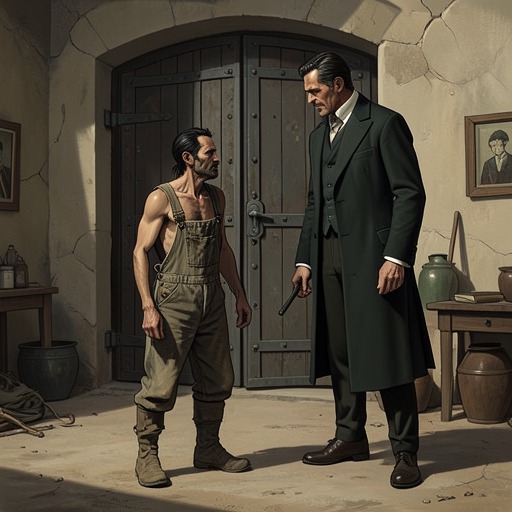
England's aristocratic social order
The Man Who LaughsEngland's aristocratic social order rests on inherited rank, concentrated property, and institutions that make privilege appear both ancient and lawful. The novel treats that order not simply as a divide between rich and poor, but as a political arrangement with contradictory effects: peers protect their own authority, sometimes check royal power, and yet preside over conditions that leave the poor exposed. Its central irony is that a body formed to preserve the privileges of a few helps create the political ground on which the rights of many can be claimed.
Peerage and Political Power
The account describes peerage as a political fiction that made the great appear equal to the king. The institution took different forms in France and England: French peers are characterized as concerned chiefly with rank and precedence, while English peers possessed more substantial political authority. In England, the peerage became a counterweight to the monarch, though not an advocate for equality in any straightforward sense. The narrator calls it parasitic, while also crediting it with significant, if involuntary and costly, political services.
That tension emerges in the novel’s account of conflict between the Crown and the Lords. Under the Stuarts, royal attempts to manage or constrain the peerage provoked resistance. During the English Revolution, forty-four peers sided with the King and twenty-two with the Republic; the shifting relationship between the Lords and the Commons is connected to the formation of the Bill of Rights. The Lords could oppose royal authority, but their resistance arose from a struggle over power among elites, not from a program to end social hierarchy.
The institution’s historical importance therefore lies in consequences beyond its intentions. The novel presents the House of Lords as a starting point for political unity and English resistance, while describing its members’ earlier actions against royalty as paving the way for the Crown’s eventual decline. The Lords did not set out to establish popular rights. In the narrator’s formulation, however, aristocratic privilege produced the rights of citizens, like a vulture unwittingly hatching an eagle’s egg. The image holds together the institution’s predatory character and the unintended opening it creates for political change.
Law, Office, and Coercive Authority
The social order also operates through a legal system in which authority is distributed among royal, local, and special jurisdictions. The narrative describes arrests made without explanation as a familiar practice, despite the Habeas Corpus Act, particularly in politically delicate cases. These silent arrests were treated as a way to keep a matter out of public view until further information emerged; the account explicitly associates them with raison d’état. Legal procedure could thus protect public order in name while reserving questions from public scrutiny.
Jurisdiction itself is depicted as layered and irregular. The Tower of London, for instance, was treated as outside the ordinary county system, with its own constable, court, church, government, and authority extending over twenty-one hamlets. County sheriffs, meanwhile, received royal commissions, with exceptions including the hereditary sheriff of Westmoreland and the elected sheriffs of London and Middlesex. Sheriffs were responsible for protecting judges on circuit, while their officers helped apprehend, examine, and imprison people awaiting trial. These offices linked local enforcement to royal authority and the circuit courts.
The account’s description of Southwark Jail further exposes the coercive edge of this legal structure: it identifies the jail as one of the prisons of King John’s time with a chamber used for torture. In Hardquanonne’s case, the sheriff states that the prisoner recognized a bottle bearing his name, refused to answer after its enclosed parchment was read, and was subjected to peine forte et dure. On the legally designated fourth day of confrontation, Gwynplaine was brought before him; Hardquanonne then broke his silence and recognized the person he had helped victimize. The sequence shows law functioning both as a mechanism for establishing identity and as an instrument capable of compelling a response.
Wealth and the Lives of the Poor
The material gulf between ranks appears through sharply opposed images of luxury and deprivation. One passage sets a heading promising satisfaction to those who have nothing beside an account of Henry Auverquerque, Earl of Grantham, who has an income of a hundred thousand a year and a marble palace renowned for its many corridors, each distinguished by elaborate materials and colors. The detailed inventory makes wealth visible as space, ornament, and abundance; the poor are figured not by a comparable possession but by their lack of necessities.
Gwynplaine encounters that lack each evening at the Green Box, where low prices draw poor and working people seeking a brief escape from hardship. From the platform, he sees children without food, workers without tools or work, families facing ruin, and people whose lives have been marked by starvation, social pressure, or the prospect of crime. The crowd changes from night to night, but its miseries recur. His view connects individual faces to structural causes: ignorance and indigence, unemployment, taxes, legal penalties, and the pressure exerted by the comfort of those above.
The novel broadens this view into a catalogue of deprivation across England. Gwynplaine’s speech refers to miners in Newcastle-upon-Tyne who chew coal to deceive hunger, to closed manufactories and forced idleness in Lancashire, and to herring fishers at Harlech who eat grass when the fishery fails. Elsewhere, he describes chronic destitution, exhausted poor communities, and children without beds. His argument is that public decisions and taxation burden those least able to bear them, while wealth and royal expenditure remain protected. The point is not only that poverty exists, but that it is produced and maintained within the same society that celebrates its riches.
Gwynplaine as Witness and Accuser
Gwynplaine’s position brings the political structure into personal focus. A declaration read during the proceedings identifies him as Lord Fermain Clancharlie, the only legitimate son of Lord Linnæus Clancharlie and Ann Bradshaw, and heir to his father’s estates and titles. It states that he had been sold as a young child on James II’s order, then disfigured and put out of the way. He had instead grown up trained as a mountebank at fairs. His inherited status is therefore inseparable from the royal power that separated him from it and shaped the life through which he came to understand the poor.
Before that identity is restored, Gwynplaine’s work brings him face to face with hardship as a performer. He wonders whether he could aid the poor if he were powerful, then dismisses his own capacity as insignificant. The narrator counters that he can make his audience laugh and, for a time, forget. That limited consolation does not remove the conditions he observes, but it establishes the unusual standpoint from which he later addresses the Lords: he has lived among the poor and has also been made, by an act of royal power, a member of the rank he condemns.
In the House of Lords, Gwynplaine turns that experience into an accusation against privilege. He presents the poor as trapped in a social structure that presses one level upon another, and asks the powerful to act with brotherhood and tenderness. His own face, made to carry a forced smile, becomes part of the argument: he describes it as the mark of a king and as a symbol of a humanity deformed by its masters. When the Lords laugh at him, the contrast between his appeal and their response makes visible the distance between political representation and actual recognition. The speech insists that the people’s suffering is not safely separate from aristocratic comfort: the destruction of one part of society threatens the whole.
Contradiction and Political Legacy
The novel’s account does not present aristocratic power as a single, unchanging force. The House of Lords can restrain the Crown and contribute to political rights while remaining an exclusive institution founded on inherited privilege. Law can identify a dispossessed heir and expose a conspiracy, yet also allow silent arrest and coercive interrogation. Material wealth can be displayed in palace corridors while poverty appears in the crowd outside the theatre. These contradictions are not incidental; they define the social order the narrative examines.
Gwynplaine’s speech gives that examination its starkest political language. He argues that the apparent solidity of privilege cannot endure forever and imagines a future in which those kept below rise against those above. The account links this forecast to the earlier English Republic and to the possibility of renewed popular power. At the same time, the Lords’ historical role is presented as deeply ambivalent: aristocratic resistance helped limit monarchy, but the rights that emerged from that struggle exceeded the purposes of the aristocracy itself. England’s aristocratic social order thus contains the means of its own challenge, even as its material and legal arrangements continue to burden those excluded from power.