English Channel
The Man Who LaughsThe English Channel is both a real maritime passage and a test of how much a sailor can know about the forces around him. In the novel, its shoals, storms, and warning buoy make navigation a matter of life and death, while the doctor’s explanations frame the sea as a system of hidden forces that ordinary observation cannot fully disclose.
A sea treated as a mystery
The narration introduces the English Channel within a discussion of the snowstorm, described as an obscure mixture of fog and storm associated with maritime disasters. The account distinguishes visible wind and waves from an invisible current called effluvium, which it proposes as an additional force shaping air and water. Thunder is presented as the moment this concealed force makes its presence perceptible. These claims belong to the novel’s speculative explanatory scheme; they are not offered here as established modern meteorology.
The argument extends from the snowstorm to the irregular behavior of ocean waves and winds. The narration asks why wave patterns vary across the Pacific and Atlantic and why a veering wind can complete an immense circuit in thirty-six hours. It then identifies such a circuit as the preface to the snowstorm of March 17, 1867. These large-scale examples are not measurements of the English Channel itself. Their relevance is structural: they prepare the reader to regard the Channel’s dangers as part of a wider, intricate natural order, not merely the result of wind and wave as sailors ordinarily perceive them.
The snowstorm receives particular emphasis as a dangerous, magnetic phenomenon, compared with the aurora borealis because both are associated in the narration with the pole and with visible signs of effluvium. Storms are also figured as disorders of the sea, some survivable and others fatal. This language makes the Channel’s peril more than a local hazard: the passage lies within a sea whose apparent surfaces may conceal forces that cannot be read directly.
The Channel and the limits of experience
The doctor makes the danger practical when he questions the skipper about his familiarity with the Channel. The skipper has crossed it for the first time. His usual sailing takes him between Fontarabia and destinations in Ireland, with occasional passages toward the Welsh coast; he has always steered outside the Scilly Islands and does not know these waters. The doctor treats that lack of local experience as serious, calling the Channel a Sphinx and warning the skipper to look out for shoals. His warning establishes a sharp distinction between having sailed at sea and being prepared for this particular passage.
Their exchange turns on depth as well as general experience. The skipper reports twenty-five fathoms where they are. The doctor says they should reach fifty-five fathoms to the west and avoid even twenty fathoms to the east. The contrast gives the danger a concrete navigational shape: the right course depends on reading depth and direction, not on the mere fact that open water lies ahead. The doctor’s confidence also contrasts with the skipper’s unfamiliarity. Knowledge of the Channel is presented as a specialized skill, and uncertainty about its shoals immediately raises the stakes.
The bell buoy and the wrong side of safety
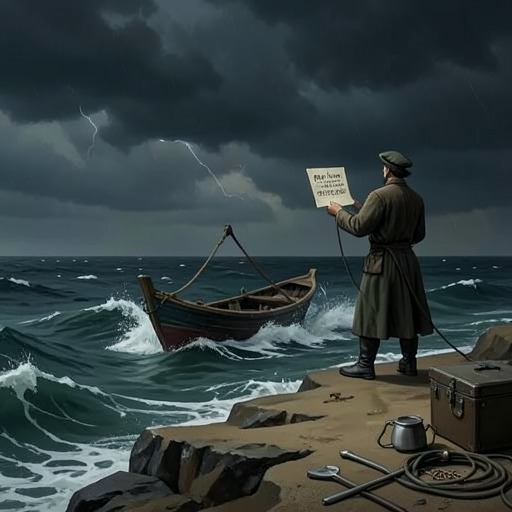
A buoy in the sea between Portland and the Channel Islands provides the passage’s clearest warning. It is moored by chains to a shoal, floats on the water, and carries an iron trestle with a bell. In bad weather, heavy seas toss the buoy and make the bell ring. The sound is therefore not incidental background: it carries information about the ship’s position in relation to the buoy, the wind, and the breakers of Aurigny.
The doctor explains that in a nor’wester the bell can signal imminent danger. The wind carries its sound to a ship situated between the buoy and the breakers. Since the breakers lie to the east, hearing the bell means the ship is on the wrong side of the buoy and the wind is driving it toward them. On the safer side, a ship could pass near the buoy without hearing it, because the wind would not carry the sound in its direction. The bell thus acts as an acoustic sign whose meaning depends on wind direction and position, not simply on proximity to the buoy.
As the doctor speaks, a lull allows the bell to ring slowly, stroke by stroke. Those aboard listen in silence, attending both to his explanation and to the sound he interprets. The scene converts a navigational principle into an immediate warning: the doctor’s account identifies the danger, but the bell confirms that the vessel is out of its course. The English Channel’s threat is consequently made legible without being made safe; recognizing the signal does not erase the peril it announces.
Narrative significance
The Channel joins the novel’s descriptive account of natural forces to a scene of decision under pressure. Its hazards are introduced first through exposition about storms, magnetic effects, and uncertain navigation, then concentrated in the skipper’s inexperience, the reported depths, and the bell buoy’s warning. This movement from general explanation to a specific sign gives technical knowledge dramatic consequence: the abstract question of how the sea works becomes a question of where the ship is being driven.
The setting also exposes the limits of ordinary perception. Wind, waves, and a ringing bell can be observed, but interpreting them requires an understanding of invisible or indirect forces, local geography, and course. The doctor’s knowledge stands against the skipper’s unfamiliarity, while the buoy makes their difference consequential for everyone aboard. The Channel is therefore not simply the space crossed by the vessel. It is the novel’s concentrated image of a natural world that may offer warnings, yet demands close attention before those warnings can be understood.