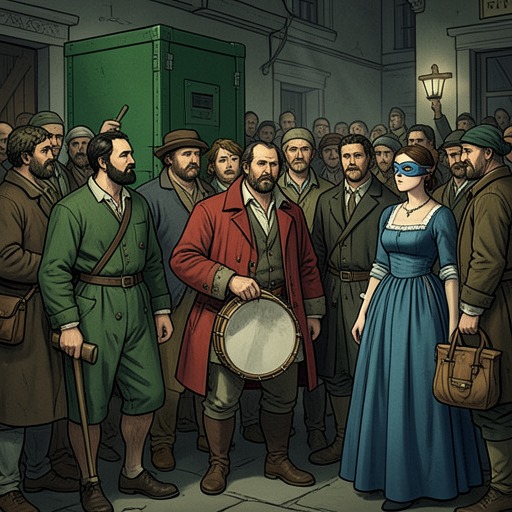
English anti-vagrancy laws
The Man Who LaughsEnglish anti-vagrancy laws made a person’s right to travel depend on whether authorities recognized a livelihood and a place within the social order. They tolerated itinerant workers with identifiable trades, but treated unexplained wandering as a possible public danger, exposing those who could not account for themselves to arrest and severe penalties.
Scope and legal principle
The laws belonged to a broader English tradition of rigorous control over people without settled homes. The book describes the governing presumption as one that regarded the unhoused wanderer as more dangerous than formidable animals. The comparison cast mobility without recognized social ties not as an ordinary condition but as a threat requiring intervention.
This suspicion did not extend equally to everyone who travelled. A mountebank, travelling barber, quack doctor, peddler, or open-air scholar could pass without the law’s attention so long as the person had a trade to live by. The distinction was therefore not simply between residents and travellers: it was between movement made legible through work and movement authorities could not explain.
Suspicion, questioning, and penalties
A person’s appearance could be enough to prompt official scrutiny, even though the book describes the grounds for suspicion as difficult to define. The practical questions were where a person lived and how they earned a living. Someone unable to give an acceptable answer faced harsh penalties; the account characterizes the legal system as using severe measures to suppress vagrancy.
The same framework made the vagrant an ambivalent figure. The law could treat a wanderer as a possible enemy of the public, while the narrative acknowledges that vagrants could also become offenders. That qualification does not soften the breadth of the suspicion: the possibility of wrongdoing helped justify a system that could seize people before distinguishing individual conduct from their unsettled condition.
Enforcement and legal discretion
The book compares the treatment of vagrants, particularly Gypsies, to a broad campaign of expulsion, but explicitly distinguishes such a roundup from persecution. The distinction matters to the narrator’s account: it places the measures within the state’s policing of a group deemed unwanted, without treating every historical expulsion as equivalent.
Vagrancy control also sat beside practices of arrest that could operate without an explanation at the point of seizure. Such silent arrests remained in use despite the Habeas Corpus Act and could be justified through inherited legal customs. The account presents them as a way of keeping a matter undisclosed while officials acted under a claim of state necessity. It does not identify every such arrest as an anti-vagrancy measure; rather, the practice shows the wider procedural environment in which suspicion and custody could precede public clarification.
County officers formed another part of that enforcement structure. The sheriff was responsible for protecting judges on circuit, while subordinate officials assisted in apprehending and examining suspected offenders, including vagabonds, and holding them for trial. In this account, anti-vagrancy policy was therefore not only a rule about status: it was connected to local officers and the ordinary machinery of arrest and prosecution.
Itinerant life and the novel’s contrast
Gwynplaine’s life as a mountebank gives the permitted category a human instance. He performs at fairs and crossroads and earns his living through his act, placing him among the travelling entertainers whom the law was said not to trouble merely for wandering. His recognized occupation, however, does not protect him from the separate violence that shaped his history: he was sold as a child, disfigured, and trained for market and fair performance.
The contrast exposes the limits of legal tolerance. A trade could make a traveller socially legible without undoing the harms imposed on him by other powers. Later, in the House of Lords, Gwynplaine describes his imposed appearance as a sign of the suffering inflicted on the people by their masters. His transformation from working mountebank to recognized heir makes the legal order’s dependence on status visible: the same figure who had lived on the margins of respectable society is eventually admitted to the aristocratic institution from which he speaks.
Significance
The laws reveal a social order in which freedom of movement was conditional. Work could distinguish a tolerated itinerant from a suspect wanderer, but the distinction left authorities broad scope to decide whose livelihood counted and whose presence warranted suspicion. The law’s stated concern for public safety thus coexisted with coercive treatment of people whose principal disqualification was an inability to demonstrate an accepted place in society.
In the novel’s larger political argument, this regime forms part of a world where legal protection and social standing are unevenly distributed. Gwynplaine’s public career brings that inequality into view: his livelihood as an entertainer allows him to travel, yet the status later conferred on him changes how society receives him. The contrast does not make anti-vagrancy laws the cause of his childhood fate; it shows how precarious recognition remains when a person’s safety and standing depend on categories controlled by those in power.