Fibi
The Man Who LaughsFibi is one of the two young women incorporated into Ursus’s traveling company, where domestic work and performance preparations sustain the troupe’s public life. Picked up with Vinos from the vagabondage of cities and suburbs, she is assigned practical duties rather than a specified stage role: she cooks, scrubs the caravan, and helps dress Dea on performance days. Her presence makes visible the labor behind the company’s theatrical image of a wandering temple.
Identity and Place in the Troupe
The narrator describes Fibi and Vinos as young and ugly, half wild and uncouth. Ursus gives them the names Phoebe and Venus; the narrative then specifies the English-pronunciation forms Fibi and Vinos. The change of spelling is small but telling: these are names bestowed by the troupe’s leader, who folds the two newcomers into the company’s deliberately theatrical world. They are called its goddesses, while also serving it—a fanciful public identity placed over ordinary, necessary work.
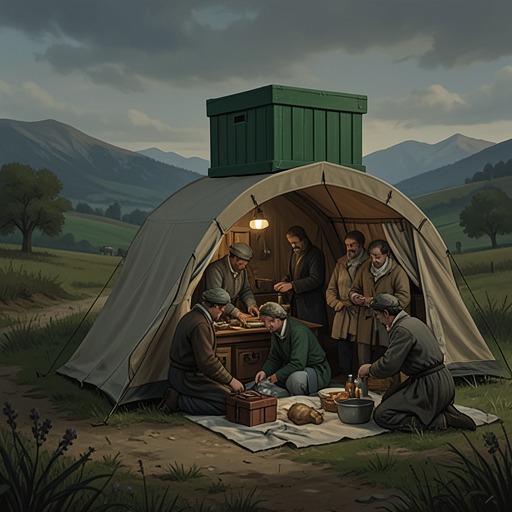
Fibi joins an already established household on wheels: Ursus, Homo, Gwynplaine, and Dea, alongside two horses and the two women. Ursus has had the large caravan built to carry a theatre along the highways. Within it, the old hut that once served as his home is incorporated into the structure, fixed in place and no longer required to roll independently. Fibi’s work therefore belongs to a compact, mobile domestic world as much as to a touring entertainment. The company’s movement depends on a shared arrangement of tasks, not simply on the performers seen by audiences.
Work and Performance Preparations
Fibi cooks, while Vinos scrubs the troupe’s wheeled home. On days when the company performs, the two women also dress Dea. The account gives no separate acting part or stage business to Fibi; her established contribution is the practical preparation that allows the spectacle to take its public form. Dea’s costume is part of that transformation: she wears a flowered Florentine petticoat and a sleeveless woman’s jacket, leaving her arms bare. Fibi’s role is thus close to the visible threshold of performance, helping prepare the figure whom spectators will encounter, though the narrative does not describe her appearing onstage herself.
The other performers have their own duties. Gwynplaine looks after the horses, while Ursus and Homo take care of one another. This division of labor places Fibi’s cooking and cleaning within a larger pattern of mutual maintenance. The caravan carries both the theatre and the necessities of the troupe’s daily life; its performances do not displace household work but grow out of it. Ursus’s grand description of the company as a wandering temple consequently has a practical counterpart in Fibi’s service and the tasks shared among its members.
Daily Life with Vinos and the Company
Fibi and Vinos share meals with the troupe but, as the narration puts it, give little trouble. Their companionship is marked by a distinct language: the two speak the gipsy language to one another. The text presents this speech as part of their bond with each other, not as a language attributed to the whole company. Their description as uncouth and half wild sits beside their everyday participation in a household whose members eat, sleep, work, and travel together.
The contrast between Fibi’s modest domestic duties and the company’s elaborate public identity is central to her place in the ensemble. The two women are styled as goddesses of the troupe, yet Fibi’s named tasks are cooking and cleaning; on performance days, the practical work extends to dressing Dea. The elevated title does not erase service. Instead, the narrative sets the troupe’s fanciful theatrical framing against the ordinary labor that keeps its life on the road functioning.
Narrative Significance
Fibi is drawn as a supporting member of the company rather than as an independently developed plot figure. The account establishes her through concrete work, her connection with Vinos, and the name Ursus gives her; it does not assign her a personal history, an individual dramatic objective, or a distinct performance. That limited but specific presence helps define the Green Box troupe as more than a collection of entertainers. It is a traveling household whose public spectacle rests on shared domestic effort, and Fibi’s place in it is clearest where the two worlds meet: in the caravan’s daily labor and in the preparations that make Dea ready to be seen.