Green Box
The Man Who LaughsThe Green Box is Ursus’s traveling theatre and home: a green-painted, horse-drawn vehicle whose transformation from a poor booth into a carefully equipped caravan follows Gwynplaine’s rise as a public attraction. Its importance lies in the double life it makes possible. Opened to crowds as a stage, it closes into a refuge where Ursus, Gwynplaine, Dea, Homo, and their companions share work, shelter, and affection.
Origin and outward design
By 1704, the troupe’s circumstances had changed markedly. Gwynplaine’s performances drew crowds from fairground to fairground, and the money gathered over years allowed Ursus, who managed the success, to have a larger caravan built. The new vehicle replaced the troupe’s miserable booth with a traveling theatre substantial enough to carry both a company and its equipment. Its prosperity was visible: the old establishment had grown with its success, while Ursus was no longer obliged to pull the smaller hut himself.
The Green Box was a conspicuous moving house, painted in graduated greens from the bottle-green wheels to the apple-green roof. Its vessel-like shape had a keel-like roof and deck-like floor; high, equal-sized wheels carried it along the roads. It had a window at either end, a rear door with steps, and a chimney that sent smoke up from the roof. The vehicle was regularly washed and varnished. At its front, two women in goddess costumes sounded trumpets from a ledge beside Ursus, who drove the horses. Beneath the van was chained Homo, described as an animal between dog and wolf. The whole arrangement announced a show before the troupe had even begun to perform.
The expanded company included two horses and two young women, Fibi and Vinos, whom Ursus had taken in from among the city’s vagabonds. They served as the troupe’s trumpeters and performers. Dea, familiar with life in the vehicle, moved through its interior with the ease of someone who could see, although she was blind. Gwynplaine cared for the horses as well as performing. The caravan was thus both transport and the material framework of a small working community.
Interior and theatre machinery
The Green Box’s interior was arranged with the economy of a vessel. Ursus’s former hut remained fixed in a rear corner, retired from its old work of rolling along the road. It served as a bedroom and dressing room for Ursus and Gwynplaine and now held two beds; the kitchen occupied the opposite corner. Three compartments divided the caravan without fully closing it off: the men’s space at the back, the women’s at the front, and a central compartment between them. Openings rather than doors joined the spaces, while hanging cloth could screen them from view.
That middle compartment changed function according to the moment. It was the stage for spectators and the troupe’s dining room when the performance was over. Kitchen stores held the orchestra’s instruments and theatrical properties; a loft beneath the arched roof held scenery. When a trapdoor opened, lamps could be brought into play to create effects of light. Ursus wrote the pieces and supplied their magic through sleight of hand, imitated voices, sudden lights and darkness, and figures that seemed to form or vanish across a partition. A tightly ordered interior became the source of public spectacle.
The stage itself could expand outward. A central panel on the vehicle’s left side, between the front and rear wheels, turned on hinges and was lowered by chains and pulleys. Three hinged legs unfolded to support it on the ground, making the dropped panel a platform in front of the stage. Raised for travel, the panel concealed the performance space; lowered, it opened the Green Box to the crowd. The mechanism gave the caravan a theatrical threshold: the home could literally unfold into a public venue and then close again.
Performances and life in London
A placard on the Green Box advertised Gwynplaine as the Laughing Man and presented a short account of his abandonment on the coast of Portland, including the date, 29 January 1690, and his age, ten. The publicity turned his history into part of the attraction. Spectators were astonished by his appearance and drawn into speculation about how his extraordinary, infectious laughter had been produced. As the company moved from one fair to another, the crowds and receipts grew, first bringing farthings, then pennies, and eventually shillings. Ursus’s ambitious theatre was the built consequence of that success.
When the Green Box reached London, Ursus established it in Southwark, attracted by a bowling green where it was fair-day even in winter. The yard of the Tadcaster Inn offered a ready-made theatre. The caravan could be drawn through the high gate and placed against one wall; the yard’s pavement served as the pit, its ground-floor windows as boxes, and the covered balcony as a gallery. Ursus even set aside a balcony compartment for the nobility, furnishing it with the inn’s best chairs and a grand velvet armchair. The room remained empty, but the rest of the audience flocked in. Southwark’s crowds came to see Gwynplaine, whose popularity eclipsed the other performers at Tarrinzeau Field.
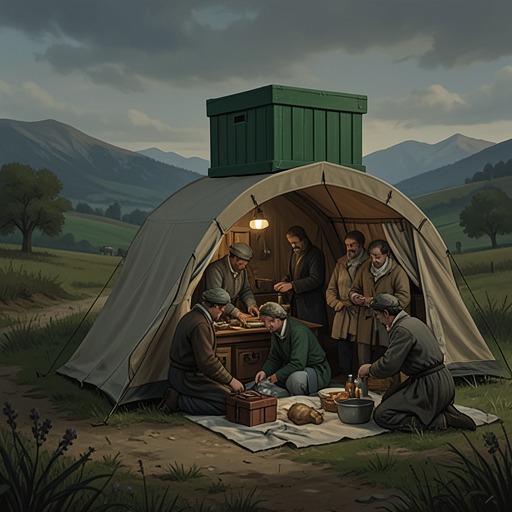
The company’s public success had a private counterpoint. Once a performance ended and the audience dispersed, the platform was drawn up like a fortress drawbridge and communication with the outside world ceased. The troupe passed abruptly from noisy display into seclusion. The central stage became their dining place: Ursus counted the receipts, and the company supped together. Gwynplaine served Dea, cutting her bread and pouring her drink. For the lovers, the modest shared meal belonged to the happiness of their life inside the caravan. Its partitions separated the troupe’s spaces, but its common routines also gathered them into a household.
Crisis, performance, and threatened dispersal
When Gwynplaine was imprisoned, the Green Box became the setting for Ursus’s effort to conceal the loss from Dea. Master Nicless closed the box office and announced that there would be no performance that evening. Ursus entered the caravan, put away the signs, and went into the women’s compartment, where Dea was asleep. Later, he resumed the public routine as though Gwynplaine were still there: he called for the platform to be lowered, addressed the absent performer, and set Fibi and Vinos at their usual places. His ventriloquism filled the stage with an orchestra of human and animal voices. The familiar machinery and performance served as a painful substitute for the missing member of the troupe.
The caravan itself soon became a practical obstacle to escape. Ursus explained that a boat might have carried the old little box on wheels, but the enlarged Green Box, drawn by two horses, could not be taken aboard the ship. The authorities also threatened Homo with death. A nearby circus proprietor, claiming friendship, offered fifty pounds for the caravan, horses, trumpets, women performers, play, blind singer, wolf, and Ursus himself. Ursus refused the proposal, answering that Gwynplaine was coming back. The local justice, meanwhile, said that the circus proprietor would soon need the equipment because the authorities intended to clear the booths from Tarrinzeau Field and send the performers away. The offer and the order alike exposed how readily a livelihood and its inhabitants could be treated as saleable or removable.
A remembered home
After the troupe’s dispersal and reunion aboard the ship, Dea recalled the Green Box as the home of their happiness. She asked Gwynplaine to remember the caravan and the blind girl who had lived there, along with her song and the sound of her voice. She remembered their life as one of constant nearness: she knew morning by hearing Gwynplaine and night through dreams of him. She also recalled how they sang and listened to applause, and how joyful it had been never to be separated. The caravan mattered to her not simply as a vehicle or a theatre, but as the place where love had shaped the rhythm of daily life.
The Green Box’s theatrical transformation gives its story a governing contrast. Its hinged platform opens outward to crowds, but can be raised to shut the troupe away; its central stage alternates between performance and supper. It carries a show built around Gwynplaine’s visible deformity while sheltering the intimate relationships that public spectacle cannot see. When the caravan becomes impossible to take aboard and the company’s life is broken apart, Dea’s recollection preserves what its doors, curtains, and moving walls once held: a shared home made from work, performance, and attachment.