Gwynplaine
The Man Who LaughsGwynplaine is both the abandoned child made into a travelling performer and Fermain Clancharlie, a hereditary peer whose identity is eventually restored by law. The distance between those lives shapes his story: the aristocracy recognizes his title, but cannot erase the poverty, isolation, and love that have made him who he is. His rise from performer to lord is therefore not a simple ascent. It brings him into the society whose inequalities he has known from below, and ends in a loss that rank and wealth cannot repair.
Identity and Background
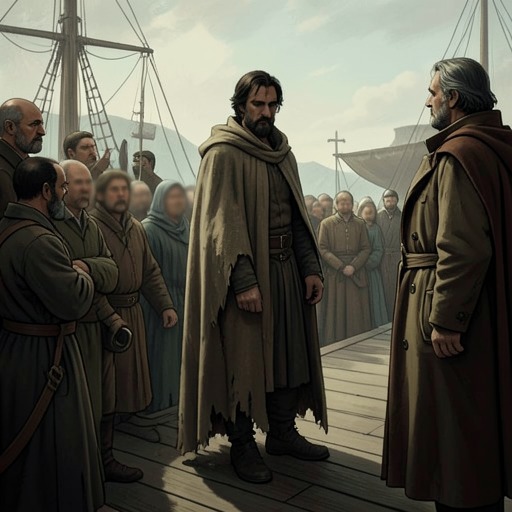
As a child, Gwynplaine belongs to a group of eight ragged fugitives preparing to leave by sea in a Biscayan urca. In the dimness on the shore, the adults are difficult to distinguish, and their clothing has erased ordinary distinctions between men and women. The child is more isolated still: it is uncertain whether either parent is present, no one shows him affection, and he is made to work for the group without being spoken to. The account presents him not as a protected member of a family but as a small dependent among people who use his labor.
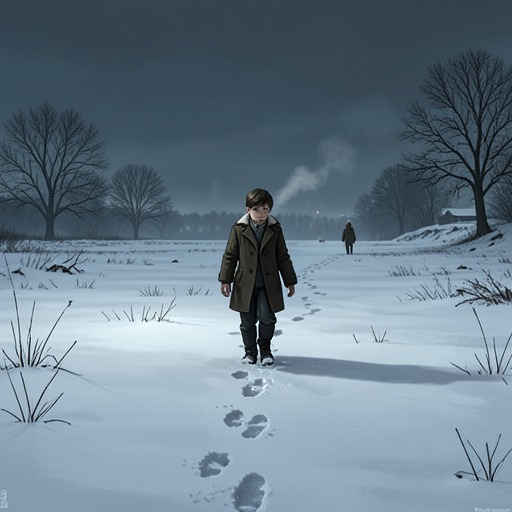
He is ten when he suddenly turns from the creek and climbs the cliff. His movement is quick and daring, but the destination remains unclear: he hurries inland as if he has a definite purpose, while in fact going nowhere. That image of flight without a safe destination anticipates a life in which movement does not guarantee belonging. The child is not simply travelling toward a new home; he is escaping a condition in which no home has been offered to him.
The later legal inquiry supplies the hidden history behind that abandonment. Gwynplaine is identified as Lord Fermain Clancharlie, Baron Clancharlie and Hunkerville, and Marquis of Corleone in Sicily, a peer of England. The evidence read in the proceeding states that he was bought at the age of two and disfigured by Hardquanonne, who knew the methods associated with Doctor Conquest. It further records that the child was deserted on the coast of Portland, where those responsible intended him to perish from hunger, cold, and solitude. The official account thus joins two circumstances that his life had kept apart: deliberate violence against a very young heir, and the later abandonment of a ten-year-old child.
From Performer to Lord
Before this identity is publicly established, Gwynplaine is encountered as part of a travelling show. A visitor to an inn courtyard sees a caravan on wheels, an old man in a bearskin, a young performer whose face resembles a mask, a blind girl, and a wolf. This arrangement places Gwynplaine within a small performing company rather than among the titled society to which he belongs by birth. The contrast is crucial: the face that makes him legible to an audience as a spectacle conceals a name and inheritance that the legal world can later restore.
His inheritance has, however, been present in an unexpected form. When he arrived at the travelling caravan at Weymouth as a forsaken orphan, the two scrolls lining it included an inventory of the estate awaiting him. He had repeatedly let his eyes pass over those lines and learned them by heart without understanding their personal significance. For fifteen years he travelled from highway to highway as a clown in a travelling theatre, earning his bread day by day and picking up farthings, while the record of his title remained beside him. The discovery is not the arrival of wholly new information: it makes the unnoticed words of his childhood suddenly intelligible.
Barkilphedro’s announcement that Gwynplaine has slept through his own life recasts the contrast in a series of oppositions: performer and senator, poor man and wealthy heir, member of the people and peer. The sheriff’s declaration gives that reversal legal force, naming the titles and confirming that he is a peer of England. Gwynplaine responds by remembering the past as a history of theft, betrayal, destruction, abandonment, and disinheritance. He imagines his lost destiny as a corpse returned to life, and himself as reborn. The intensity of that response shows how completely the revelation changes his account of his own past, even as it cannot change what he endured.
Rank, Performance, and Public Speech
The restoration also changes Gwynplaine’s public appearance. At his introduction to the House of Lords, two elderly barons, named as his sponsors, raise their hats in greeting, and he returns the salute. Officials announce him by his restored titles; he proceeds in the company of the parliamentary attendants, wearing a scarlet robe and carrying a golden sword like the peers beside him. The ceremony makes aristocratic identity visible through titles, gestures, clothing, and protocol. Yet the man dressed as a peer is the same former clown whose face had made him an object of public entertainment.
When Gwynplaine rises to speak, he begins from that divided identity. He names himself through wretchedness and insists that his history is not separable from the suffering he has witnessed and experienced. He describes growing up in poverty and knowing winter, hunger, contempt, pestilence, and shame. His speech turns the experiences associated with his former life into testimony addressed to the privileged assembly. The title gives him entry to the room, but his authority as a speaker comes from a history the room’s inherited rank has not shared.
That confrontation gives his elevation a sharp irony. Gwynplaine has been admitted among peers because the legal record establishes his noble birth, yet he uses the occasion to speak as one formed among the poor. He presents himself as someone made from the same material as the great but cast into deprivation by a king’s pleasure. The speech therefore challenges the assumption that social position reliably reflects a person’s worth or experience. His restored status does not make his earlier life irrelevant; it gives him a platform from which to bring that life into the chamber.
Dea and the Final Reversal
After his parliamentary experience, Gwynplaine flees in a state of mental and emotional upheaval. He does not know where he is; what he longs for is Dea. The narrative frames this desire as a search for a fixed point amid a confusion of life and death, day and night. His escape is not toward a newly claimed title or public triumph. It is directed toward the person whose presence matters to him beyond the sudden changes in his legal standing.
When Gwynplaine reaches Dea, she feels his head beneath her hand and cries out. Their recognition brings them together again, but the reunion is immediately shadowed by her failing life. Gwynplaine begs her to live and tells her that her existence gives meaning to his own. He invokes their bond as husband and wife, insisting that he cannot accept a world in which she is taken from him just as he has found her again. His words expose the difference between his new public identity and his private dependence: he can be proclaimed a lord, but he cannot command the person he loves to remain alive.
Dea dies, and Gwynplaine turns from pleading to a final gesture of despair. He rises in the darkness, looks upward, and stretches out his hands; then he steps beyond the ship’s unguarded edge into the water. No one sees or hears him disappear. The ship continues on, and the river continues to flow. His death closes the movement from abandonment to recognition without allowing recognition to become rescue: the inheritance restores a name and a place in the peerage, but it cannot restore Dea or give him a life he can bear without her.
Narrative Significance
Gwynplaine’s plot is organized around a reversal of visibility and identity. His face makes him recognizable as a performer, while his ancestry remains concealed in the scrolls beside which he grows up. Later, the law makes his noble identity public, but that revelation does not make his face, childhood, or social experience disappear. The same person is treated first as an object of spectacle and then as a peer entitled to ceremonial recognition; the change lies in the social meaning assigned to him, not in a change of character.
His story also makes the House of Lords a place of collision between rank and lived experience. Gwynplaine enters through hereditary entitlement and speaks about deprivation from personal knowledge. Yet the final measure of his transformation is not the successful possession of the titles recited for him. After losing Dea, he leaves the ship and vanishes into the river. The arc that seemed to promise an ascent into power ends instead by revealing the limits of power, wealth, and public recognition when the relationship that gives life meaning is gone.