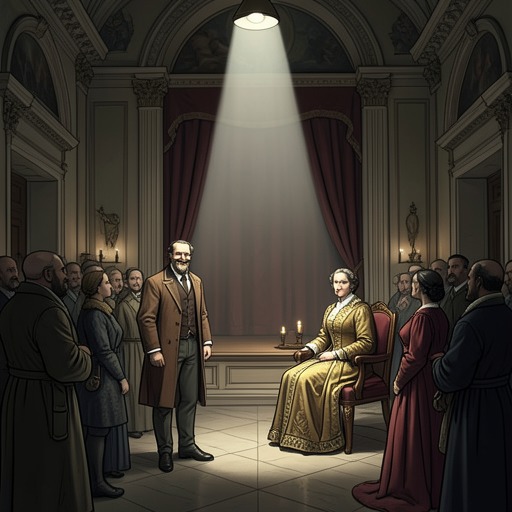
Gwynplaine and Dea’s loving, mutually supportive bond
The Man Who LaughsGwynplaine and Dea’s loving, mutually supportive bond is the refuge each finds in a life marked by abandonment and bodily difference. Gwynplaine, whose face has been made to wear an unending laugh, is treated by the public as a spectacle; Dea, who is blind, cannot see the face that provokes that response. Their intimacy rests instead on what the crowd misses: his compassion and courage, and her ability to recognize and trust the person behind the grotesque expression.
Origins in Rescue and Care
Gwynplaine and Dea’s connection begins in childhood, before either can understand what their shared fate will mean. As Gwynplaine later recounts to Ursus, he found Dea as an infant beside her dead mother during his own desperate journey after being deserted. He was himself a child without shelter, exhausted and exposed to cold, hunger, and fear; nevertheless, he took the other child into his care. He gave her his rags when she was cold and sought food and drink for her. The bond therefore begins not with an exchange between equals who are already secure, but with an act of practical charity by someone who has almost nothing to give.
That act becomes the foundation of Dea’s understanding of him. She learns the circumstances of her rescue from Ursus, and sees in them a pattern that continues into their later life: the boy who carried her to safety becomes the man who supports her weakness, attends to her illness, and guides her through a world she cannot see. Her trust has a history. It is grounded in remembered care, not in the public appearance that defines Gwynplaine for strangers.
Recognition Beyond Appearance
The difference between public judgment and private recognition shapes their relationship. Gwynplaine’s face is permanently arranged as a laugh, and the expression cannot be made to match his feelings: suffering, anger, pity, or tears only intensify its appearance of mirth. He is tall, well made, and agile, but the crowd sees the face first. People laugh at him and then turn away; women in particular recoil from him. The same expression that makes him successful as a mountebank also isolates him from ordinary human regard.
Dea cannot see that expression. Her blindness does not mean that she knows nothing of Gwynplaine; instead, she understands him through his actions and presence. To her, he is the child who lifted her from danger, the comforter who makes life bearable, and the guide whose hand leads her through the maze of blindness. She regards him as brother, friend, support, and beloved companion. Where spectators reduce him to a grotesque performer, she recognizes his goodness and devotion. Their relation thus reverses the usual terms of sight: the seeing crowd mistakes the face for the person, while the blind girl perceives the character that the face conceals.
A Shared Refuge
The narrative presents their love as a meeting of two people whom society has marked as outcasts. Gwynplaine adores Dea, and Dea idolizes Gwynplaine. She calls him beautiful, not because she has access to his appearance, but because his goodness is the light by which she understands him. For Gwynplaine, Dea is the person whose presence makes love and belonging possible; for Dea, his presence is a sustaining certainty in a life otherwise bounded by darkness and vulnerability.
Their afflictions are not identical, but each finds in the other something the self lacks. Dea’s blindness makes Gwynplaine’s face irrelevant to her choice; Gwynplaine’s disfigurement does not prevent him from valuing and loving her. The story imagines this mutual need as the basis of their attachment: what might exclude each from conventional acceptance becomes, between them, a point of recognition. They do not merely endure the world side by side. Their closeness creates a private happiness within circumstances the narrative describes as hellish, a shared haven in which each is sufficient to the other.
This refuge is made of ordinary forms of companionship as well as idealized devotion. Dea takes comfort in knowing that Gwynplaine is near and dependable; the touch of his hand and the sound of his presence orient her in the darkness. Gwynplaine, in turn, receives from Dea a form of acceptance unavailable from the crowd. She can be happy with him without first requiring the face to change. His laugh and her smile become contrasting signs of their connection: his outward expression misrepresents his inward life, while her response affirms a happiness founded on intimacy rather than appearance.
Trust in Moments of Inner Conflict
The narrative tests this bond through Gwynplaine’s brief, confused attraction to an unknown woman. The experience stirs a conflict between earthly desire and his ideal devotion to Dea, though he scarcely understands the struggle as it unfolds. The possibility threatens the emotional security of both, but Gwynplaine never ceases to adore Dea. His fevered agitation passes, and the unknown woman fades from his thoughts.
A later moment makes the force of their attachment visible without requiring a declaration or argument. After a sleepless night of emotional turmoil, Gwynplaine hears Dea ask whether he is awake. Her appearance at the half-open doorway and her familiar, serene presence coincide with the storm within him subsiding. The narration presents her presence as a restoration of his moral clarity: he feels again like the innocent and good person he understands himself to be. Dea does not need to know every detail of his inward conflict to steady him. Their closeness operates through confidence and recognition, as well as through speech.
When they speak privately, Dea describes the reassurance she draws from knowing Gwynplaine is there for her amid darkness and solitude. He answers that she is everything to him and asks what she wants; she says that she does not know, because she is happy. The exchange gives their bond a quiet measure. Its fulfillment does not depend on wealth, public status, or an imagined future beyond one another; companionship itself is the happiness they name.
Public Meaning and Narrative Significance
Their intimacy throws the crowd’s judgment into relief. To spectators, Gwynplaine is a clown and a grotesque figure whose face provokes involuntary laughter. To Dea, he is a savior and beloved guide. The contrast is not simply between false and true opinions about beauty: it distinguishes looking at a body from attending to a life. Dea’s understanding is rooted in the care Gwynplaine has repeatedly shown, while the crowd’s response stops at the visible surface.
Gwynplaine later turns the forced laugh on his face into an accusation against the powerful, describing it as an imposed sign of suffering and as a symbol of the people whom their rulers have mutilated in spirit. That public interpretation gives political reach to the bodily stigma that structures his life; it also sharpens the contrast with Dea’s private recognition. The crowd sees a comic mask and uses it to dismiss him, whereas Dea’s love answers the person hidden beneath it. Their bond is therefore both a personal refuge and the clearest counterexample to a society that mistakes appearance for truth. It shows how care can establish recognition where public judgment has failed, and how two people treated as incomplete by the world can form a sustaining life together.