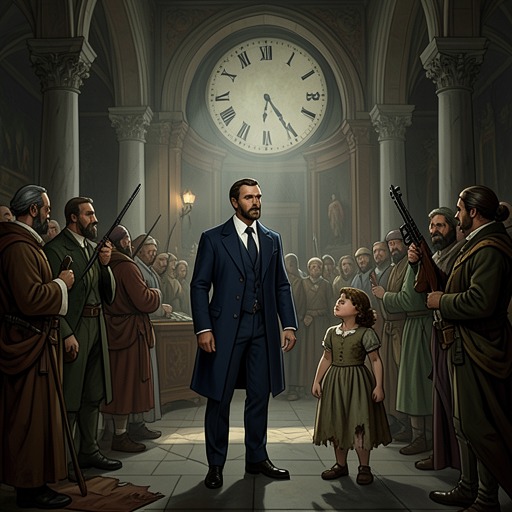
Gwynplaine is admitted to the House of Lords
The Man Who LaughsGwynplaine is admitted to the House of Lords in a formal ceremony that converts his restored identity into a publicly recognized peerage. The procession, royal documents, registers, and sword make his new standing legible through the institution’s established rites; the scene’s sharpest measure of change is that only thirty-six hours separate his entrance into the House from his entry into Southwark Jail.
The Procession and Its Regalia
Gwynplaine approaches the woolsack between two peers who act as his sponsors, bringing up the procession. The ceremony places him between established members of the order he is about to join: his admission is not presented as a private announcement but as a passage conducted before the House and under the sponsorship of peers. When the two sponsors uncover their heads, Gwynplaine does the same, following their gesture within the formal sequence.
The surrounding regalia give the procession a carefully ranked appearance. The robes are scarlet velvet lined with white silk, with ermine bands trimmed in gold lace over the shoulders; the coronation robe is distinguished by a wider ermine band. The librarian carries the Red Book on a square of Flanders leather. This small red-morocco volume contains a list of peers and commons, blank leaves, and a pencil, and is customarily presented to each new member on entering the House. Its practical contents sit beside the ceremony’s more conspicuous symbols: a new member is being entered into a recorded order as well as welcomed into a visible one.
The Crown’s Summons and Gwynplaine’s Admission
At the woolsack, the King-at-Arms receives a black portfolio on a cushion of silver cloth and presents it to the Lord Chancellor. The Clerk of the Parliament opens the portfolio, which contains the two customary messages: the royal patent addressed to the House of Lords and the writ of summons. He reads both aloud, standing and with deliberate respect. The writ is addressed to Fermain Lord Clancharlie and ends with the accustomed formalities. The documents thus connect the ceremony to royal authority while identifying the man being summoned by the title under which he is to enter.
After the summons has been read and the proceedings advance to the moment of seating, the King-at-Arms takes the sword from its stand and buckles it around Gwynplaine’s waist. The sword is a distinct, visible step in the ceremony: his admission is marked not only by words and documents but by an act of investiture. The sequence moves from the Crown’s written authority, through the formal proceedings of the House, to the sword borne by the new peer.
The two clerks then write in separate registers, one for the Crown and one for the House. They bring the books to the Lord Chancellor, who signs both. Only after these records have been signed does he rise to deliver the formal welcome: “Fermain Lord Clancharlie, Baron Clancharlie, Baron Hunkerville, Marquis of Corleone in Sicily, be you welcome among your peers, the lords spiritual and temporal of Great Britain.” The welcome names Gwynplaine’s several titles and places him among the assembled peers. His sponsors touch his shoulder; he turns, and the great gilded door at the end of the gallery opens. It is the door of the House of Lords, marking the culmination of the ritual in an actual threshold.
Reversal in Thirty-Six Hours
The ceremony’s institutional order stands in striking contrast to Gwynplaine’s immediately preceding experience. Thirty-six hours earlier, surrounded by a different procession, he had entered the iron door of Southwark Jail. Now two peers sponsor him, the Crown’s patent and writ are read on his behalf, the registers are signed, and the Lord Chancellor welcomes him to the House. The text makes the interval brief enough for imprisonment and elevation to press against one another rather than settle into separate chapters of his life.
The contrast also gives the formal details their narrative force. The iron door of the jail and the gilded door of the House frame opposite passages; the first brings Gwynplaine into confinement, while the second opens after his titles have been publicly pronounced and his admission recorded. The ceremony does not erase the recent arrest. Instead, the stated thirty-six hours keep the arrest beside the welcome, so that the newly conferred dignity remains inseparable from the abrupt reversal that brought him there. Gwynplaine’s entry into the House is therefore both a legal and a theatrical transformation: the same person who entered prison under guard is now presented by peers and received among their number.