Gwynplaine rescues Dea
The Man Who LaughsGwynplaine rescues Dea in an act of child-to-child care that reverses his own abandonment: although he has little protection or provision himself, he takes responsibility for an infant in danger. As Dea later understands the story through Ursus’s account, the rescue becomes the origin of the devotion and trust that shape their life together.
Circumstances and Rescue
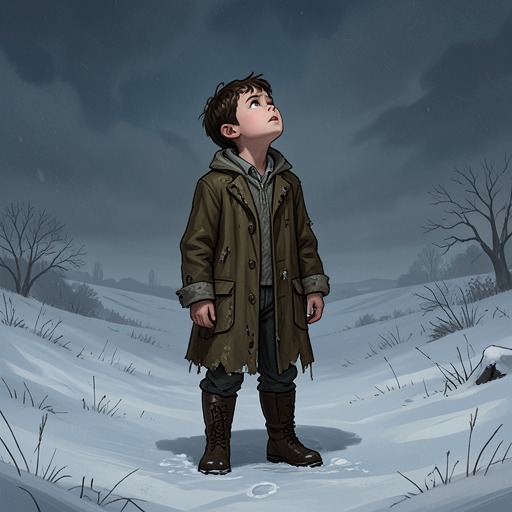
The rescue belongs to Gwynplaine’s difficult journey from Portland toward Weymouth, after the gang has left him behind. He is still a child, scarcely larger than Dea, and has no secure shelter or dependable support. During this journey he hears the infant’s cry and responds, though he is himself exhausted and exposed to hardship.
Dea is an infant beside her mother, who has died. Gwynplaine takes her up and accepts responsibility for her when no one else has come to her aid. The contrast is central to the event: a child who has himself been cast off does not pass by another helpless child, but assumes a duty that exceeds his own means.
Care After the Rescue
Gwynplaine gives Dea his rags because she is cold, despite being poorly clothed himself. Hungry and distressed, he also thinks of finding food and drink for her. The account presents the rescue not as a single gesture but as an undertaking against a succession of hardships, including winter, snow, solitude, fear, cold, hunger, thirst, and the storm.
His care continues beyond the journey. Dea later knows him as the person who answers her weakness with strength, her poverty with provision, her sickness with healing, and her blindness with a sustaining presence. The rescue thus begins a lasting relation of care: the child who had no refuge becomes a refuge for someone still more vulnerable.
Dea’s Knowledge and the Rescue’s Significance
Dea learns what happened from Ursus, to whom Gwynplaine had related his journey and suffering. Although she cannot see him, she understands the rescue as evidence of his devotion, self-denial, and courage. Her account of his character rests not on his appearance but on what he did when he, too, was alone and in need.
The episode also establishes the contrast between Dea’s perception and the crowd’s judgment. The crowd sees Gwynplaine’s face and regards him as a grotesque performer; Dea, informed by his actions, recognizes the goodness behind it. His rescue of her gives their bond its first defining fact: before he could offer her lasting care, he had already chosen to protect her at a moment when he had almost nothing to give.