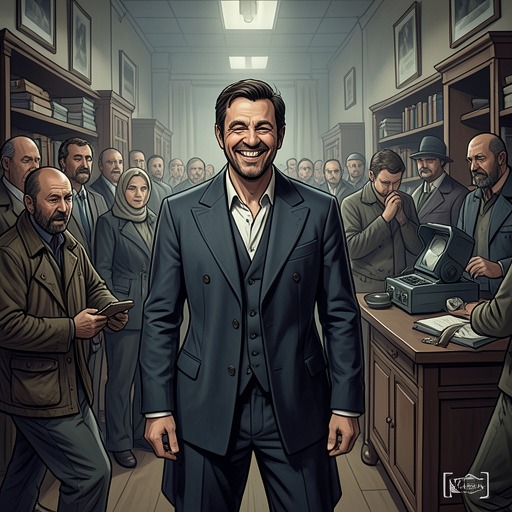
Gwynplaine's childhood mutilation
The Man Who LaughsGwynplaine’s childhood mutilation is presented as the deliberate making of the permanent grin that defines his public appearance. The novel treats the precise circumstances as an inference rather than a witnessed scene, but its consequences are unmistakable: a child’s face was altered so that strangers would laugh at him, while the adult beneath that expression remained capable of grief, anger, and pity.
An Alteration Inferred from the Face
The account begins with the contrast between Gwynplaine’s body and his face. He is tall, well made, and agile; only his face bears the unnatural alteration. The narrator argues that such a complete appearance of laughter could not plausibly be nature’s work alone, and that the face had likely been changed when Gwynplaine was very young. His lack of conscious memory does not disprove the event: an infant would have had little understanding of what was happening to him.
The narration describes the work as intentional, carried out by people skilled in manipulating children. It attributes the result to a specialized practice, likened to a dark counterpart of surgery, and names a range of alterations to the features without presenting the operation as a directly observed episode. Its central claim is that Gwynplaine was not born with this face: someone made it, apparently to produce an exhibition-worthy spectacle.
The Permanent Grin
The alteration gave Gwynplaine a mouth stretched toward his ears, distorted features, and an expression that appeared to laugh. That expression did not report his actual feelings. His face seemed to laugh while his thoughts did not, and he could not simply remove the grin: it had been fixed upon him. When he experienced sorrow, astonishment, anger, or pity, the movement of feeling only intensified the appearance of hilarity. Even tears would be read through a face that seemed to smile.
This division between appearance and inward life made the mutilation an ongoing condition, not merely a past injury. The crowd encountered a spectacle before it could recognize a person. The same expression that advertised amusement concealed the possibility of pain, making Gwynplaine’s public face a misleading account of the person behind it.
Performance and Public Response
As a mountebank, Gwynplaine displayed himself on a platform, and his face made him an exceptionally effective attraction. Spectators laughed at the sight of him; even an executioner was made to laugh. The laughter could interrupt solemnity, including among people in mourning, and his reputation as a horrible man spread through fairs and at crossroads. His altered face thus became a means of earning a living, even as that livelihood depended on other people treating his appearance as entertainment.
The response did not end with laughter. Once the first amusement had passed, onlookers turned away, and women in particular recoiled from the sight of him. The text distinguishes the involuntary tribute of laughter from the revulsion that followed it: his appearance could command a reaction while also making him difficult for others to contemplate. His figure remained intact, but the crowd’s attention fixed on the face that had been made for its amusement.
From Personal Mark to Public Accusation
The permanent grin returns with political force when Gwynplaine speaks before the House of Lords. As he pleads for the poor, emotion brings sobs into his throat and triggers uncontrollable laughter. The assembly’s mood turns to hilarity, and the lords jeer at the speaker. The mutilation therefore shapes not only how he is seen but also how his words are received: the visible comic expression can overpower the appeal he is trying to make.
Gwynplaine then interprets the grin as a mark imposed by royal power and as a sign of wider human suffering. He presents himself at once as Lord Clancharlie and as the man whose face bears the consequences of what a king did to him. In that speech, the face manufactured to entertain a crowd becomes evidence against the society that laughs at it. The mutilation’s decisive significance lies in this reversal: an imposed comic expression becomes a public emblem of torment, enforced silence, and the humiliation of the powerless.