Gwynplaine—David Dirry-Moir
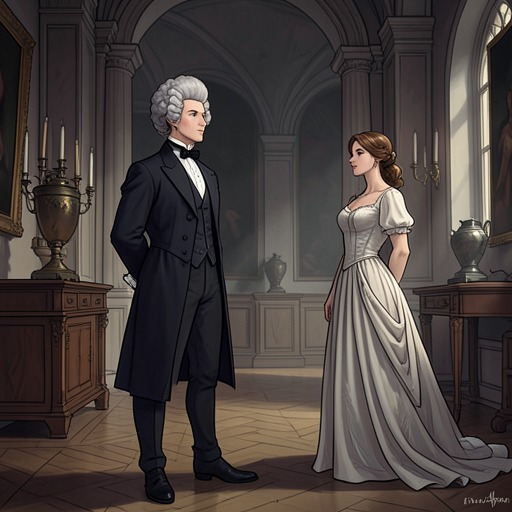
The Man Who LaughsGwynplaine—David Dirry-Moir is a relationship defined by a concealed family bond and an abrupt reversal of social position. They share a father, but David has been recognized within the courtly order while Gwynplaine has lived as a traveling performer. Once Gwynplaine’s descent is disclosed, he becomes the lawful claimant to the Clancharlie peerage that David had occupied. Their reunion therefore turns an intimate recognition into a conflict over inheritance, status, and Josiana.
Kinship and the concealed succession
The brothers’ common father is Lord Clancharlie. David is described as the natural son of their father and a woman who later became the mistress of Charles II during Lord Clancharlie’s exile. That parentage accounts for David’s high position at court, but it does not give him the stronger claim to the peerage. Gwynplaine’s legitimacy and right of succession are treated as clear; if he accepts the title, David stands to lose it.
This truth is withheld while the succession is managed. Barkilphedro keeps the affair secret from both David and Josiana, and David is sent to sea off Flanders without knowing that his peerage is threatened. The concealment makes their eventual meeting more than a delayed family revelation: David encounters the man whose lawful claim can overturn the identity and rank on which David’s public standing rests. Until the secret is disclosed, the brothers cannot understand that their positions have been arranged around the same inheritance.
A political reversal of fortune
The Queen’s handling of David’s naval advancement shows how the succession crisis is folded into court policy. When Captain Halyburton’s name is proposed for promotion to vice-admiral, Anne substitutes David’s name. The promotion gives him a distinguished naval position at the very moment that his peerage may pass to Gwynplaine. The maneuver combines apparent favor with an underlying displacement: David receives advancement without being told what he may lose.
Gwynplaine’s acceptance is also made decisive by the possibility that the claim can be erased if he refuses. The people who know of his existence and rights are described as subject to reasons of state, and David is presented as the person to whom the peerage would revert if Gwynplaine did not consent to become a peer. The brothers’ relationship is thus governed not only by their father’s history but by a political choice imposed on Gwynplaine: his recognition changes David’s inheritance, while silence would preserve the existing arrangement.
Recognition and confrontation
The brothers meet again when David enters the room in naval uniform. Gwynplaine recognizes him as Tom-Jim-Jack, and David recognizes Gwynplaine; both speak the other’s name at once. The encounter joins two versions of their lives. David recalls Gwynplaine from their earlier association at the Tadcaster Inn, where they could box as equals, while the man before him now claims the title of Lord Clancharlie.
Their exchange exposes the distance between personal familiarity and public rank. David argues that a sword is a gentleman’s weapon and that, as a rear-admiral, he can fight only his equals; he contrasts that rule with their earlier equality at fisticuffs. Gwynplaine answers that he too is now a peer and insists on fighting. David initially treats the claim as theatrical role-playing, invoking Gwynplaine’s life as an actor, before identifying himself as Lord David Dirry-Moir and hearing Gwynplaine assert his own title. The dispute is not simply over a weapon or a challenge: each man is testing whether the other will recognize the identity that his changed status now demands.
Josiana and the brothers’ rivalry
Their conflict is sharpened by their connection to Josiana. David says that both men love the same woman and frames this shared attachment as the reason for his forgiveness. The line binds romantic rivalry to the succession crisis: Gwynplaine’s new title makes him the man intended to win Josiana, while David already has a relationship with her. A voice then identifies them as the two husbands, making explicit that the planned marriage and the existing attachment have brought the brothers into the same contest.
The evidence does not show the two men resolving either the dispute over the peerage or their rivalry for Josiana in this encounter. Instead, recognition makes the conflict personal. David’s laughter and skepticism confront Gwynplaine’s insistence that his title is real; their shared history, meanwhile, prevents the meeting from being reduced to a contest between strangers.
Kinship and the meaning of Gwynplaine’s claim
The brothers’ opposing positions also illuminate the difference between Gwynplaine’s visible identity and his inherited one. Gwynplaine’s face, permanently shaped into an involuntary expression of laughter, has made him a public spectacle and a performer whose appearance provokes laughter in others. The peerage gives him a formal identity that the court can recognize, but it does not undo the experiences that have separated him from David’s world.
When Gwynplaine later addresses the House of Lords, he presents the imposed smile as a sign of suffering produced by royal power and compares his mutilation with the deformation of humanity under its masters. That political claim gives the brothers’ inheritance conflict a wider resonance: David belongs to the established order that has benefited from title and courtly recognition, while Gwynplaine enters it bearing the consequences of violence committed by a king. Their kinship reveals the arbitrary workings of inheritance; their unequal histories show that a shared father does not mean a shared life or an equal experience of power.