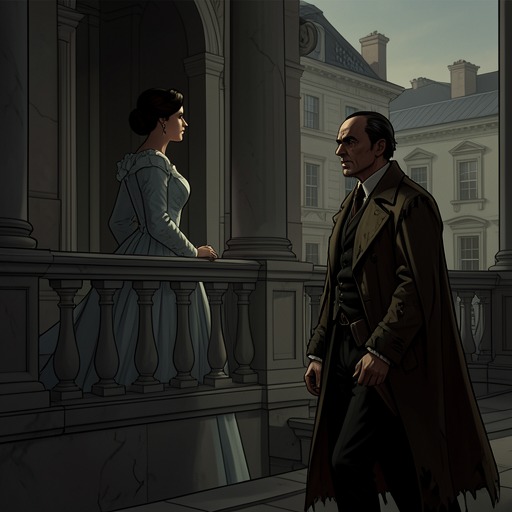
Gwynplaine—Josiana
The Man Who LaughsGwynplaine—Josiana is a relationship founded on fascination but broken by a reversal of power: Duchess Josiana first presents Gwynplaine’s disfigurement and low social position as the very qualities that attract her, then rejects him when Queen Anne makes him her husband by royal command. For Gwynplaine, the encounter is overwhelming and difficult to separate from his earlier hope that Josiana had seen and desired him. For Josiana, desire is bound to novelty, defiance, and the thrill of choosing what her rank ordinarily excludes; it does not become a durable commitment to him.
A desire formed at a distance
Before meeting Josiana in private, Gwynplaine had received a strange letter from her. He tried to banish its influence and burned it, but its promise remained powerful: in the moment of recognition, he thinks of her as the only woman who has seen him and desires him. His response is therefore not simply to a beautiful stranger before him. It is the return of a possibility he had tried to suppress, and he experiences recognition as a sudden upheaval.
That hope rests against the public meaning of Gwynplaine’s face. Its fixed expression provokes laughter from spectators, although he does not share their amusement; he cannot remove the appearance stamped on him, and even distress intensifies the effect. People laugh and then turn away, while women especially shrink from him. His well-made, agile body contrasts with the face by which others judge him. Josiana’s apparent desire sets her apart from that ordinary response, making her letter seem to Gwynplaine like recognition of the person concealed beneath the spectacle.
The encounter at Corleone Lodge
When Josiana finds Gwynplaine in her private apartment, she recognizes him at once. Her reaction combines pleasure and contempt, followed by an impulsive embrace and close inspection. The scene makes their attraction reciprocal in a limited but consequential sense: Gwynplaine is captivated by Josiana’s beauty and rank, while she is fascinated by the very disfigurement that usually makes him an object of public laughter and avoidance. Neither response amounts to knowledge of the other. The encounter presents fascination as immediate and bodily, preceding any settled understanding between them.
Josiana speaks of loving him and treats the match as a way to break with the restraints attached to her royal family and noble standing. She presents the relationship as a deliberate scandal: the attraction of a grandee to a mountebank and a socially degraded man is part of its appeal to her. Gwynplaine, however, is unable to take in the force and speed of her declarations. Her words and attention leave him overwhelmed rather than able to answer on equal terms. The imbalance is not that one feels and the other feels nothing; it is that they attach different meanings to the same attraction. To Josiana, his position and appearance make him an alluring departure from courtly respectability. To Gwynplaine, her desire seems to promise that he has been seen beyond the face that governs other people’s reactions.
The royal order and the reversal
That private encounter is interrupted by a change in Gwynplaine’s public identity. A letter from Queen Anne announces that he has been recognized as the legitimate son of Lord Linnæus Clancharlie, bearing the name Lord Fermain Clancharlie, and will be installed in the House of Lords. The Queen also orders him to marry Josiana, replacing Lord David Dirry-Moir in the arrangement and seeking to preserve the Clancharlie estates for her sister’s use. The same document that elevates Gwynplaine’s rank thus converts a private declaration of desire into a state-directed marriage.
Gwynplaine reads the royal letter aloud. Josiana listens, examines the accompanying report concerning the wreck of the Matutina, and reads the Queen’s message again. Her answer is not consent to the intimate relationship she had described moments earlier. She calmly tells Gwynplaine to leave, then insists that, since he is now her husband, he has no right to occupy the place she reserves for her lover. She says she hates him and leaves the room. The reversal is stark: before the order, she had treated him as the lover she chose precisely because he stood outside her rank; once the Crown defines him as her husband, she repudiates him. The marriage command supplies a legal relation, not mutual attachment.
The face as spectacle and testimony
The contrast between Josiana’s fascination and Gwynplaine’s experience becomes clearer in light of his later speech in the House of Lords. He describes his unchangeable laugh as a mark imposed by a king, a sign of torture, enforced silence, rage, and despair. He insists that the face is not a personal joke but a symbol of a people whose suffering has been concealed beneath an appearance of laughter. His argument gives political meaning to the spectacle that Josiana had treated as an exciting private transgression: the face that fascinates her is also the visible record of violence and a wider social condition.
This contrast does not establish that Josiana understands the history or public meaning Gwynplaine later assigns to his disfigurement. Rather, the relationship places two readings of the same face beside one another. Josiana prizes its strangeness and its power to defy convention; Gwynplaine lives with the involuntary exposure and misrecognition it produces. Her momentary exception to the crowd’s revulsion cannot undo that experience, and her rejection after the marriage order confirms that fascination is not the same as recognition. Their relationship ends, in the evidence presented here, with a royal designation and a personal refusal, not with a shared future.